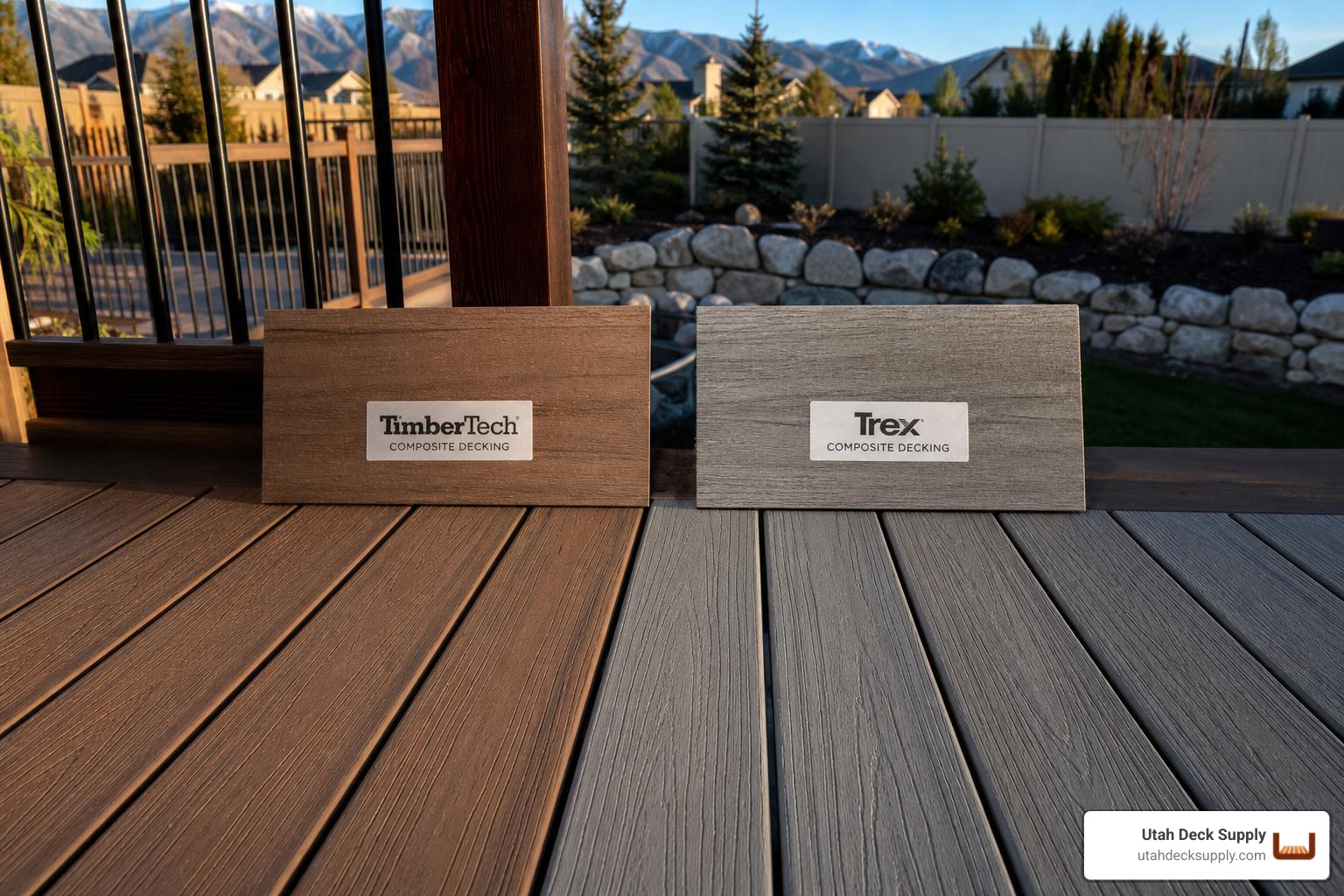
If you are researching TimberTech vs Trex reviews to find the perfect material for your outdoor space, you are likely looking for honest answers about how these brands perform in real-world conditions. Both options offer incredible durability and low maintenance, but they differ significantly in cost, heat retention, and moisture protection. Let’s explore the details so you can choose the best decking line for your home, climate, and budget.
Why TimberTech vs Trex Reviews Actually Matter Before You Buy
Honestly, both are trusted low-maintenance decking options, but they shine in different situations, and choosing confidently starts with knowing what matters most under your feet.
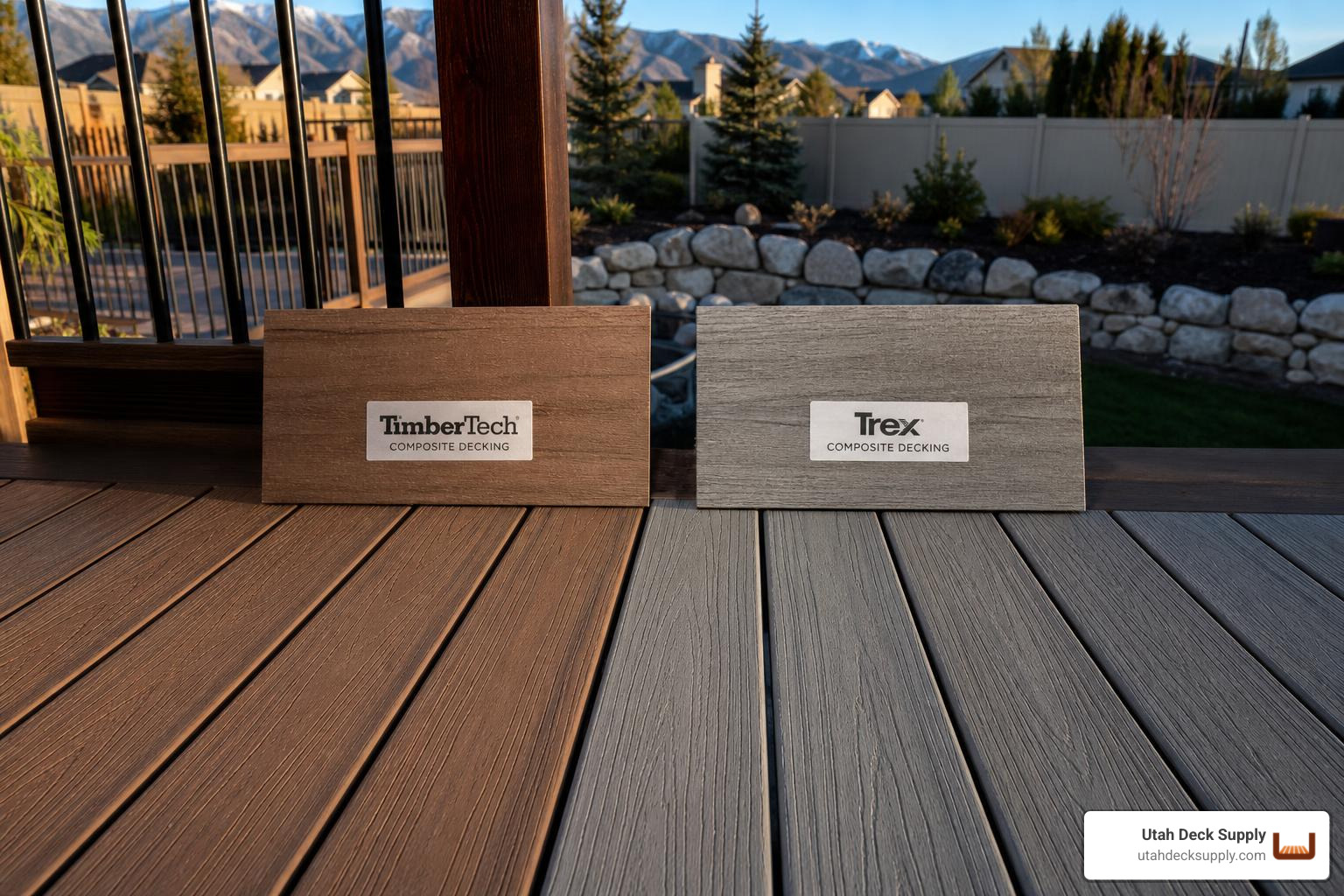
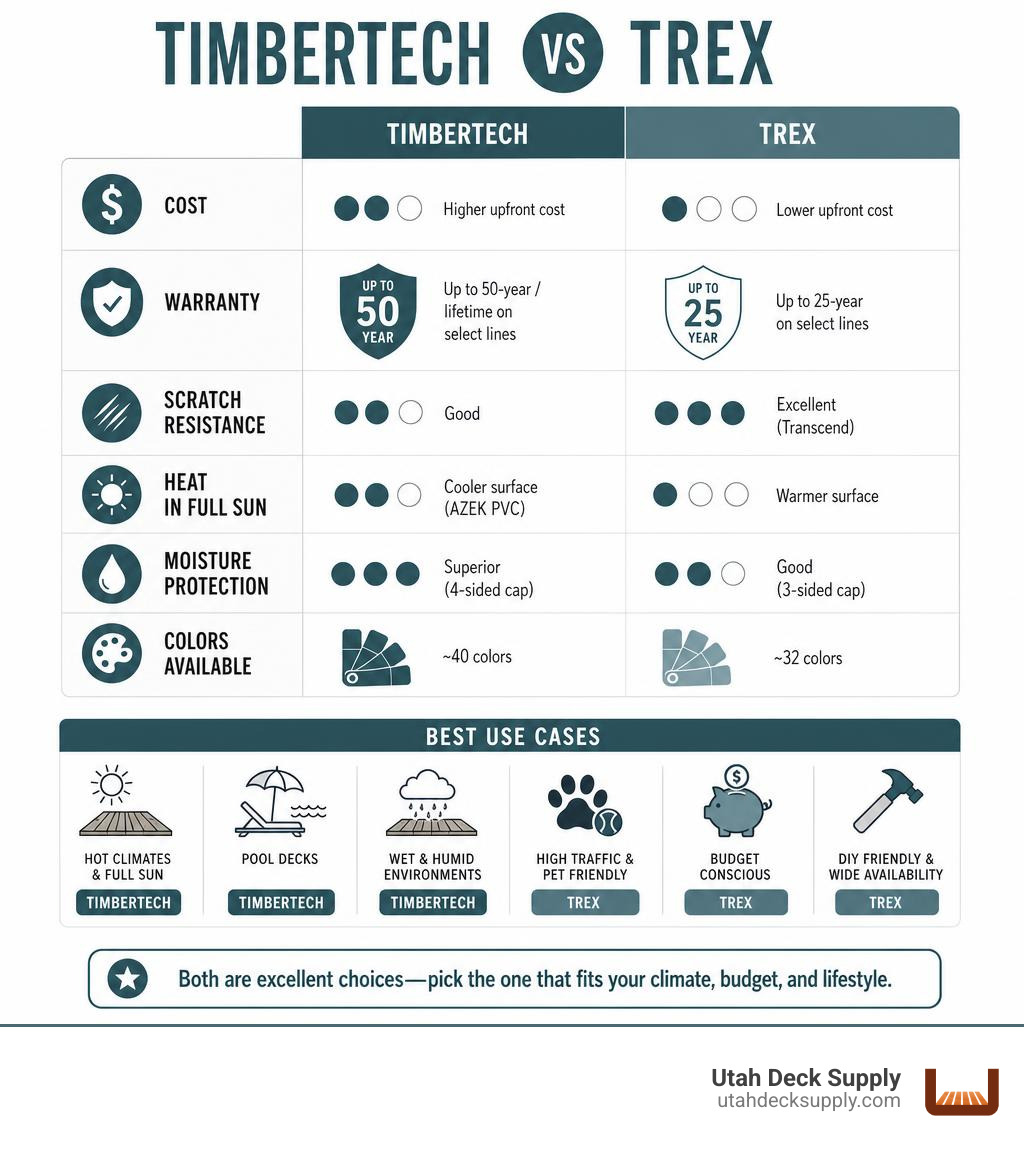
Quick answer: TimberTech and Trex are the two most trusted composite decking brands on the market. Here’s how they stack up at a glance:
| Priority | Best Choice |
|---|---|
| Lowest upfront cost | Trex |
| Best scratch resistance | Trex Transcend |
| Coolest surface in full sun | TimberTech AZEK |
| Most realistic wood look | TimberTech Legacy Collection |
| Best moisture protection | TimberTech (4-sided cap) |
| Longest warranty | TimberTech (up to 50-year / lifetime on select lines) |
| Most eco-friendly recycled content | Trex (up to 95% recycled) |
| Best for pool decks | TimberTech AZEK PVC |
| Best for DIY / wide availability | Trex |
| Most color options | TimberTech (~40 colors vs Trex’s ~32) |
You’d think picking a deck board would be simple. It’s a board. You walk on it. But anyone who’s replaced a deck knows the decision runs deeper than that — material composition, capping technology, heat behavior in a Utah summer, how it holds up to a golden retriever, and whether the warranty actually covers what you think it does.
Both brands have been compared thousands of times by homeowners and contractors, and the honest takeaway from those reviews is this: neither brand is universally better. Trex wins in some situations. TimberTech wins in others. The right pick depends on your specific deck design, your climate exposure, and how you plan to use the space.
Here’s what makes this comparison worth reading carefully. Trex invented composite decking back in 1996 and still leads the market in recycled content and scratch resistance on its premium Transcend line. TimberTech, particularly its AZEK PVC line, answers back with superior moisture protection, cooler surface temperatures, and longer warranty coverage on top-tier products. These are real, measurable differences — not just marketing.
I’m James Bonham, co-founder of Utah Deck Supply and a former Trex Company team member, and I’ve spent years working hands-on with both brands across the full spectrum of TimberTech vs Trex reviews, installations, and real-world performance data. That background shapes everything in this comparison — so you get straight answers, not brand spin.
Quick TimberTech vs Trex reviews definitions:
Introduction
When we help Utah homeowners, contractors, and DIY builders compare TimberTech and Trex, we always start with one practical question: which deck would you actually enjoy using every day?
A deck in West Jordan, St. George, Provo, Lehi, Ogden, or Salt Lake City has to deal with real life: intense sun, snow, dry air, pets, patio furniture, family gatherings, grilling, and the occasional “who forgot to put furniture pads under that chair?” moment.
So this review looks at:
- Composite decking vs PVC decking
- 3-sided vs 4-sided capped boards
- Scratch resistance, heat, moisture, fading, and traction
- Price and long-term value
- Warranty differences
- Homeowner and contractor feedback patterns
- Installation and maintenance realities
For broader material context, our Deck Material Comparison is a helpful companion guide.
TimberTech vs Trex Reviews: Materials, Performance, Cost, and Warranty
Here is the big-picture comparison before we get into the details.
| Category | TimberTech | Trex |
|---|---|---|
| Main materials | Capped composite and AZEK PVC | Capped wood-plastic composite |
| Premium lines | TimberTech AZEK, Legacy, Reserve | Trex Transcend, Lineage |
| Value lines | TimberTech EDGE | Trex Enhance |
| Capping style | Often 4-sided, depending on line | Typically 3-sided |
| Moisture protection | Strongest with AZEK PVC and 4-sided caps | Strong with proper ventilation |
| Scratch resistance | Good to very good, line dependent | Excellent in Transcend |
| Heat performance | AZEK can stay up to 30 degrees cooler than standard composites | Lineage improves heat performance; color still matters |
| Recycled content | Up to about 85% in composite lines | Up to 95% recycled content |
| Color options | Around 40 options | Around 32 options |
| Typical board price | Often higher, roughly $65 to $91 per board in many markets | Often lower, roughly $43 to $68 per board in many markets |
| Warranty | 25 years to 50 years, with lifetime structural on select premium products | Commonly 25-year residential coverage, with longer coverage on select premium lines |
| Best fit | Premium looks, moisture, heat, pool decks | Value, scratch resistance, DIY access, high traffic |
Simple summary? Trex is usually the better value choice. TimberTech is usually the better premium-performance choice, especially if you are considering AZEK PVC. For general material background, see composite lumber.
For more details on the TimberTech side, see The TimberTech Advantage. For the Trex side, see Trex Decking: The Ultimate Low-Maintenance Solution.
TimberTech vs Trex reviews on board construction, capping, and moisture protection
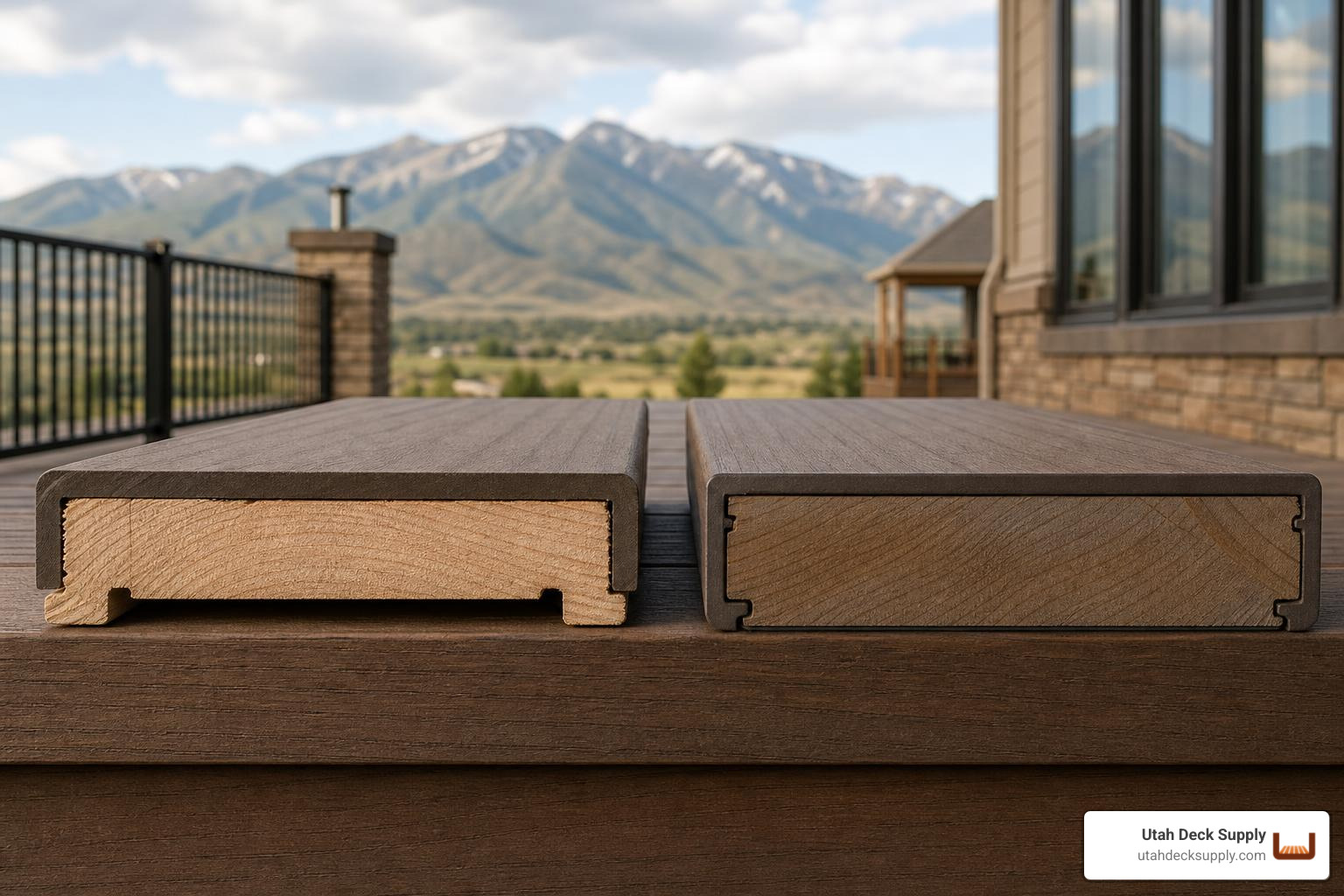
Heres the thing: moisture risk depends heavily on deck design and airflow.
Trex boards are generally capped on the top and sides, leaving the bottom uncapped. That design lets the board breathe from below if moisture gets in, and it works well on raised decks with proper airflow.
TimberTech composite boards commonly use a 4-sided cap, and TimberTech AZEK PVC goes further because it contains no wood fiber. That gives TimberTech an advantage in:
- Pool-adjacent decks
- Shaded spaces
- Low-clearance decks
- Areas where airflow is limited
- Wet or snowy conditions
- Decks where moisture may sit longer
In Utah, this matters most when a deck is close to grade, tucked into shade, or exposed to snow buildup. A properly ventilated raised deck? Trex can perform beautifully. A low-clearance or moisture-prone design? TimberTech AZEK is usually the safer call.
Durability review: scratches, pets, kids, furniture, and high-traffic wear
You know what? Real decks get dragged chairs, muddy paws, kids with scooters, dropped grill tools, and weekend traffic. A showroom sample helps, but life is the real scratch test.
Trex Transcend has one of the strongest reputations for scratch resistance among capped composites. If your deck will see heavy use from pets, children, furniture, or frequent gatherings, Trex Transcend deserves a serious look.
TimberTech is also highly durable, but performance depends on the line. TimberTech composite lines are strong, stain-resistant, and splinter-free, while TimberTech AZEK PVC offers excellent rot and moisture resistance. Some TimberTech composite finishes may show scuffs more readily than Trex Transcend, especially with heavy furniture or large dogs.
Both brands resist:
- Rot
- Insects
- Splintering
- Warping
- Everyday staining
- Most fading under normal use
Expected lifespan depends on the product line, installation, and care, but 25 to 50 years is realistic for many premium composite and PVC decks.
Want a deeper dive into Trexs premium option? Read Benefits of Choosing Trex Transcend for Your Deck. For TimberTech durability, see TimberTech Decking: A Durable Choice.
Heat, fading, traction, and outdoor comfort in full sun
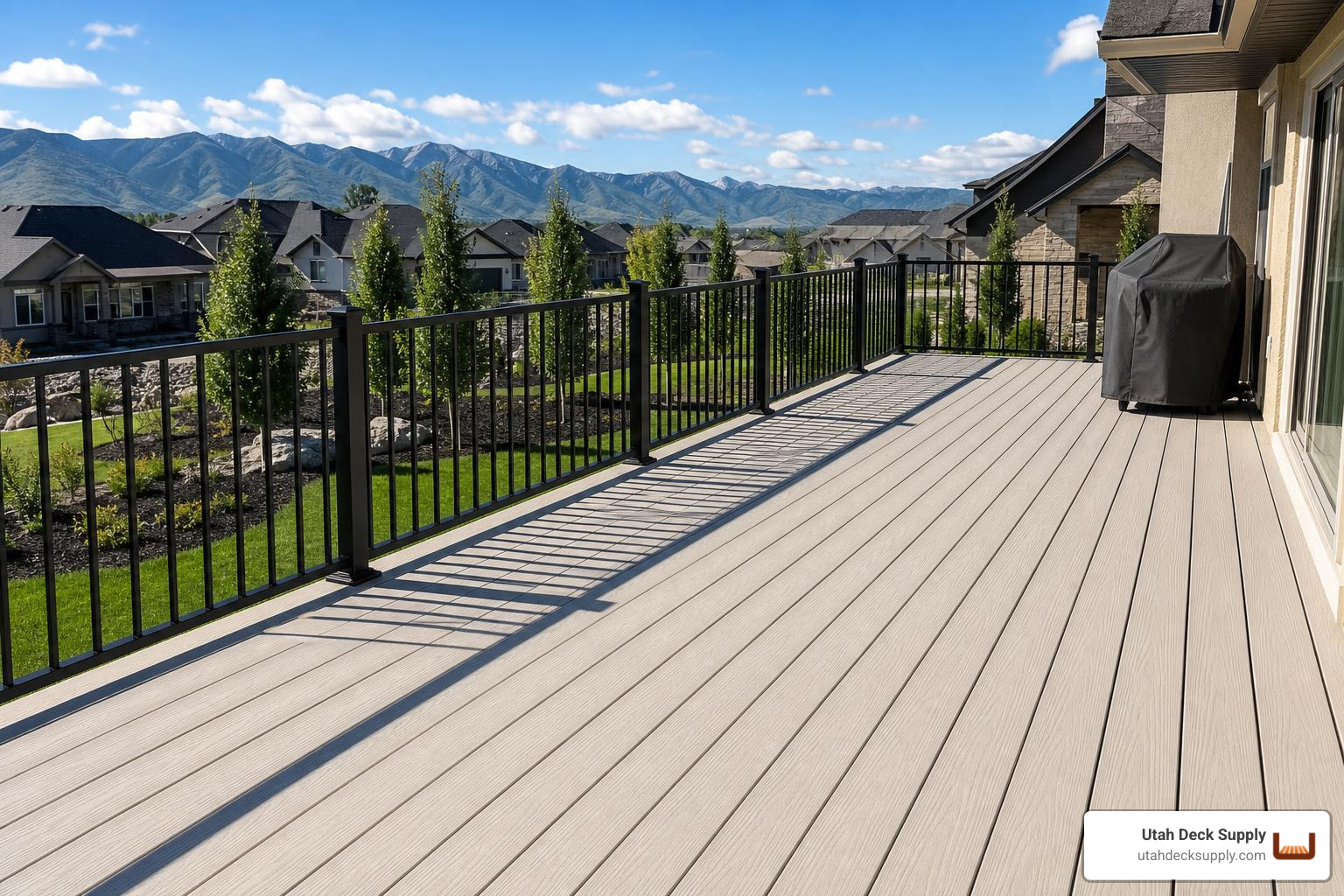
Let me explain why color choice can matter as much as brand choice.
All synthetic decking gets warm in full sun. Dark colors get hotter than light colors. That is true whether you choose TimberTech or Trex. If your deck faces south or west in Sandy, Draper, St. George, Saratoga Springs, or Eagle Mountain, heat belongs in the decision.
TimberTech AZEK has a measurable heat advantage. Its PVC boards can stay up to 30 degrees cooler than many standard composites in direct sun. Trex has responded with heat-mitigating technology in products like Trex Lineage, and lighter Trex colors can perform very well. Still, if the question is “which one stays coolest?” TimberTech AZEK usually wins.
On fading, both brands are strong. TimberTech AZEK has shown excellent UV resistance in testing, and Trex offers strong fade and stain protection across its major lines. Expect some early color adjustment after installation with most composite products, usually in the first few months. After that, color stabilizes.
For wet traction, TimberTech PVC has an edge, which is why we like it for pool decks and rainy or snowy exposure.
For color planning, visit A Complete Guide to TimberTech Pro Colors and AZEK Palettes.
Price, value, warranties, color options, and sustainability
Is the lowest upfront price always the best long-term value? Not always. But sometimes, yes.
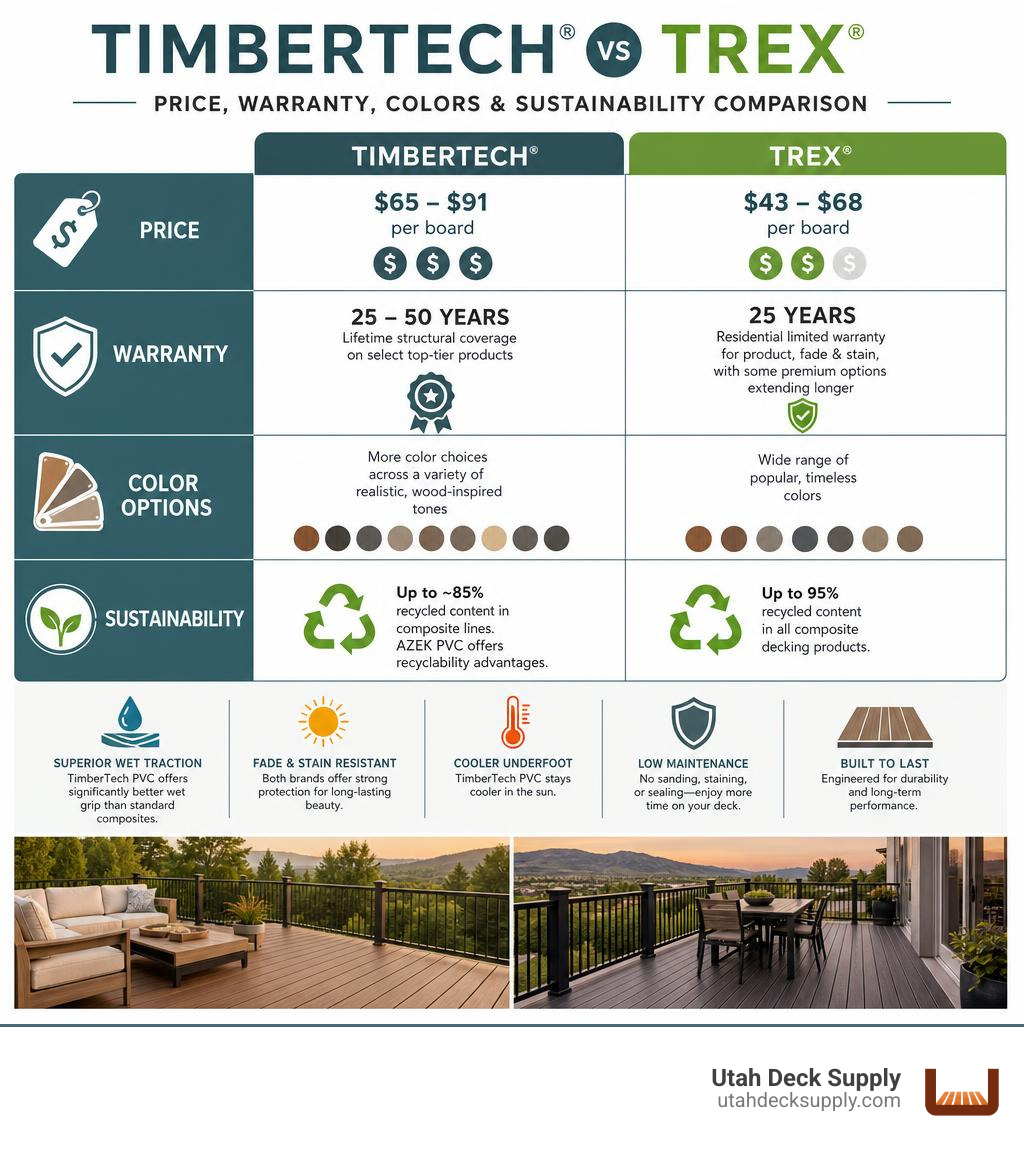
Trex is usually less expensive than TimberTech. Typical board pricing often puts Trex around $43 to $68 per board, while TimberTech can run around $65 to $91 per board depending on line, length, and market conditions. Installed costs vary based on framing, stairs, railings, fascia, demolition, layout, and labor.
For many homeowners, Trex offers the strongest cost-to-performance ratio. If you want a proven, attractive, low-maintenance deck without premium pricing, Trex Enhance, Select, or Transcend can make sense. Our guide on Where to Buy Trex Decking for Cheap in Utah can help if budget is a major factor.
TimberTech costs more in many comparable tiers, but it can justify that price with:
- More realistic wood-like grain
- More color options
- 4-sided capping on many lines
- AZEK PVC performance
- Cooler surface temperatures
- Longer warranty options on premium products
Warranty comparison matters. Trex commonly offers 25-year residential limited warranties for product, fade, and stain coverage, with some premium options extending longer. TimberTech ranges from 25 years to 50 years depending on collection, with lifetime structural coverage on select top-tier products. Always read the fine print because labor, transferability, prorating, and installation compliance matter.
On sustainability, Trex leads in recycled content, using up to 95% recycled material. TimberTech composite lines use up to about 85% recycled content, and AZEK PVC has recyclability advantages. If recycled content is your top priority, Trex wins. If wood-free moisture performance is your top priority, TimberTech AZEK wins.
For more context on long-term material value, see Composite Decking vs Wood: Which is Best?.
Final Verdict: Which Brand Should You Choose for the Perfect Deck?
Here is our honest verdict:
| Scenario | Best Pick |
|---|---|
| Best overall value | Trex |
| Best premium look | TimberTech |
| Best high-traffic family deck | Trex Transcend |
| Best hot-climate deck | TimberTech AZEK |
| Best pool deck | TimberTech AZEK PVC |
| Best realistic wood appearance | TimberTech Legacy or Vintage-style collections |
| Best consistent color appearance | Trex |
| Best DIY-friendly option | Trex |
| Best low-clearance or moisture-prone deck | TimberTech AZEK |
| Best recycled-content story | Trex |
If you are budget-focused and want excellent durability, Trex is hard to beat. If you want the most realistic wood look, stronger moisture defense, or cooler boards underfoot, TimberTech deserves the premium price.
You can compare our available options here:
TimberTech vs Trex reviews from homeowners, contractors, and real-use scenarios
The most common pattern in real-world TimberTech vs Trex reviews is not “one brand failed and the other won.” It is more specific than that.
Homeowners who like Trex often mention:
- Strong value for the price
- Reliable scratch resistance in premium lines
- Easy availability
- Good color consistency
- Confidence in a long track record
Homeowners who like TimberTech often mention:
- More realistic wood-like textures
- Better premium color blending
- Cooler AZEK boards
- Stronger moisture confidence
- Longer warranty options on select lines
Contractors tend to focus on installation conditions. Raised deck with great airflow? Trex is a very practical choice. Pool deck, shaded deck, or low-clearance layout? TimberTech AZEK often gets the nod.
One important reminder: neither brand is maintenance-free. Both are much lower maintenance than wood, but they still need cleaning.
For more owner-style feedback, read TimberTech Decking Reviews.
Installation, maintenance, and buying guidance before you decide
Before buying TimberTech or Trex, ask these questions:
- Is the deck raised, ground-level, or low-clearance?
- Will it sit in full sun most of the day?
- Are pets, kids, or heavy furniture part of daily use?
- Is barefoot comfort important?
- Do you prefer realistic wood grain or consistent color?
- What railing, fascia, stair risers, and fasteners will match?
- Does your layout require diagonal decking?
- Are you following the exact span chart for the product?
- Are hidden fasteners compatible with the board profile?
- Have you checked expansion gaps, especially for PVC?
- Do you need help matching old boards for a repair?
Typical joist spacing is often 16 inches on center for perpendicular decking and 12 inches on center for diagonal layouts, but always confirm the exact manufacturer span chart. TimberTech PVC can move more with temperature changes, so gapping and installation precision matter. TimberTech CONCEALoc and Trex-compatible hidden fasteners both create a cleaner walking surface when used correctly.
Maintenance is simple:
- Sweep off debris regularly
- Wash with soap and water at least annually
- Avoid harsh chemicals unless approved by the manufacturer
- Be cautious with ice melt and rock salt
- Use grill mats where appropriate
- Add furniture glides under chairs and tables
- Avoid excessive pressure washing; follow brand limits
For a full decision checklist, see our Ultimate Guide to Choosing Composite Decking and browse Products: Trex Decking.
Closing CTA
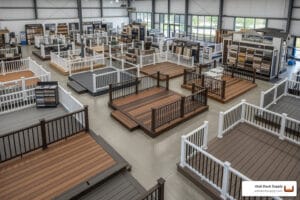
Honestly, the best next step is seeing the boards side by side and getting guidance for your exact deck layout. At Utah Deck Supply, we help homeowners, contractors, and DIY builders compare samples, check availability, match fasteners and railing, review span charts, and choose the right product for Utah conditions.
For help choosing between TimberTech and Trex, call Utah Deck Supply at 385-993-5492 or Request a Free Quote.