A lot of Utah homeowners reach the same point in the planning process. The deck layout is set, the boards are picked, and then the railing decision starts to shape the whole project. If the goal is to keep a view of the Wasatch Front, a valley lot, or an open backyard without the railing feeling heavy, cable usually moves to the top of the list.
That choice works well on many Utah decks, but it works best when the system is treated as a structural assembly instead of a design accessory. Stainless steel cable deck railing systems can look clean and last a long time, but the results depend on the cable type, the post material, the rail stiffness, the spacing, and the follow-up maintenance after installation. Utah's freeze-thaw cycles, dry air, strong sun, and big temperature swings make those details matter.
What Are Stainless Steel Cable Railing Systems
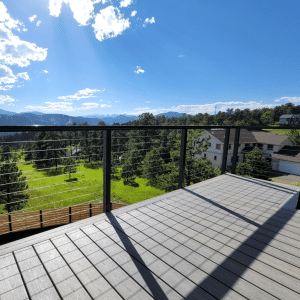
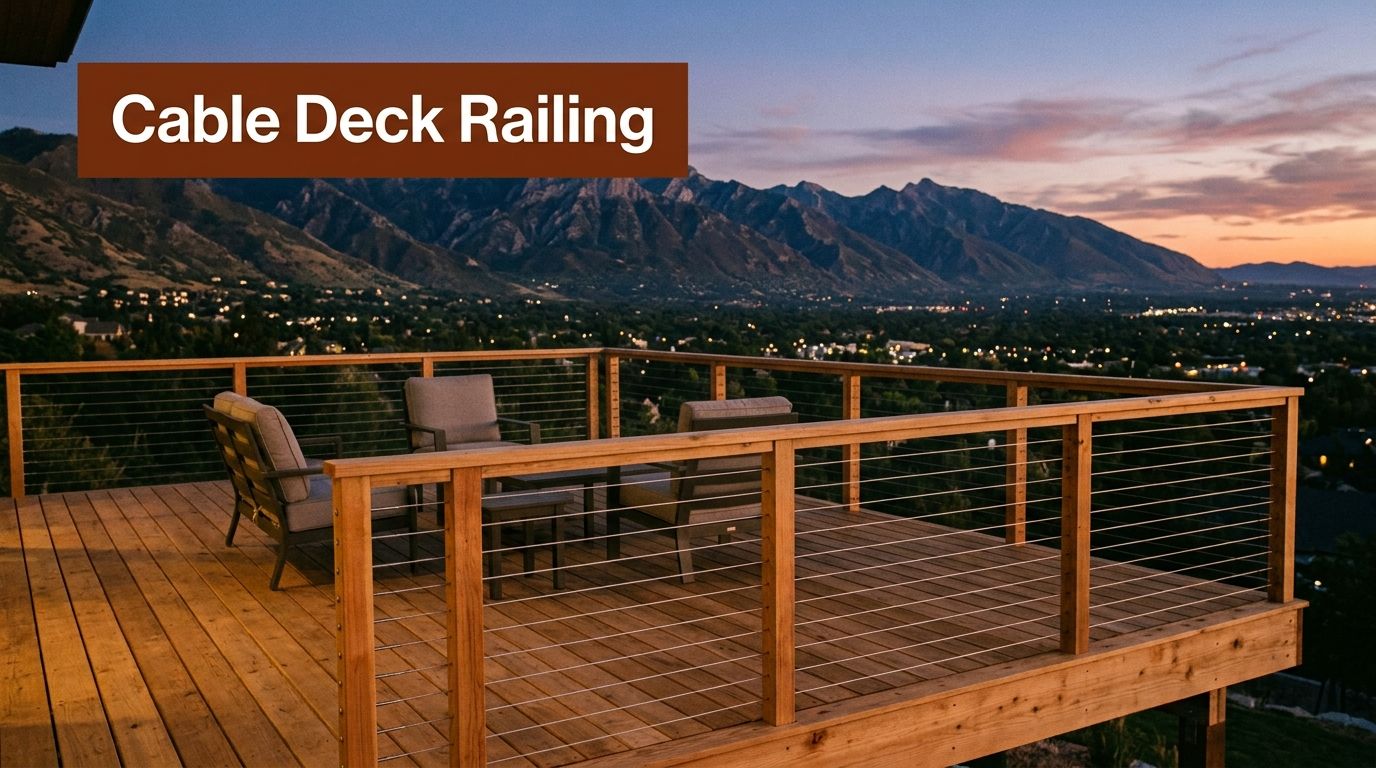
A homeowner in Utah usually notices cable railing from inside the house first. You look through the glass at the deck and want the view of the mountains, the valley, or the backyard to stay open instead of getting chopped up by thick pickets. Stainless steel cable railing systems do that by using horizontal stainless cables as the infill between structural posts.
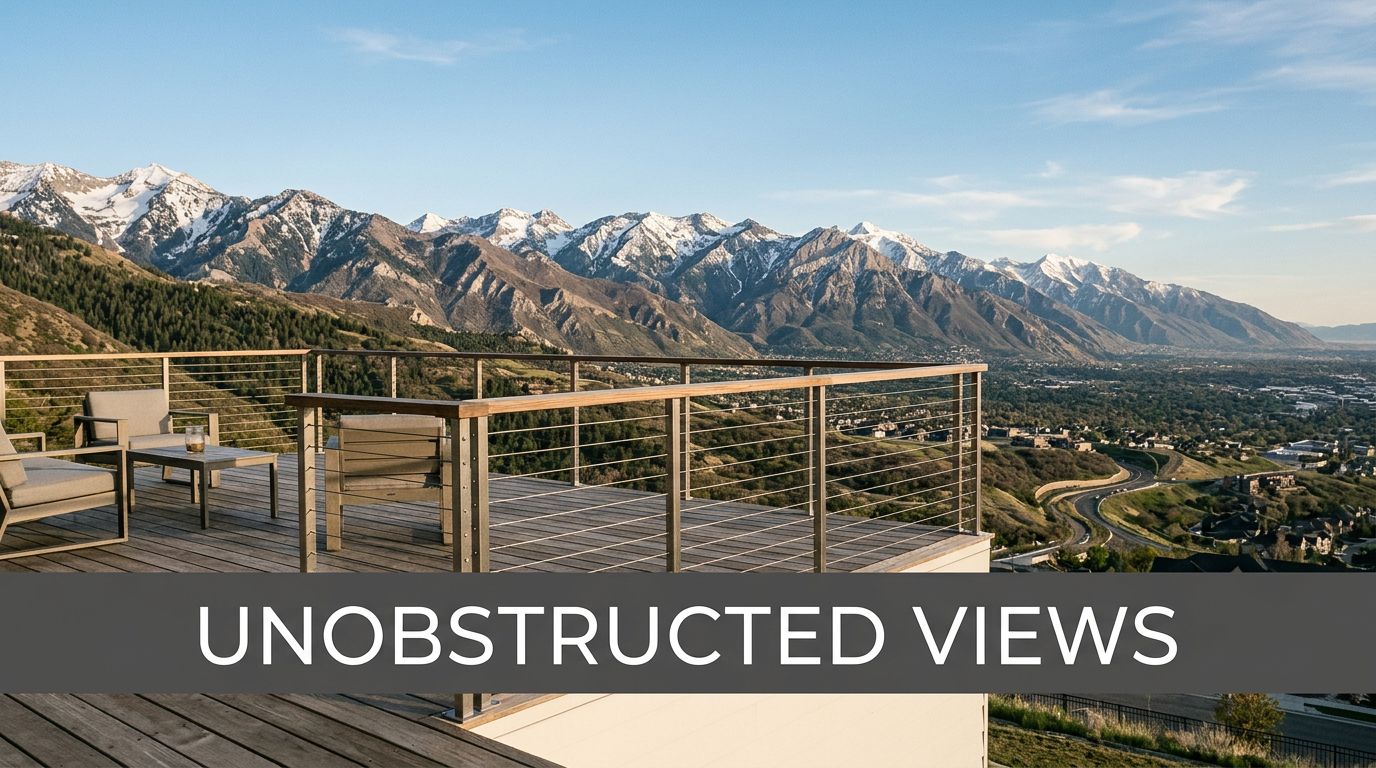
This guardrail system is built around tension. The posts and top rail form the frame. The cables span between posts. The fittings anchor each run and let the installer tighten the cables so the infill stays straight and safe. If any one of those parts is undersized, the railing can start to feel loose or look uneven long before the deck itself shows age.
That matters in Utah. Freeze-thaw cycles, dry summers, strong UV exposure, and wide temperature swings all put stress on connections and on the materials around the cable. A cable system can perform well here, but only if the full assembly is chosen for outdoor movement and repeated retensioning over time.
Homeowners usually pick cable for the clean look, but the better reason is that it gives an open sightline without giving up a solid perimeter guard. On mountain lots and raised decks, that balance is hard to beat. It also pairs well with several design directions, from powder-coated metal frames to wood posts with a more natural deck surface.
A product like Cinch railing shows the category well. The cables stay visually light, while the frame carries the structural work. That distinction is important because cable railing is never just about the cable.
Finish selection also matters more than many homeowners expect. Stainless holds up well outdoors, but surrounding metal parts and exposed surfaces still need to be chosen with weathering in mind, especially on decks with snow exposure or full sun. For a useful overview of protective finishes for railings and balustrades, it helps to look at how coatings affect long-term appearance and maintenance.
A good cable railing keeps the view open, meets guard requirements, and stays tight through Utah's seasonal temperature swings.
Components and Materials of a Cable Railing System
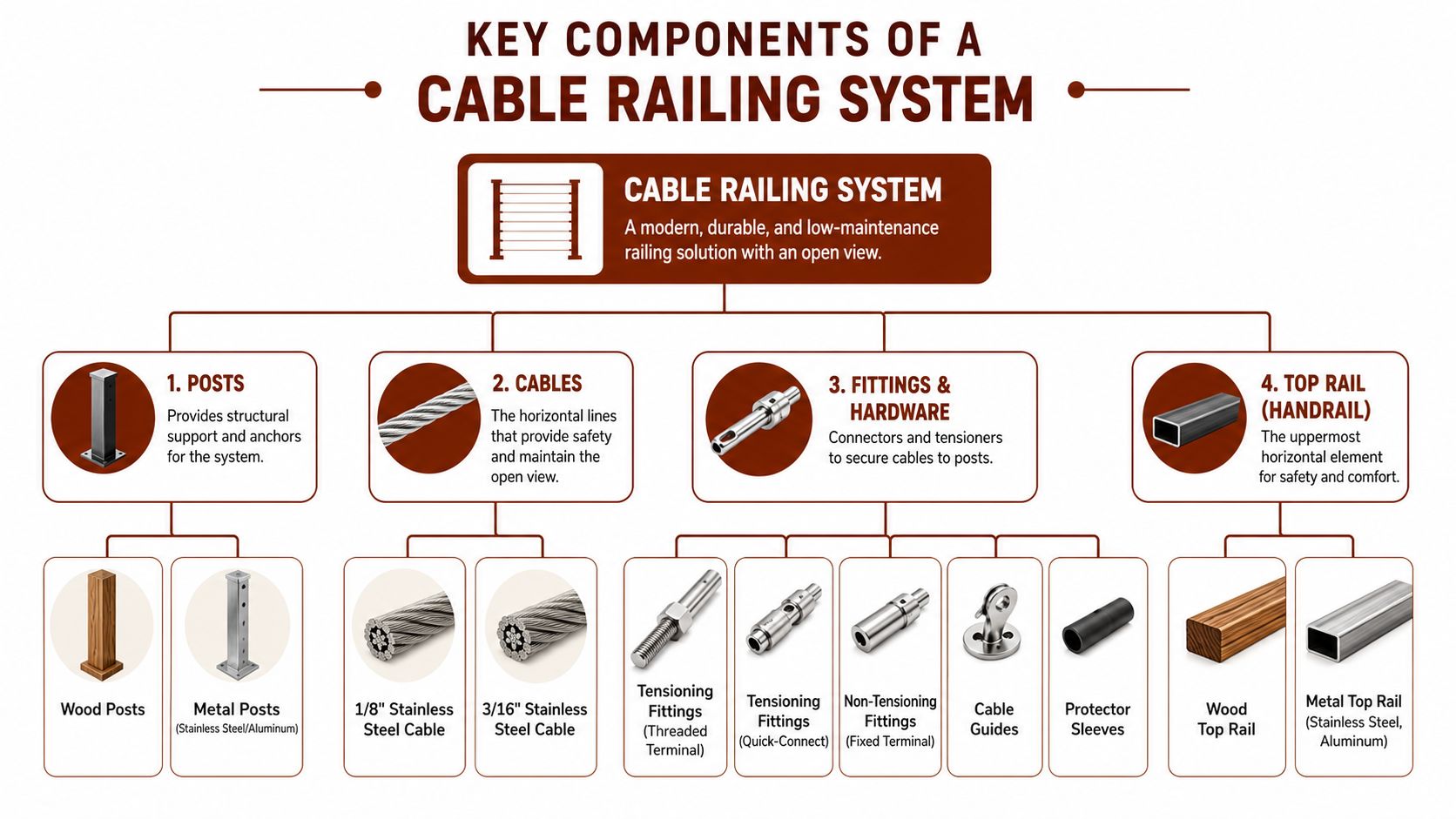
A cable railing system succeeds or fails at the frame first. In Utah, I see the same issue over and over: the cable gets the attention, but the posts, top rail, and terminal hardware determine whether the guard stays straight and tensioned after a few seasons of snow, dry heat, and freeze-thaw movement.
Posts and top rails
Posts carry the load from every cable run. Wood and metal can both work, but they do not behave the same way outdoors. Wood posts can fit the look of a mountain deck or backyard remodel, yet they need careful drilling, proper blocking, and enough section thickness to resist cable pull without gradual deflection. Metal posts are usually easier to keep consistent, especially on longer runs where even slight movement becomes visible.
Top rails matter for code and stiffness. On cable systems, the top rail is not just a cap. It helps control flex across the entire assembly. If the rail profile is too light, cables can pull the line out of shape and leave the railing looking tired even when the parts are still technically sound. That is one reason mixed-material systems need some thought before ordering. A warm wood deck surface can pair well with cable, but the frame still has to be built for tension.
Cable and stainless grade
Most residential systems use 1/8-inch or 3/16-inch cable. The smaller diameter usually gives the cleaner sightline people want, while the larger option can make sense on heavier frames or longer runs where the owner prefers a more substantial look. The right choice depends less on trend and more on span, post spacing, fitting style, and how rigid the frame will be after installation.
For exterior work, 316 stainless is the grade I steer customers toward for cable and exposed fittings. It handles moisture, snow hold, and irrigation overspray better than lower stainless grades. That matters in Utah because decks often cycle from wet winter conditions to hot, dry summer exposure, and those shifts tend to expose weak points in cheaper materials.
Fittings and small parts
The fittings are where serviceability lives. A cable system needs tensioning ends, fixed ends, sleeves or grommets at pass-through points, and structural fasteners that match the frame material. If those parts are mixed from unrelated systems, small fit problems show up fast. Cables bind in the posts, ends do not seat correctly, and future retensioning gets harder than it should be.
These parts deserve as much attention as joist hangers or ledger screws. Anyone building a material list should review the full set of hardware for building a deck so the railing is planned as part of the structure, not added at the end.
Selection rule: Buy a tested system of matched parts, with posts, cable, fittings, and top rail designed to work together.
Finish choice also affects long-term appearance. Stainless cable may hold up well, but coated rails, fastener heads, and exposed metal surfaces still have to deal with sun, abrasion, and seasonal moisture. For a useful reference, review protective finishes for railings and balustrades before settling on a frame finish for a full-sun or snow-exposed deck.
Pros and Cons for Utah Decks
A homeowner in Park City or along the Wasatch Front usually asks the same question after seeing a cable rail sample in the showroom. Will it still look good and stay tight after a few Utah winters and a few summers of hard sun? That is the right question, because cable railing performs well here when the frame is built stiff, the materials are matched, and the owner knows what maintenance looks like.
Where cable railing performs well
The biggest advantage is the view. On raised decks facing the mountains, open space, or a sloped backyard, cable keeps sightlines open in a way thicker infill does not.
Utah weather also favors stainless in a few practical ways. Intense UV does not break down stainless cable the way it can fade or dry out some other railing materials. Snow is not usually what hurts these systems either. Freeze-thaw cycles tend to expose weak posts, loose fittings, and rushed installation work. A properly built cable rail handles the climate well. A flimsy one starts showing movement.
Cable railing also fits a lot of Utah homes better than people expect. It works on clean modern builds, but it also pairs well with wood or composite decking where the goal is to keep the structure warm-looking and the railing visually light.
Where buyers get surprised
Cable railing asks more from the frame than many homeowners assume. Posts need to resist tension. Top rails need to stay firm. Drilling has to stay consistent from post to post, especially on longer runs where small layout errors become visible fast.
Wood movement is another real trade-off in Utah's dry summers and wet winters. If the railing frame is wood, seasonal shrinking, swelling, and checking can change cable tension enough that a spring tune-up may be part of ownership. Metal frames usually hold tension more consistently, which is one reason I often point customers to broader expert advice on Utah deck railing before they commit to a material package.
Family use matters too. Horizontal cables create a climbable pattern, and some homeowners with small children decide that alone is enough to rule it out. Others are comfortable with it and care more about preserving the view. That decision is less about style than daily use of the deck.
A practical Utah view
On Utah projects, cable railing makes the most sense when these conditions line up:
- The view is a priority, especially on raised decks, walkouts, and hillside lots
- The frame is strong enough for cable tension, whether that means steel, aluminum, or carefully detailed wood posts and rails
- The budget covers precision work, because this system shows layout mistakes more than balusters or panels do
- The owner is willing to check and retension cables as needed, particularly after seasonal movement on wood-framed decks
Cable railing gives a clean result, but it is not forgiving. In Utah, the climate rewards good materials and careful installation, and it exposes shortcuts within a season or two.
Cable Railing Code and Safety Spacing
Cable railing only works when it satisfies code and stays tight enough to keep satisfying code over time. The two key details to understand are the load requirement and the opening requirement.
The two rules that drive most layouts
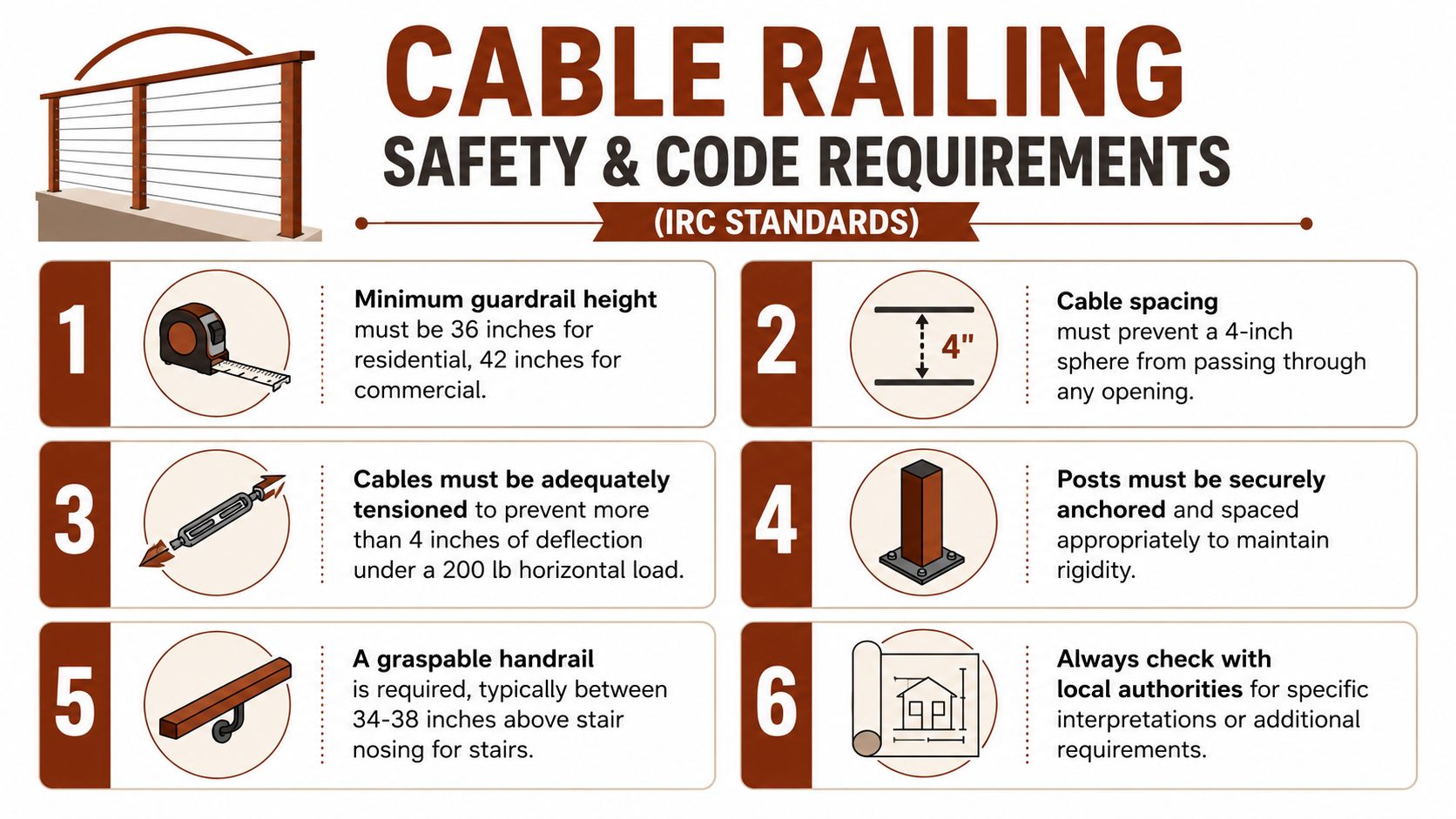
Residential railings must resist a 200-pound force at the top rail, and the infill can't allow a 4-inch sphere to pass through. For cable systems, that often means posts are spaced no more than 4 feet apart to limit deflection, based on this summary of cable railing design requirements.
Those numbers shape nearly everything else. They affect post spacing, the number of cable runs, how much the top rail needs to resist movement, and how carefully the installer has to tension the system after assembly.
What that means on a real deck
For a homeowner or builder, the practical code checklist usually looks like this:
- Post spacing must stay controlled because wider spacing increases cable deflection
- Cable runs need consistent tension so the openings don't grow under pressure
- Top rails must be structural enough to resist the force transferred into them
- Anchorage matters because a strong post still fails if the base attachment is weak
A cable rail can look perfect on day one and still fail inspection if the cables deflect too much under load. That's why “appearance” and “compliance” aren't separate conversations with this product.
Utah permit and inspection reality
Different cities can interpret details differently, especially on stairs, graspability, and how they evaluate a specific system. West Jordan, Salt Lake City, Sandy, Draper, Herriman, Lehi, Ogden, Provo, and other Utah jurisdictions may not all review plans the exact same way.
Code reminder: Always confirm manufacturer instructions and local code requirements before ordering materials or drilling posts.
That step is especially important on remodels, walkout basements, and decks where framing conditions limit post placement options.
Design Tips and Aesthetic Choices
Cable railing has a narrow visual profile, but it isn't locked into one style. The frame choice changes the personality of the whole deck.
Modern homes and cleaner lines
On contemporary homes in Salt Lake City or newer neighborhoods along the Wasatch Front, cable often looks best with dark metal posts and a simple top rail profile. The railing becomes a quiet outline instead of a decorative feature. That approach works especially well when the decking has a clean board pattern and minimal visual clutter.
A black frame can also help the cables recede. From inside the house, the eye tends to move past the railing and toward the yard or mountain backdrop.
Warmer combinations for mountain and suburban homes
Not every cable project should look industrial. A lot of Utah decks look better when stainless cable is paired with a warmer frame element such as substantial wood posts or a top rail that visually connects to the deck boards. That gives the openness of cable without making the deck feel too cold.
Good pairings often include:
- Wood posts with cable infill for a rustic-contemporary look
- Metal posts with a broader top rail when the deck needs a stronger visual cap
- Color-matched railing and decking for a more integrated finish
- Rail lighting or post accents when night use matters as much as daytime view
Matching style to maintenance expectations
Some homeowners choose cable because they like the open look but later realize they would have been just as happy with another metal railing profile. Looking at broader deck railing costs and styles can help narrow that down before the material order is final.
The best-looking cable decks usually have restraint. Limited color changes, clean post alignment, and a top rail that feels intentional usually outperform overly busy designs. Cable doesn't need much decoration. It needs good proportions.
Installation and Maintenance in Utah
A Utah cable railing job usually looks best right after install, then gets tested by the first hard winter, spring thaw, and full summer sun. That is where good planning shows up. A clean cable run can stay tight and sharp for years, or it can start to sag, bow posts, and collect cosmetic issues if the frame, hardware, and maintenance plan were not matched to the site.
Installation details that matter most
The work starts with structure, not cable. Posts need solid attachment into framing that can handle rail loads and cable tension without flexing. On many Utah decks, the weak point is not the stainless cable. It is a rim board connection, a light-duty post, or a top rail that is too flexible for the span.
Cable layout also needs discipline. Hole spacing has to stay consistent, end fittings need proper alignment, and stair sections take more care than straight runs because the geometry changes fast. A small layout error is easy to see once the cables are tensioned.
For the cable itself, 1×19 Type 316 stainless is the standard I recommend for most exterior deck rail applications. It stays straighter under tension than looser constructions and gives the finished railing a cleaner line. Homeowners often focus on the cable diameter, but the frame design matters just as much because the posts and top rail are carrying the primary stress.
Tensioning is part of the job, not a callback surprise
New cable rail almost always needs follow-up adjustment. In Utah, I tell customers to expect seasonal checks after installation, especially after the first freeze-thaw cycle. Wood framing dries and moves. Composite moves differently. Metal stays more stable, but the deck structure underneath can still shift enough to affect cable tension.
That does not mean the system failed. It means the system is settling into service conditions.
A good install leaves room for that reality. Access to tensioning hardware should be planned from the start, and the installer should tighten the system evenly so one post is not taking more load than it should.
Material pairings that hold up better in Utah
Some pairings age better than others here. Stainless cable with aluminum or steel posts usually gives the most stable long-term tension because the frame moves less with moisture and temperature swings. Cable with wood posts can still work well, but the wood species, post size, and connection details need more attention. In dry summers and snowy winters, wood movement is real, and that movement shows up in cable tension.
The same goes for top rails. A stiff top rail helps the whole assembly feel solid. An underbuilt top rail may meet the design intent on paper and still feel soft in use once the cables are fully tensioned.
Cleaning and seasonal care
Utah is dry, but cable railing still needs routine care. Dust, irrigation overspray, de-icing residue, and general grime can sit on stainless and fittings longer than many owners expect.
A practical maintenance routine looks like this:
- Wash cables and fittings with a cleaner that is suitable for stainless and the rail finish
- Rinse off sprinkler minerals and winter residue before they bake on in summer sun
- Check cable tension at least seasonally, especially after the first winter
- Inspect end fittings, fasteners, and post connections for looseness or movement
- Watch wood-framed systems for shrinkage, twisting, or slight post rotation that changes cable alignment
Bleach-based cleaners are a bad choice for stainless. Use products that are intended for exterior metal surfaces and follow the finish care guidance for the frame material too.
Homeowners who want a broader seasonal checklist can review deck maintenance tips for Utah, especially for decks that deal with snow, irrigation, and strong UV exposure.
A realistic maintenance expectation
Cable railing is low maintenance compared with many wood rail designs, but it is not no-maintenance. The owners who stay happiest with it are usually the ones who want the open view and are fine doing light seasonal checks to keep the system looking crisp.
If you are planning a Utah project and want help matching cable railing to your deck frame, exposure, and maintenance expectations, you can get a decking quote.
Cost Comparison and Getting a Quote in Utah
A Utah cable railing quote can swing more than many homeowners expect. Two decks with the same square footage can price out very differently once you account for stair runs, corner posts, framing material, and how much adjustment the system may need after a freeze-thaw season.
Cable railing usually lands in the premium range, but the cable itself is only part of the number. Posts, top rail choice, end fittings, stair geometry, and installation time often move the budget more than people expect. On wood-framed decks, I also tell customers to plan for the realities of seasonal movement. If posts dry, shift, or rotate slightly, that can affect cable tension and long-term service calls.
Deck Railing System Comparison
| Railing Type | Initial Cost (per linear ft) | Maintenance Level | Typical Lifespan |
|---|---|---|---|
| Pressure-treated wood railing | Lower than stainless steel cable systems | Higher | Depends on lumber quality, moisture exposure, finish maintenance, and sun |
| Composite railing | Mid to premium range | Moderate | Depends on brand, reinforcement, exposure, and installation quality |
| Aluminum railing | Mid to premium range | Lower to moderate | Depends on coating quality, fastener condition, and site exposure |
| Stainless steel cable railing | Premium range | Low to moderate, with periodic tension adjustment | Long service life with proper material pairing, cleaning, and seasonal checks |
The best cost comparison is not cable versus wood versus aluminum in the abstract. It is full system versus full system, installed on your deck, in your exposure, with your maintenance tolerance.
Here is what usually changes the quote on a Utah project:
- Post and frame material. Cable performs best when the posts stay rigid. Aluminum or steel-supported systems often hold tension more consistently than wood-only assemblies.
- Stairs, corners, and long runs. These add fittings, drilling time, and layout work. Stairs are usually the biggest labor jump.
- Top rail choice. Many cable systems need a sturdy top rail to meet code and control post movement.
- Site exposure. Full sun, snow load, canyon wind, and heavy irrigation overspray can all influence material recommendations and hardware selection.
- Finish details. Lighting, drink rail caps, fascia trim, and upgraded hardware add cost fast.
A quick online allowance rarely helps much here. A useful quote should reflect actual dimensions, post spacing, stair count, frame type, and whether the deck is getting hit with direct sun all afternoon or buried in snow through part of the winter.
If you want pricing that matches your specific layout and local conditions, get a decking quote.
If stainless steel cable deck railing systems are on the shortlist, compare the whole assembly instead of the cable alone. Utah Deck Supply helps homeowners, DIY builders, and contractors across West Jordan, Salt Lake City, South Jordan, Sandy, Draper, Herriman, Lehi, Ogden, Provo, and the Wasatch Front sort through railing materials, hardware, and deck supply lists. Visit the showroom in West Jordan or call 385-993-5492 to narrow down the right system for the project and the local climate.