
Standing in front of a rack of grey deck samples can feel simple until the samples are outside in Utah sun, next to stucco, stone, black rail, and a dusty backyard. Grey works for a lot of homes across West Jordan, South Jordan, Sandy, Draper, Herriman, Lehi, Ogden, Provo, and the broader Wasatch Front, but the right grey depends on more than taste.
Some grey boards hide dust well but run warmer. Some stay more consistent in high UV but need closer attention to spacing details. Some customers ask for “plastic decking” when they really mean capped composite, while others want PVC because summer surface comfort matters more than wood-like texture. Getting that call right early saves time, sample churn, and expensive change orders.
Why Everyone Is Choosing Grey Decking
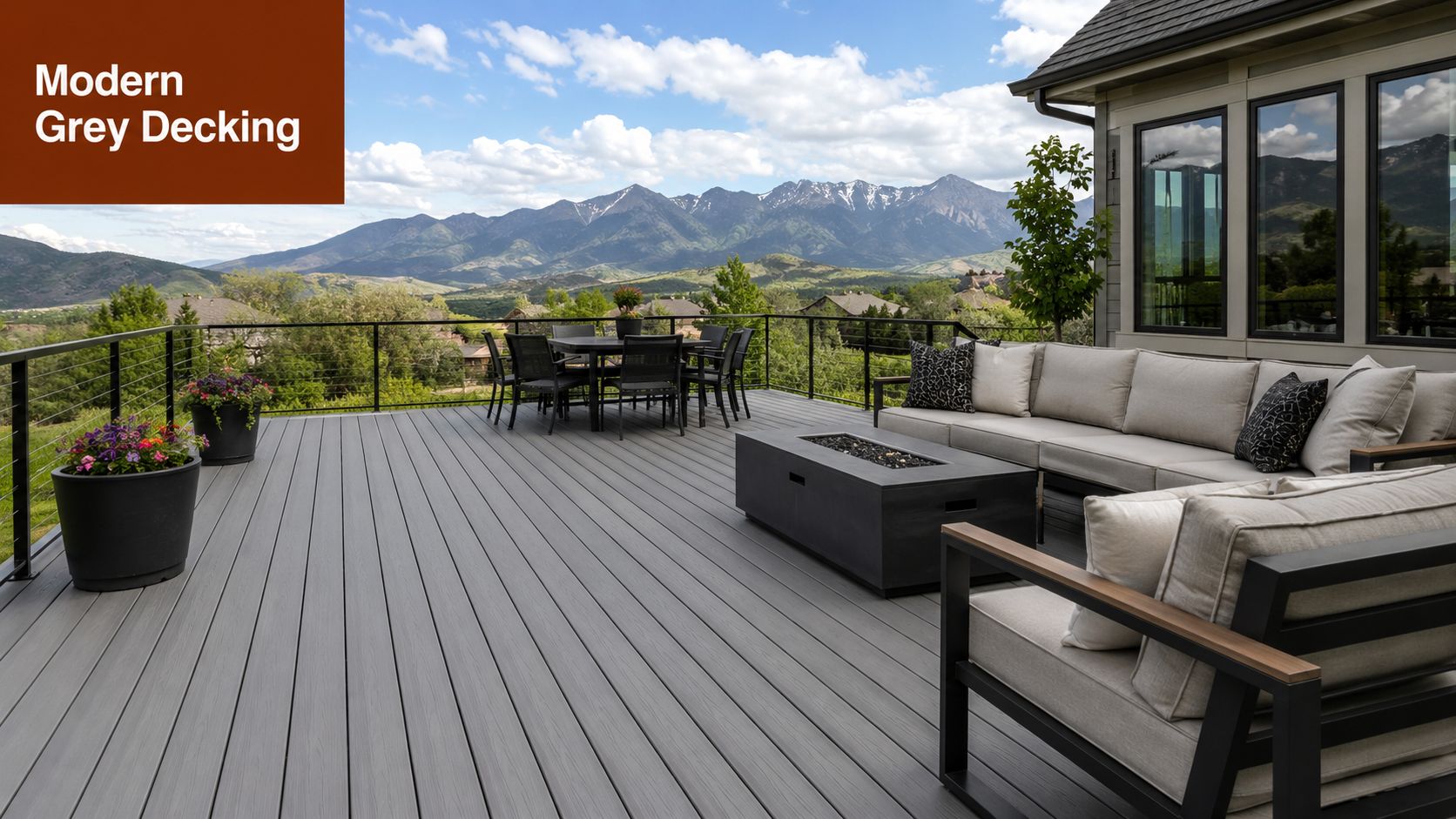
Grey isn't one color in the showroom. It usually falls into three practical groups. Light silver and soft ash. Mid-tone weathered greys. Dark charcoal and graphite.
That matters because homeowners usually aren't just choosing a color. They're choosing how visible dust, dog prints, pollen, and daily traffic will be on the deck surface.
Grey families behave differently
A clean, pale grey can look sharp against white trim and dark window frames. It also tends to show contrast more clearly when wind pushes dust across the boards. A deeper grey often hides the mess better from week to week, especially on exposed decks along the Wasatch Front where fine dirt can settle fast.
Variegation changes the look just as much as the base color. A solid-looking grey reads cleaner and more modern. A board with more grain contrast usually does a better job disguising everyday surface mess because the pattern breaks up visual uniformity.
Practical rule: If the deck sits fully exposed to backyard traffic, pets, and open wind, mid-tone and darker variegated greys usually stay visually cleaner between wash-downs.
Why grey keeps winning in Utah
Grey fits a lot of Utah exterior palettes without forcing the deck to dominate the house. It works with painted homes, brick, stone veneer, black aluminum railing, cable rail, and mixed-material backyards where pavers and concrete already bring cool tones into the space.
It also gives homeowners the weathered-wood look many people want, without committing to actual wood movement, staining cycles, or the uneven aging that makes some real-wood decks look tired before the frame is done paying them back.
A quick way to narrow the field is to look at the space like this:
- For busy family use: Mid-tone greys usually strike the best balance between appearance and day-to-day forgiveness.
- For a modern exterior: Clean, cooler light greys pair well with minimalist railing and large glass doors.
- For dust-prone yards: Darker charcoal shades tend to mask dirt and prints better.
- For a wood-look finish: Variegated grey boards often feel less flat and more natural from the yard.
Grey has moved past trend status. In this market, it's become a practical surface choice.
Not All Grey Boards Are Created Equal
The biggest mistake in shopping for composite decking boards grey is treating every grey board like the only difference is the pigment. It isn't. The material under the color drives how the deck handles heat, moisture, movement, and long-term wear.
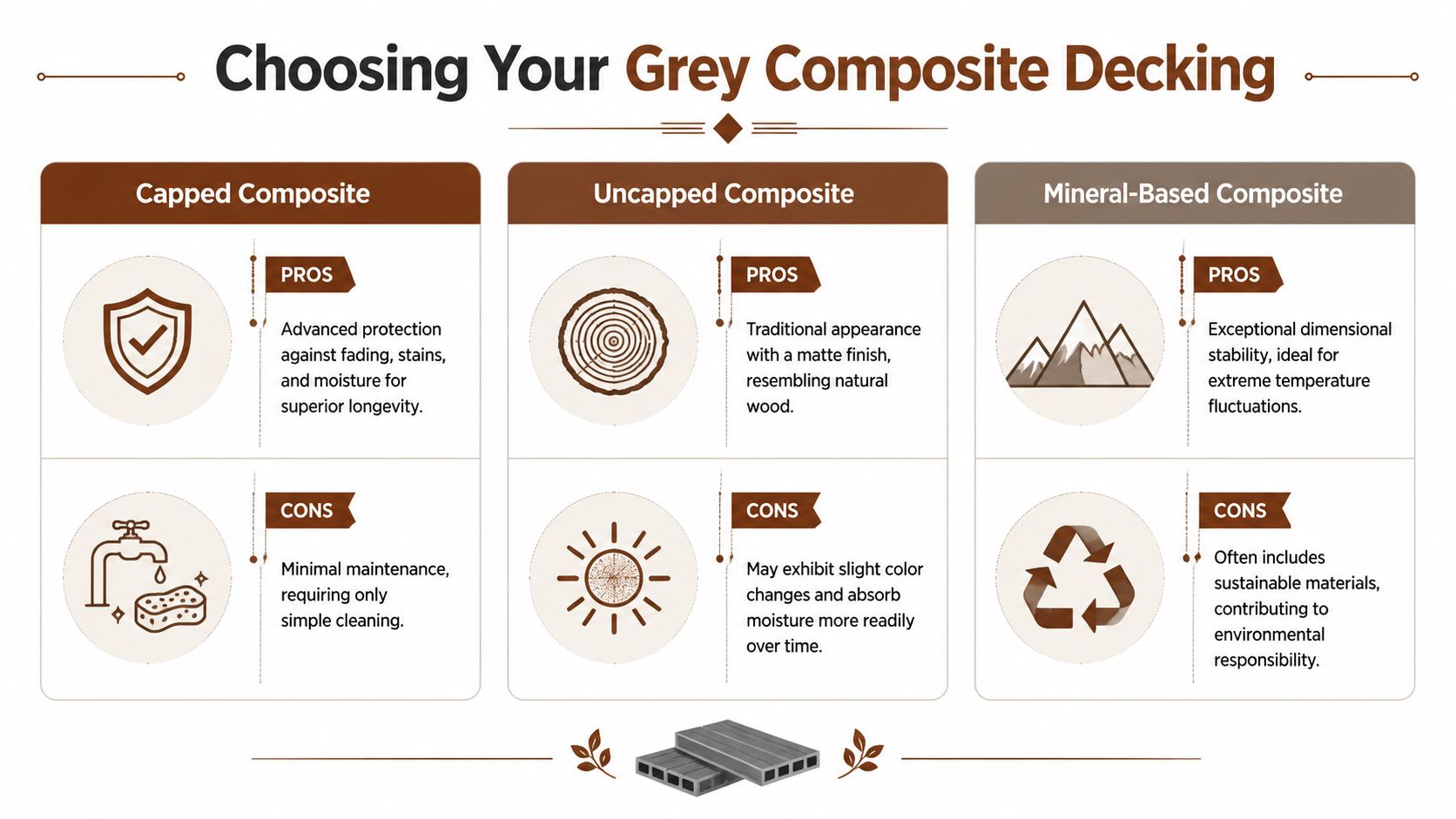
Most customers shopping grey boards are really choosing between capped composite and PVC, even if they use the catch-all term “plastic decking.” For a closer breakdown of the categories, this guide on choosing the right deck boards is useful before locking in a color.
What capped composite actually means
A capped composite board has a composite core with a protective outer shell. That cap is the working surface that helps resist staining, moisture intrusion, and color wear. The easiest way to think about it is a jacket over the structural body of the board.
Some products protect more sides of the board than others. More complete coverage generally means better defense against moisture exposure from the top, edges, and underside. That matters in a four-season climate where snow, standing water, sprinkler overspray, and freeze-thaw conditions all show up in the same year.
What people mean by plastic decking
When customers say plastic decking, they usually mean a fully synthetic board rather than a wood-fiber composite. In practical terms, that often points them toward PVC.
PVC boards don't have the same wood-fiber content as traditional composite. That can be a real advantage if the project has full sun, heavy moisture exposure, or a homeowner who wants less concern about surface retention of seasonal grime. It can also be a better direction when bare feet on hot afternoons are a major concern. In Utah conditions, PVC lines are often the category people look at first for better heat comfort.
A board can look nearly identical in the sample rack and still behave differently once it sits through July sun and January cold.
What works in Utah and what doesn't
For many homes, capped composite is the practical middle ground. It gives a more wood-like appearance, good durability, and a broad spread of grey tones. For buyers focused on lower maintenance and moisture resistance, it often checks the right boxes without moving fully into PVC.
For projects where heat mitigation rises to the top of the list, PVC deserves a serious look. That's especially true on south-facing decks with little shade. In that conversation, it's important not to overgeneralize. Some lines are better than others, and for heat mitigation, TimberTech Vintage is the stronger direction than Trex Transcend Lineage.
A simple decision framework helps:
| Board type | Often fits best when | Trade-off to watch |
|---|---|---|
| Capped composite | Wood-look texture and balanced value matter most | Can run warmer than some PVC options |
| PVC | Heat comfort and moisture performance lead the list | Usually feels less like traditional wood |
| Mineral-based composite | Dimensional stability is a major concern | Product feel and fastening details need close review |
Anyone comparing categories side by side can also browse Utah Deck Supply's main decking page to sort material options before narrowing to a grey family.
Comparing Grey Decking from Top Brands
Once the material category is clear, the next step is matching the look and performance priorities to a specific product line. At this stage, many homeowners and contractors save time by comparing greys on a short list instead of trying to evaluate every board in the rack.
The practical filters are straightforward. Is the project chasing lower heat feel, stronger grain variation, a more uniform modern look, or a specific cap construction? Does the deck need to coordinate with black aluminum rail, cable rail, or a warmer brown exterior palette? Those questions matter more than broad brand loyalty.
What to compare in grey boards
Leading grey composite boards have engineered 360-degree protective layers and deep-embossed textures that resist UV fading and absorb less than 1% of moisture after prolonged exposure, preventing rot and splintering common in untreated wood.
That doesn't make every line equal. Some grey boards are quieter and flatter in appearance. Others have heavier movement in the grain pattern, which can be useful when the goal is to disguise dust and foot traffic. Some collections lean more contemporary, while others look closer to weathered timber.
When a customer wants a grey deck that still feels warm and residential, grain variation usually matters as much as the actual hue.
Grey Composite Decking Brand Comparison
| Brand | Popular Grey Collections | Material Type | Capping | Key Feature |
|---|---|---|---|---|
| Trex | Transcend grey options, Enhance grey options | Composite | Capped | Familiar composite feel with several grey looks |
| TimberTech | AZEK Vintage grey options, composite grey options | PVC and composite | Capped | Strong option when heat mitigation is a top priority |
| Deckorators | Voyage grey options and other grey finishes | Composite category options | Capped | Good fit when movement and long-term stability are part of the discussion |
| Fiberon | Multiple grey-toned collections | Composite and PVC category options | Capped | Broad design flexibility across grey tones |
The table isn't a ranking. It's a starting point for narrowing what fits the project.
How these brands tend to fit real projects
Trex often fits buyers who want a known composite look and a broad mainstream color range. It's usually part of the conversation when the customer wants a practical composite surface and a familiar appearance.
TimberTech deserves close attention when the project is sun-heavy and bare-foot comfort matters. On those jobs, the conversation often moves toward PVC, and specifically toward its cooler-underfoot direction relative to many composite boards. For anyone comparing those two product families more directly, this article on TimberTech vs Trex helps frame the decision.
Deckorators can make sense when dimensional stability is high on the checklist and the deck will live through strong seasonal swings. Fiberon often enters the mix when customers want another path to a grey color story without forcing the project into a single visual style.
For brand-specific browsing, the most direct routes are the Trex decking options and TimberTech decking options. Looking at those pages before a showroom visit usually helps customers arrive with a shorter, more realistic sample list.
Installation and Hardware for Utah Decks
A grey board can be the right product and still fail if the installation ignores Utah movement, drainage, and framing details. That's where many avoidable callbacks start.
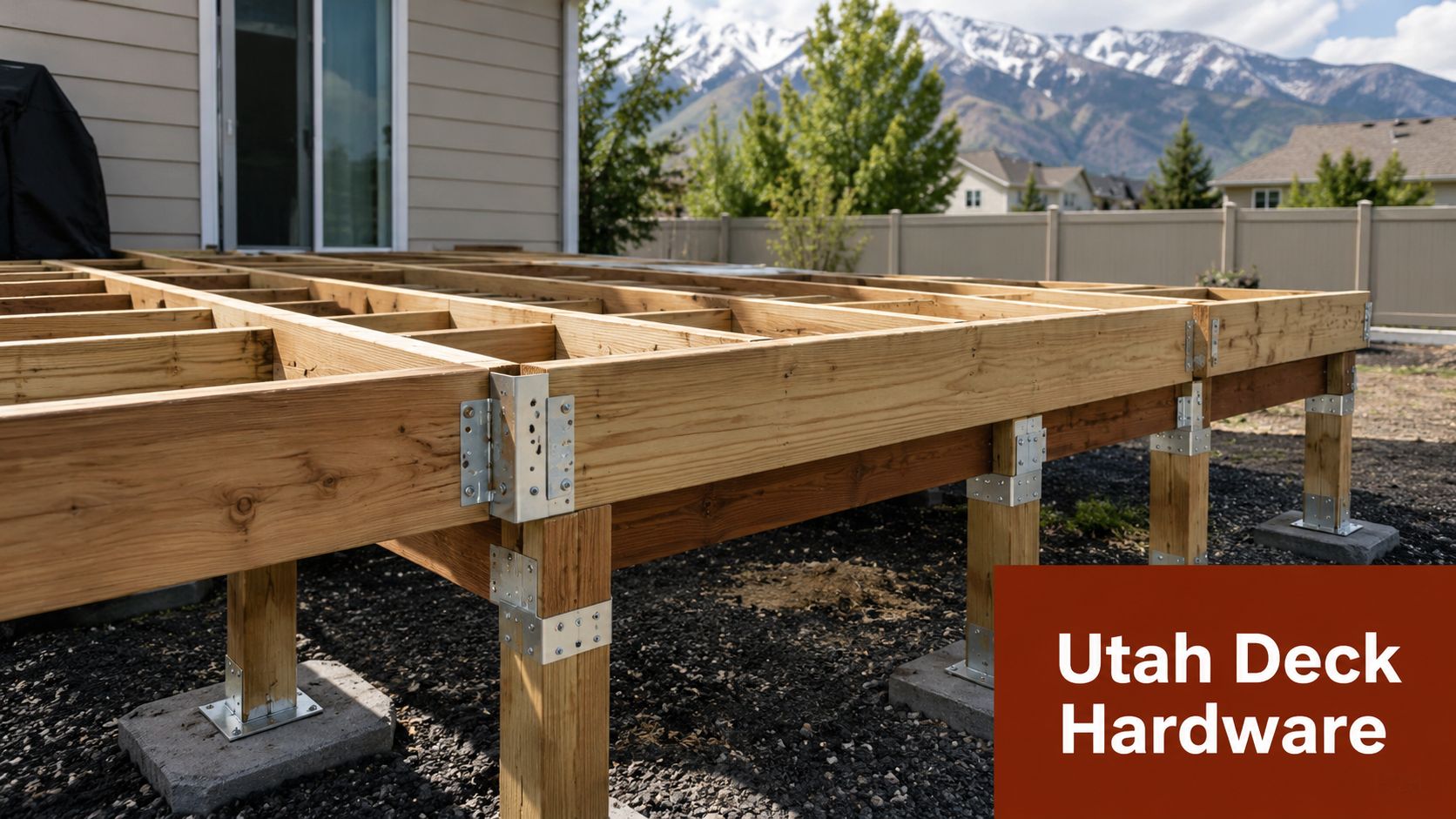
Grey composite decking's thermal expansion coefficient is 1.9 × 10⁻⁵ inch/inch/°F, which allows for tighter installation gaps than pure PVC. However, lighter grey boards can expand up to 0.08% more per 10°F swing than darker ones, so manufacturer fastener and spacing guidance matters if the goal is to prevent buckling in Utah's variable climate.
Spacing and fasteners aren't optional
Generic online advice causes trouble. “Two screws per joist” isn't enough guidance when the board color, board length, exposure, and material type all affect movement.
Hidden fastener systems help create a cleaner look, but they also need to match the board profile and movement requirements. End gaps, side gaps, breaker board layouts, and perimeter details all need to account for what the specific board will do across seasonal swings. Local code requirements and manufacturer instructions should always control the final installation approach.
A few jobsite rules carry a lot of weight:
- Check board-specific instructions: Grey tone alone can affect movement behavior, especially in lighter shades.
- Match the fastener system: Hidden clips, face screws, and plugs each solve a different problem.
- Protect the frame: Joist tape and flashing help keep the framing package from becoming the weak link.
- Plan airflow early: Ventilation under the deck affects moisture management and long-term stability.
The deck is a system
The board surface gets the attention, but the system underneath decides how long the project stays quiet and flat. Framing hardware, structural screws, joist tape, and flashing deserve the same care as the finish boards. A useful starting point for that side of the project is this deck framing hardware guide.
Railing should also be chosen as part of the deck system, not as an afterthought. Grey decking usually pairs cleanly with deck railing options, especially aluminum, cable, steel, or coordinating composite rail systems. The hardware side matters just as much, so it's worth reviewing the available deck hardware before ordering boards alone.
Field note: Most ugly deck problems start at transitions, edges, stairs, and picture-frame borders. Those are the areas where movement and fastening details show up first.
Budgeting Maintenance and Getting Your Materials
A grey deck budget in Utah should account for more than the first invoice. Sun exposure, dust, snow, and freeze-thaw cycles all affect how the deck looks over time and how much work it takes to keep it looking clean.

Composite usually costs more up front than pressure-treated lumber. For many Utah homeowners, a key question is whether lower upkeep, longer service life, and a more stable appearance in high UV make that added cost worth paying now instead of dealing with refinishing and earlier replacement later.
What to budget beyond the boards
Board price is only part of the package. Fascia, risers, stair treads, hidden fasteners or plugs, trim, railing, framing connectors, post sleeves, lighting, and protection products can shift the total quickly. A clean-looking grey deck with stairs and rail often lands far above the raw square-foot board number people start with.
That is why a full material takeoff matters. It shows where the money is going and helps prevent the common mistake of choosing a board line that fits the budget, then getting surprised by stair, fascia, or railing costs.
If cost control is the goal, compare the whole build, not just the decking line. This guide to affordable deck materials is a good place to sort out where composite, PVC, and rail packages fit before ordering.
Maintenance is low, but climate still matters
Grey composite does not need staining, sealing, or painting. It still needs washing. Utah wind carries grit, light grey boards show dust faster, and shaded areas can hold debris longer after storms or snowmelt.
Shade choice affects maintenance more than many buyers expect. Very light greys can look sharp on a sample board, then show footprints, pollen, and grill residue faster on a full deck. Mid-tone and variegated greys usually do a better job hiding everyday mess while still staying cooler-looking than charcoal or near-black boards.
Material type matters too. Some capped composites hold their color well but can show surface dust more easily in pale grey. PVC boards often clean up fast and resist moisture well, which helps on decks with poor winter sun or heavy snow exposure. The trade-off is price and, in some lines, a different underfoot feel than composite.
At our West Jordan showroom, many homeowners and contractors bring in a siding color, a paver sample, or even a photo of the backyard light at noon. That helps narrow down the right grey faster than buying from online photos, especially in Utah where bright summer sun can wash out lighter tones and make cool grey look much different outdoors than it does inside.
Your Next Step to the Perfect Grey Deck
A Utah homeowner often narrows the choice to two grey samples at the end. One looks cleaner in bright sun. The other hides dust, snowmelt residue, and dog traffic better by the second week. That is usually the ultimate decision.
The right grey deck comes down to four choices that should be made together, not one at a time.
Start with the shade family. In Utah's high-UV light, pale cool greys can wash out outdoors and look much different than they did inside or on a phone screen. Mid-tone greys and variegated boards are usually the safer pick for full-sun yards because they hold visual depth better and do a better job hiding everyday dust and footprints.
Then choose the material type based on how the deck will be used through all four seasons. Composite is often the better fit when you want a more wood-like appearance and solid value across a larger footprint. PVC earns a close look on decks that deal with lingering snow, more shade, or moisture exposure, but the higher price and different board feel should be part of the decision.
Next, compare the details that show up after installation. Surface texture, board width, edge profile, capping quality, and color variation matter more on a finished deck than they do on a small sample piece under showroom lights.
Finally, treat installation and hardware as part of the system. Proper gapping, hidden fastener compatibility, ventilation, frame protection, and railing coordination have a direct effect on how that grey deck looks and performs after a few Utah summers and winters.
If you are down to a short list, the practical next move is to request a deck materials quote based on your actual layout, exposure, and finish selections.
Utah Deck Supply works with homeowners and contractors in West Jordan, Salt Lake City, South Jordan, Sandy, Draper, Herriman, Lehi, Ogden, Provo, and across the Wasatch Front to compare grey decking options and build a material list that fits the project.
Color reality: Grey boards look simple on a rack and complicated outside. Dust, stucco, black rail, and Utah sun all change the read. Always check samples outdoors before ordering full lengths.
Internal links:
- Composite decking guide
- Coastal Bluff Trex guide
- Composite deck boards reviews
- Railing finishes to pair with grey boards
- Compare grey samples in person
Resources and references
- Manufacturer color charts for Trex, TimberTech, Deckorators, and Fiberon grey families
- Composite lumber overview