
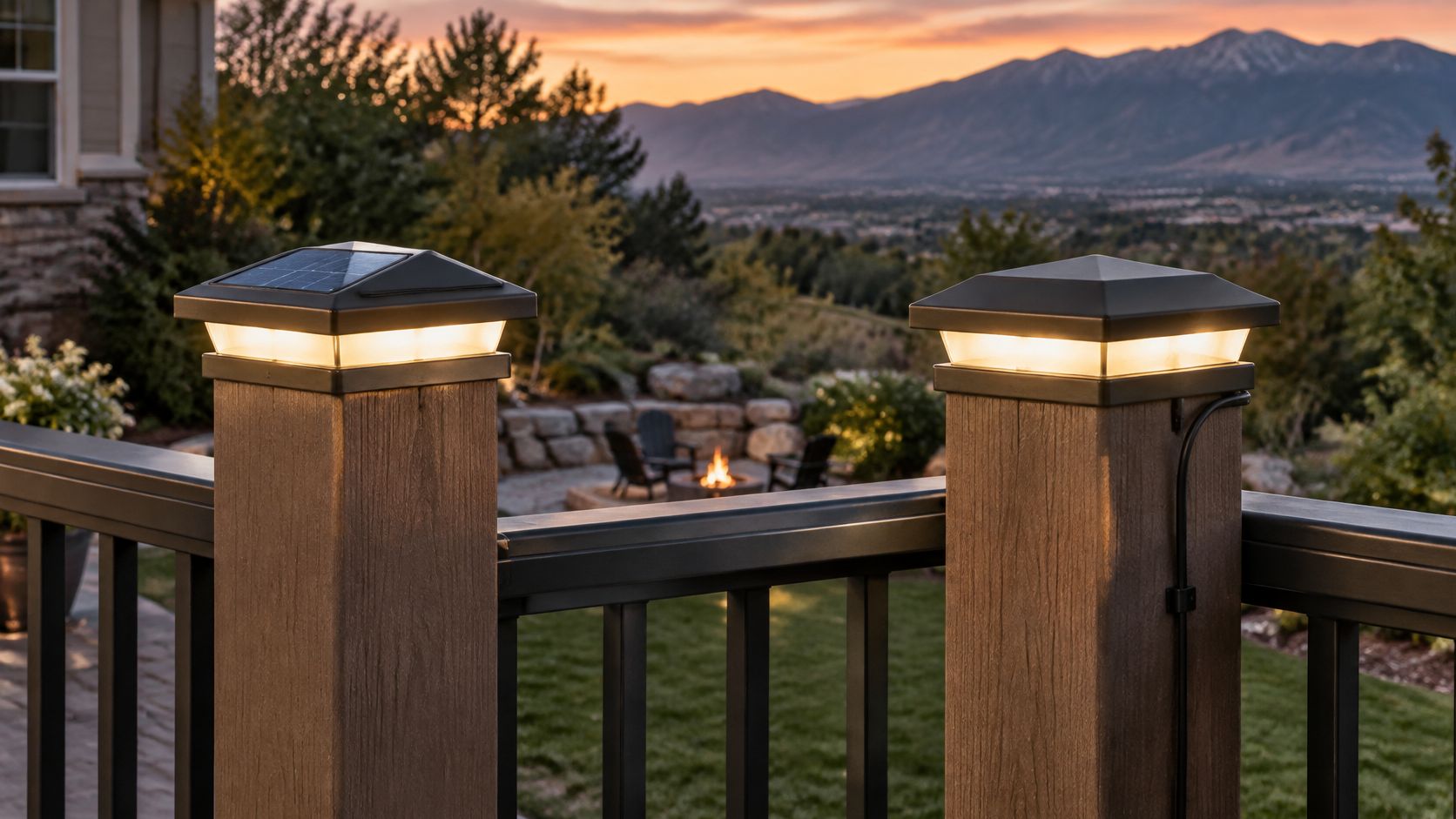
You're standing at the railing layout, posts not ordered yet, trying to decide whether each cap should charge itself or share one timed circuit. On a Wasatch Front deck that choice is about January nights and cable paths, not a brightness slogan on the box. Pick solar and a shaded or snow-covered cap can fade while the open posts stay lit. Pick low voltage without a wire route and you're cutting into finished rails later.
For most decks people use after dark, low-voltage post caps are the steadier choice. Solar post caps fit when every cap has clear sun and a changing runtime is acceptable. That is the practical frame for solar vs low voltage deck post cap lights before posts are ordered.
Which Power Source Fits Your Utah Deck
The power source decides whether a cap keeps a schedule or follows the weather. A solar cap runs on its own photovoltaic module, a rechargeable battery, and daylight. A low-voltage cap draws from a 12-volt transformer on a timer, and that transformer connects to household power. The LED can be efficient in either fixture; the source is what changes January performance, stair reliability, and how much wiring must be settled while the post layout is still on paper.
ENERGY STAR's LED technical bulletin uses a 9-watt LED as a representative replacement for a 60-watt incandescent, an 85% reduction in operating power, and describes certified LEDs as using 70 to 90% less electricity while brightness is compared in lumens rather than watts. Applied to ten post caps used 4 hours nightly, the arithmetic is 10 lights × 51 W saved × 4 hours × 365 nights ≈ 74.5 kWh per year, before transformer losses or control settings.
A 12-volt system still draws grid power through the transformer. Its advantage is a schedule you can hold across every post. Solar can avoid grid electricity, though usable runtime depends on charging, battery capacity, weather, shade, and seasonal daylight. Compare nighttime lumens, watt-hours, the operating schedule, and what remains after several cloudy days.
Power source by Utah deck condition
| Deck condition | Solar post caps | Low-voltage post caps | Better choice |
|---|---|---|---|
| Shaded deck under eaves or tree canopy | Weak charging, shorter runtime | Steady output from transformer and timer | Low voltage |
| Winter use with short days and snow on caps | Reduced charging; panels may need clearing | Consistent if transformer and wiring are sound | Low voltage for frequent winter use |
| Stairs and level changes that must stay lit nightly | Each cap follows its own charge and battery | Same schedule across all posts | Low voltage |
| A few decorative posts in open sun, used occasionally | Works well with no trenching | Needs a cable route to each post | Solar |
| Remodel with no wiring path to the posts | Works well without new cable | Needs a planned cable route; household power connection may belong to a licensed electrician | Solar, or plan wiring before framing |
| Mixed exposure with some posts shaded | Uneven results; test each cap | Consistent output | Low voltage, or treat shaded posts separately |
The rows assume typical exposure, so walk the deck and note shade before you commit. Give stairs and changes in level the most reliable source. Decorative posts in open sun can stay solar.
Practical rule: If a post must be visible every night, do not leave it on a battery that may be empty.
Utah Deck Supply talks through exposure, traffic, pets, shade, snow, view lines, code needs, and maintenance expectations before recommending products. Those notes can shape the supply list, including post caps, lighting, fasteners, fascia, brackets, joist tape, stairs, and delivery details. Confirm the exact cap and lighting model against current stock, and keep installation and household electrical work with licensed professionals.
Winter Daylight and Snow Cover on Solar Caps
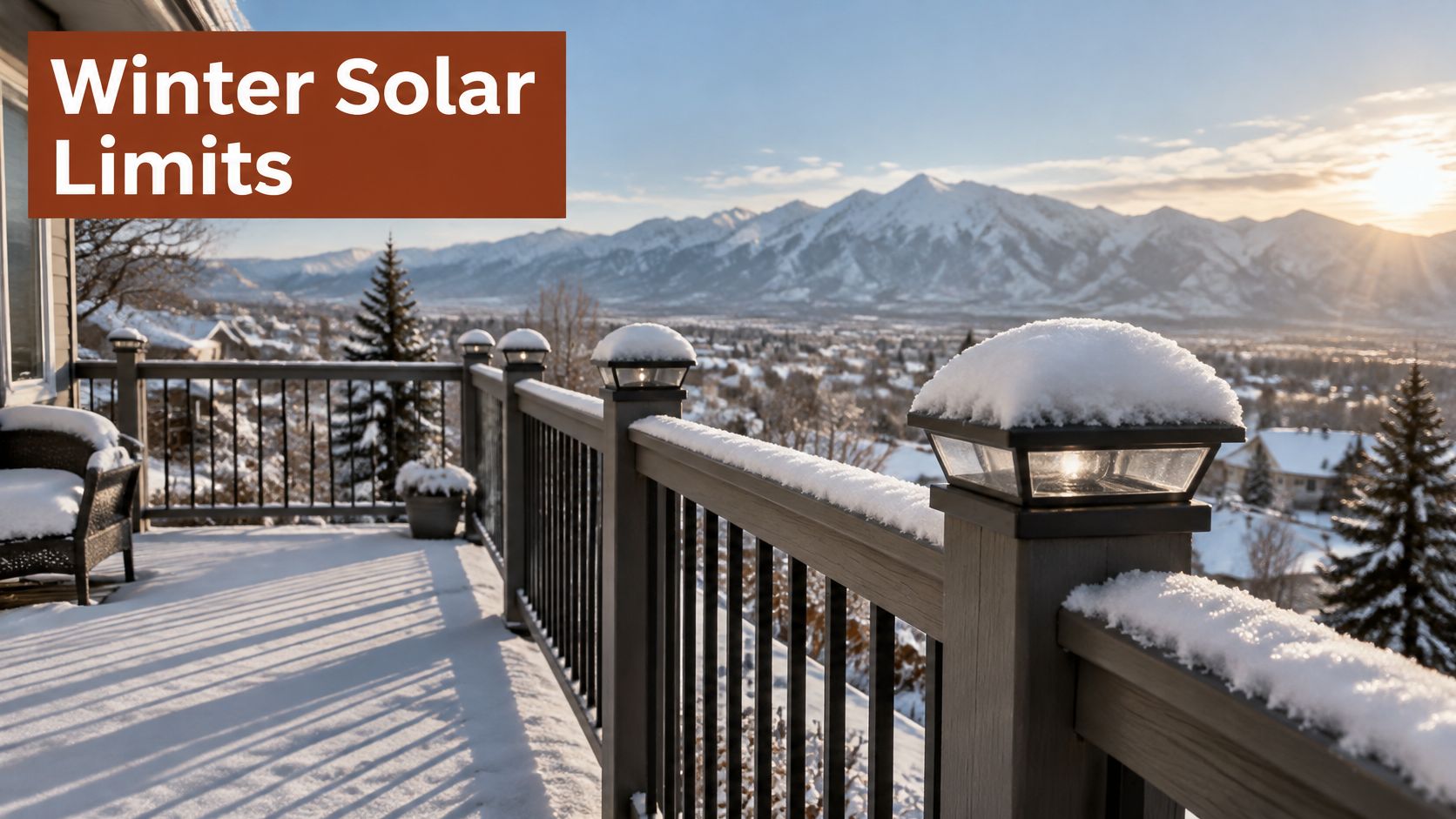
A January evening in Salt Lake County is the test for solar post caps. Days are short, the sun sits low, and snow can sit on a cap for days. A solar cap still needs its module, its battery, and several hours of usable daylight. Snow cover, shade from a house wall or rail, and a panel aimed away from the sun all cut charging and shorten the night.
Three checks before you buy solar
- Southern exposure: Each cap needs an unobstructed view toward the winter sun, not just a bright afternoon in July.
- Snow clearing: If the panel will hold snow, someone has to clear it or runtime drops until it melts.
- Battery access: Confirm in the manufacturer's documents that the battery is user-replaceable. If that line is missing, treat replaceability as unknown.
A summer demo or a long June evening can look fine and still fail in January. Solar can suit decorative, intermittent lighting on open posts. For frequent winter use, steady brightness, and one shared timer, wired low voltage is the more predictable choice.
UL identifies ANSI/CAN/UL 8801 as a safety standard for photovoltaic luminaire systems, including small garden luminaires, while low-voltage systems for outdoor use are evaluated under UL 1838 and UL 2108. Check the edition the manufacturer cites for the exact model, because a general "outdoor rated" line on a listing page is not the same thing.
Utah Deck Supply weighs UV, freeze-thaw, dry summers, snow load, and mountain exposure when matching products to Utah conditions. That same weather list is why a daytime showroom glow tells you little about winter performance.
Run this check on any solar shortlist: after several cloudy days, leave each cap on through a full night and note when it dims or shuts off. Compare that time with the published runtime. If no runtime figure is published, record it as unknown and ask the manufacturer before ordering.
Output, Controls and Wiring Access Compared
Judge brightness in lumens, beam direction, and coverage. The U.S. National Park Service explains that lumens measure LED light output, and that LEDs can produce equivalent brightness with significantly fewer watts than older lighting. Two caps with the same lumen rating can still light a stair differently: a narrow beam concentrates light on the tread below, while a wide spread washes the post and thins out before it reaches the walking surface. The same guidance cautions that raising output does not necessarily make a nighttime area safer and can reduce visibility through glare. Use only the light needed for stairs, edges, or wayfinding.
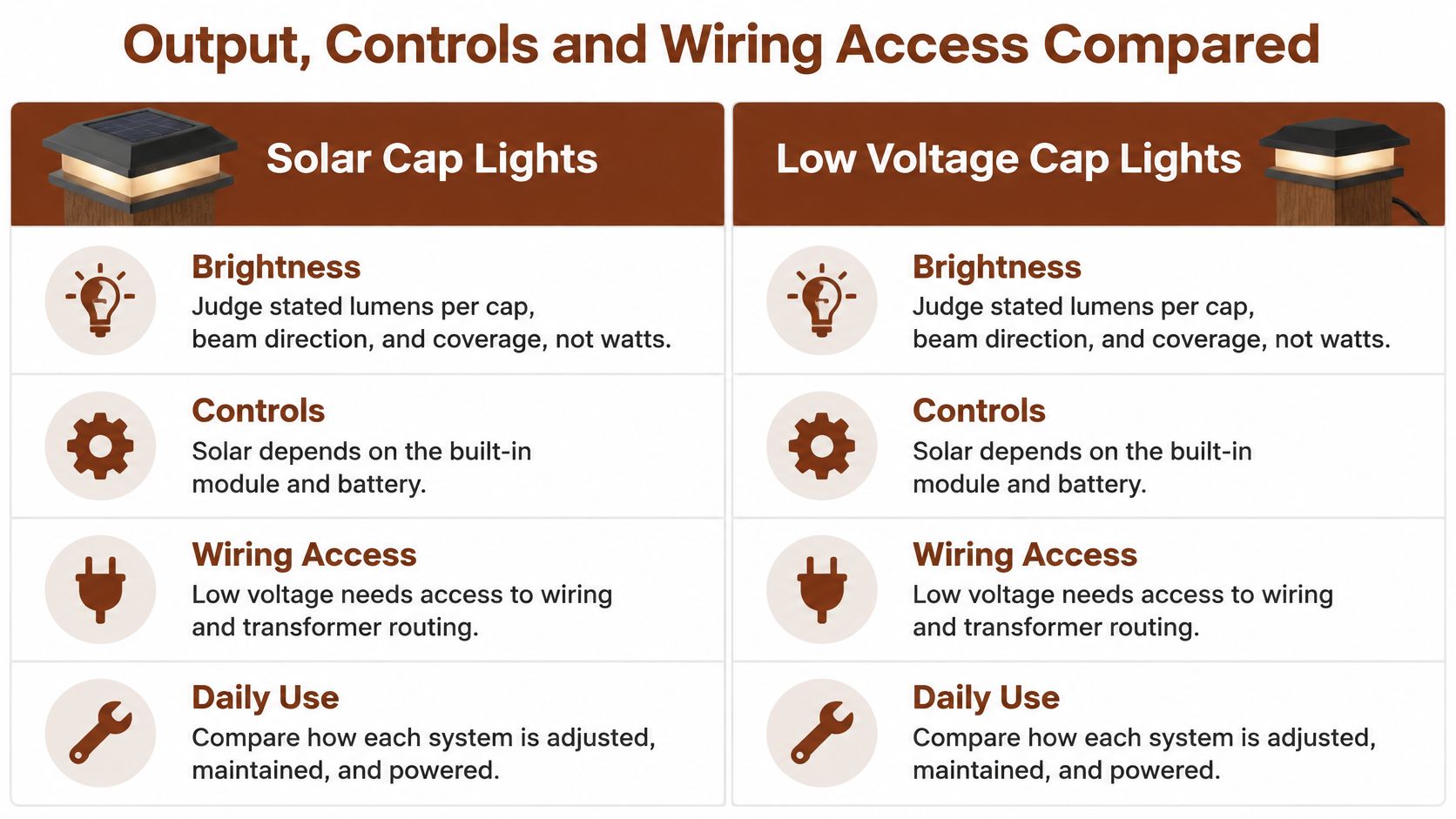
Solar and low-voltage post caps compared in daily use
| Factor | Solar post caps | Low-voltage post caps |
|---|---|---|
| Grid electricity | None; runtime depends on charge and battery | Draws grid power through the transformer; LED draw stays low |
| Schedule control | Each cap often has its own sensor, so shutoff times can differ | One timer or dimmer can run every post |
| Wiring access | Unshaded sun path to each cap | Cable route to each post, most practical before framing |
| Shielding | Check downward aim and diffuser on every cap | Same test; avoid exposed globes visible from the side |
Controls are where mixed decks feel uneven. Solar caps often decide dusk and shutoff on their own sensor and battery state, so one post can quit while the next stays on. On a stair run that matters: a dark cap mid-run leaves a step edge unlit while its neighbors still glow. Low voltage puts every post on one timer or dimmer, so the whole run dims and shuts off together.
Wiring access is the remodel constraint. Low voltage needs a cable to each post, which is hardest once rails and decking are closed, so the power decision belongs in the same conversation as post layout, before anything is ordered. Solar skips that cable and instead needs sun on every cap. You can browse post cap lights while you map which posts have a clear sun path and which have a realistic wire route.
Match the source to the job. A shielded, downward cap on the steadier source suits stairs and entries where light is a nightly task. Solar variation is easier to accept on decorative posts away from the walking route.
Battery Upkeep and Connector Compatibility
Solar caps age at the battery. Check whether it is user-replaceable, the chemistry and size the manufacturer specifies, and any service life printed in the official document. If no interval is published, record it as unknown and ask the manufacturer. Do not invent a replacement year. Clean the panel when the guidance calls for it, especially after storms, and look at cap seals for water entry.
Low-voltage caps age at connections. Check connectors, splices, and the transformer, keep joints dry, and place the transformer only where the manufacturer allows. Match connector type and cable inside one system. Compatibility lists are set by each maker, and mixed parts can make poor contact that shows up as flicker or a dark post.
Replacement availability is a model question, not a category promise. Ask whether that cap, its battery, and its connectors will still be sold before you order posts. The same matching habit matters when crews are picking the right pack for contractors: the pack has to be the one the tool was specified for, not a lookalike.
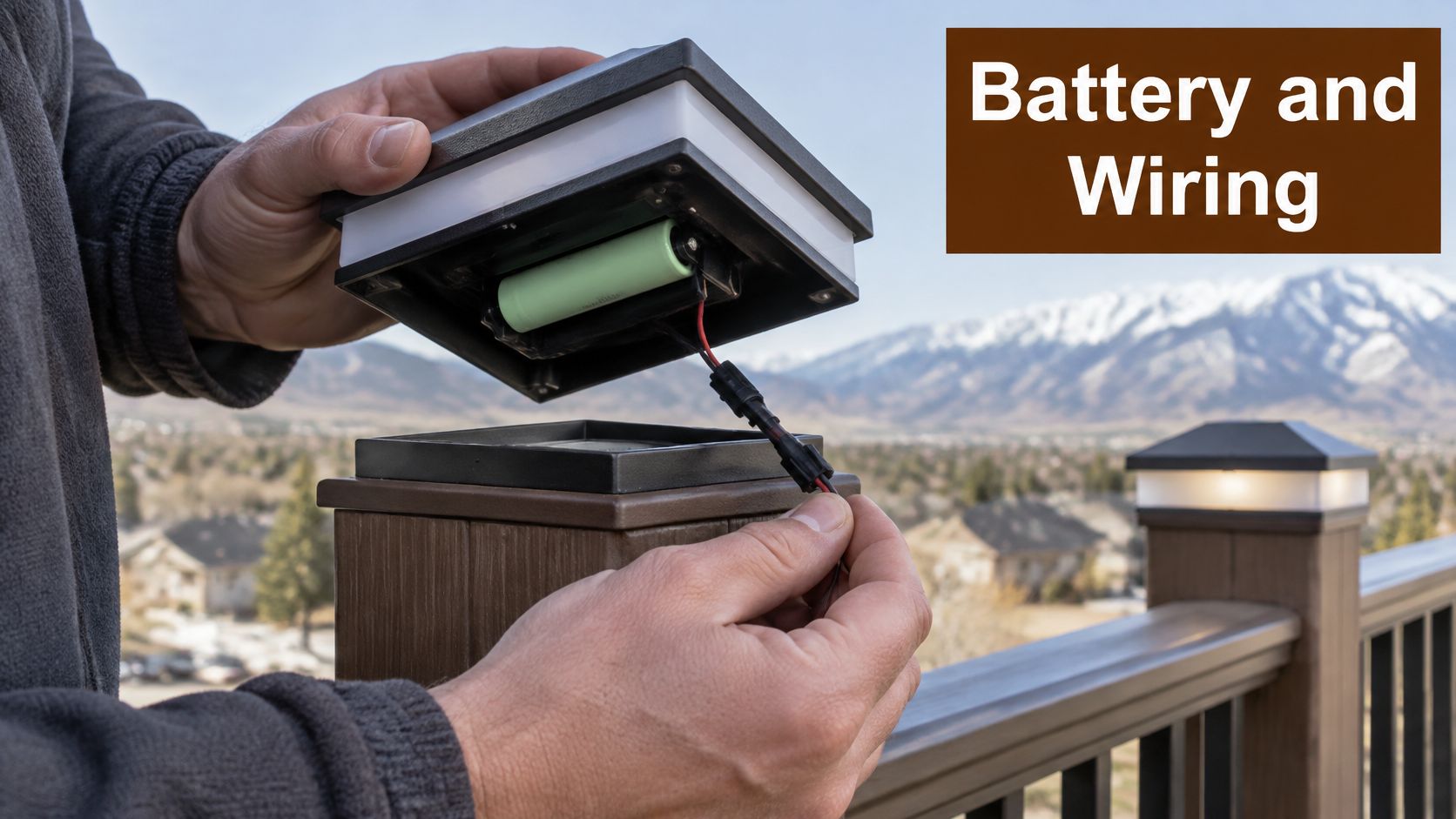
Caps also have to land on the post the rail was built around. Confirm fit against the deck railing systems on the plan, including any sleeve, before the lighting order goes in.
- Record the model and connector type from the spec sheet.
- Check whether the battery is replaceable and where the manufacturer says the part is sourced.
- Confirm those replacement parts are still available before the posts are ordered.
Post Cap Specs to Check Before You Buy
A cap with no documented ingress rating is a reject, whatever the power source. Run this list against the current manufacturer document, and require the rating to cover the complete assembled fixture: housing, seals, and lens, rather than the LED module alone. Solar units pack a panel, battery, controls, and light engine into one weather-exposed piece, so they carry more seals and more places for meltwater to get in through a Utah winter. Low-voltage caps keep the transformer and most cable off the post, but the cap and its connector still need an outdoor rating.
LEDVANCE's explanation of IEC 60529 breaks the code into two digits: the first rates solids and dust on a 0–6 scale, and the second rates water on a 0–9 scale. IP65 means dust-tight protection plus resistance to water jets, a practical floor where caps take rain, irrigation overspray, dust, and snow. IP44 only protects against splashing water, so it suits a sheltered porch post rather than an open stair rail. IP67 adds temporary immersion protection up to 1 meter under the same standard. Whatever the rating, inspect cable entries, battery compartments, connectors, and the cap-to-post seal, because that is where water entry shows up first.
DarkSky recommends careful aiming and shielding so light does not spill past the task. A fully shielded fixture sends light down onto treads and deck boards, which is what makes stair footing readable after dark. No power source fixes an exposed globe.
Post cap specs to confirm before ordering
| Spec to check | What to confirm | Why it matters |
|---|---|---|
| Post size | Cap fits the post and any sleeve or railing system, confirmed with the manufacturer | Wrong fit leaves gaps and loose caps |
| Fixture voltage | 12-volt low voltage or photovoltaic solar, as labeled | Sets the transformer and wiring method |
| Ingress protection | IEC 60529 rating for the complete assembled fixture; IP65 or higher for exposed caps | Shows dust and water protection; IP44 suits sheltered spots only |
| Light output | Lumens per cap, with beam direction and coverage stated | Watts alone do not show brightness |
| Shielding | Downward-aimed diffuser or shield; no exposed globe visible from the side | Limits glare, spill onto neighbors, and upward light |
| Connector type | Manufacturer-specified connector and matching cable | Mismatched parts cause poor contact |
| Transformer capacity | Rated load compared with total wattage of all caps | Overloading is a risk; check the rating |
| Battery | Chemistry, capacity, replaceability, and stated life for solar models | Sets how long the cap runs after dark; unknown values stay unknown |
| Warranty | Terms in the official document for the exact model | Coverage varies; assume none until confirmed |
| Replacement parts | Availability of the model, battery, and connectors after purchase | Avoids mismatched replacements later |
Where a cell is blank on the sheet, mark it unknown. Do not estimate lumens, battery life, or warranty length. Hardware in this lane includes hidden fasteners, deck screws, framing hardware, and post caps and lighting. Compare the sheet to that checklist, then stop if the IP rating, connector, or post fit is missing. Spans, fastener compatibility, and local code still need the manufacturer guide and the authority having jurisdiction.
Hardwired Limits Where an Electrician Takes Over
Low voltage sounds like a weekend project because the caps themselves run at 12 volts. The transformer still ties into household power. That tie-in, any new circuit, outdoor-rated boxes, and burial or conduit work sit under electrical code and often need a permit. Solar caps skip wiring, which is why they fit a remodel with no nearby outlet and no open framing.
Do not treat mains connections, panel work, or added circuits as a DIY step. Hire a licensed electrician, and check permit rules with the city. Nothing here sets Salt Lake County or city requirements.
Plan the cable route before framing or railing goes on, so wire is not fished through finished rails later.
Confirm the transformer location against the manufacturer's weather and mounting guidance. Ask the supplier for listing documentation on the exact low-voltage system, not a generic outdoor-lighting claim. A useful parallel for the household side is checking wiring, panels and outlets before you assume an existing exterior circuit can take a new transformer. That review belongs to a qualified person, not a cap installation sketch.
Common Questions About Deck Post Cap Power
Are solar post cap lights bright enough for stairs?
Read the stated lumens and beam for each cap, then run it through a full night after several cloudy days. A stair light earns its place under the worst charging conditions, not the best. If the sheet does not state lumens or coverage, that value stays unknown until the manufacturer publishes it.
Can low-voltage caps be added to a finished deck?
Only if a cable can reach each post without damaging the rail or structure. Fishing wire through finished rails is the main constraint, and the transformer tie-in then follows the wiring limits covered above. If there is no route, solar on well-exposed decorative posts, or waiting until framing is open, is the cleaner path.
Do solar caps keep working through Utah winters?
They keep working, but judge runtime by a multi-night test through short, cloudy days rather than a sunny afternoon demo. If the model does not publish runtime, leave it unknown.
Can a solar post cap be wired to a timer?
No. A solar cap is a self-contained unit, and its own photocell handles dusk switching, so there is no input for an external timer or switch. Scheduled control lives on the low-voltage side, where a timer or photocell at the transformer sets the run hours for every cap on the line. Confirm the control options on the transformer spec sheet before choosing fixtures, including when you are browsing railing and deck lighting inspiration for layout ideas.
Confirm Your Power Source Before Ordering Posts
The power decision is cheaper to make on paper than on a finished rail. Pick the source from the condition table before posts are ordered, test solar caps after cloudy weather rather than after a sunny afternoon, and confirm IP rating, lumens, and connector type on the current spec sheet. Any cable route needs to exist before posts and rails are set, since pulling wire through a finished rail is the expensive version of this choice. A full deck package compares deck boards, railing, hardware, fascia, stair parts, lighting, and joist protection together, so the lighting choice can sit on the same list as the Utah Deck Supply takeoff help rather than as a last-minute add-on.
Work through five checks:
- Map each post and its winter sun.
- Choose the source from the condition table.
- Match the spec sheet to the checklist.
- Confirm battery replacement or the cable route.
- Send those notes for a materials review.
No price, delivery date, or stock promise attaches to a specific model until it is confirmed. Customers can request a free quote by sending project details through the website: request a deck materials quote, or compare fixtures in person at the West Jordan showroom.
Utah Deck Supply is a West Jordan deck materials supplier and showroom for homeowners, DIY builders, and contractors along the Wasatch Front, with post caps and lighting alongside composite, PVC, and wood decking, railing, and hardware. Bring your post sizes, sun notes, and whether stairs must stay lit every night, and the supply list can be built around that power choice. Visit Utah Deck Supply to compare materials or start a quote.