

Composite decking static electricity has a signature. A dry afternoon, a walk across the boards in soft-soled shoes, a reach for the metal railing, and a snap that stings the fingertips. Nothing looks wrong with the deck. The boards are clean, the railing is tight, and the same surface felt fine in July.
That gap between how a deck looks and how it behaves is the whole story with static. Charge builds on a polymer-rich surface when the air is dry, and it leaks away when moisture returns. Sorting a friction shock from a real electrical problem takes a few minutes, and it's worth doing before anyone prices new boards. Three things settle it: a symptom table, a fixed order for reducing static, and a care record worth keeping.
Why Composite Decking Gives You a Shock
A hypothetical but familiar scene. A homeowner in Sandy opens the slider on a cold January morning, crosses the deck in stocking feet to grab the mail, and gets a sharp zap when the hand lands on the stair railing. Same deck, same railing, no zap in June.
The cause is static electricity, not a live board. Friction between shoes and the decking moves electrons, dry winter air keeps them from bleeding away, and the discharge happens when skin meets something more conductive than the board. Most mild shocks in dry weather are a harmless nuisance.
Shocks that arrive in every season, or that come with tingling near outdoor lights, outlets or wiring, are an electrical question for a qualified electrician rather than a decking question. Utah Deck Supply is a deck materials supplier and showroom in West Jordan, not an electrical or repair service, so the guidance here covers product and care choices rather than a remote diagnosis.
What follows sorts the symptom, then reduces static in an order that won't damage a cap layer. By the end, a reader should have a stop-or-continue answer for their own deck.
Telling a Static Shock Apart From an Electrical Fault
Start with what was noticed, not what is feared. The six patterns below cover nearly every report, and each one has a different next step.
| What You Notice | What It Points To | Next Step |
|---|---|---|
| Brief spark or tingle after walking across boards in dry weather | Static discharge from friction and low humidity | Keep a log and follow the reduction order |
| Shocks cluster near a dryer or heat-pump vent blowing toward the deck | Air discharge path plus dry air | Check vent direction; have a qualified technician adjust equipment |
| Shocks happen in every season and weather | Not a typical static pattern | Call a qualified electrician |
| Tingling near outdoor lights, outlets or wiring | Possible electrical fault | Stop using the area and call a qualified electrician now |
| Burning smell, buzzing or warm fixtures | Possible electrical hazard | Stop using nearby equipment and call a qualified electrician now |
| Shocks persist after dust removal and normal humidity returns | Cause not explained by static alone | Schedule an electrician inspection |
A shock is a discharge, not proof of a wiring fault. Friction transfers electrons between dissimilar materials, charge collects on a surface that doesn't carry it away, and the spark happens when a finger bridges to something more conductive. OSHA's guidance on static electricity describes that buildup at a specific location through friction, including ordinary handling of plastic materials. OSHA also notes that dry wood generally slows or stops electrical flow while water-saturated wood becomes conductive, which is part of why the same deck behaves differently on a parched afternoon and a damp morning.
Composite boards are polymer-rich, so they dissipate charge more like plastic than like wet lumber. That makes shoes, furniture feet, synthetic clothing and surface dryness the first things to inspect, not the load center.
A photo can't clear a circuit. Pictures, video and written descriptions sort symptoms. They don't confirm or rule out an electrical fault, and no supplier of deck boards can make that call from a distance.
Tingling near fixtures, a burning smell or buzzing is a stop signal. The next move is a qualified electrician, and it isn't a question about which brand of decking is installed.
Once a pattern reads as static, the useful moves are mechanical. Understand what makes charge build on that particular deck, confirm which treatments the board maker approves, then work through a fixed reduction order.
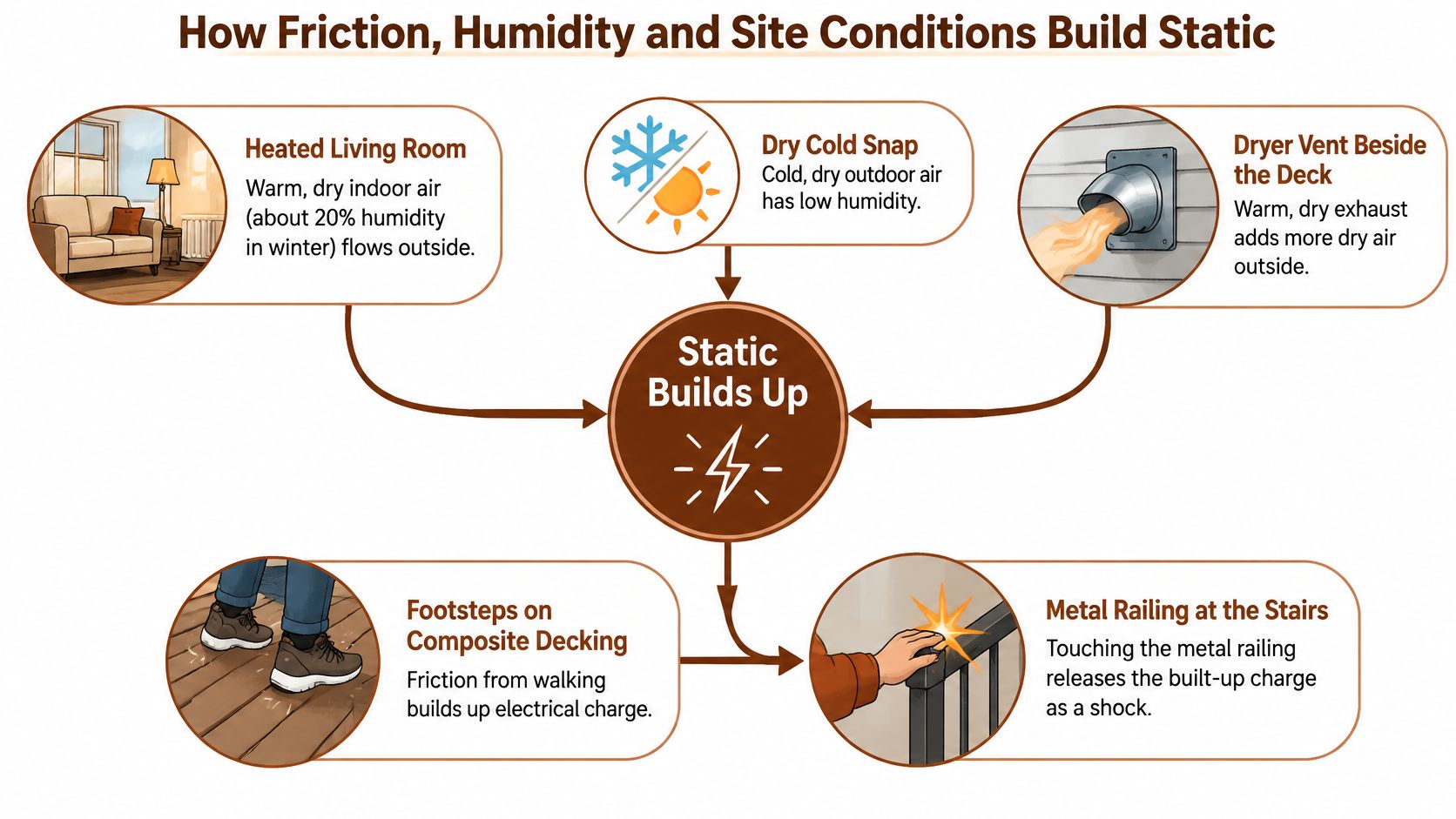
How Friction, Humidity and Site Conditions Build Static
Below 30% relative humidity, polymer particles in a lab study became strongly charged. The same deck can behave differently in February because dry air leaves charge on the surface longer, while moisture can help it dissipate.
A clear, cold week in Herriman can bring several static-building conditions together: a heated home, a dryer vent near the deck, an aluminum stair rail, and capped-composite boards underfoot. The details help explain why a shock may happen in one spot or under particular conditions.
Where the Charge Comes From
Composite decking has a polymer-rich surface that can charge through triboelectric contact. Shoes moving across boards, furniture feet dragging, or a synthetic jacket brushing the railing bring different materials into contact. Electrons move between them, and the surface can hold the resulting charge. It works much like socks sliding across carpet before a touch to a doorknob.
A board's appearance alone does not predict its static behavior. Composition, cap layer, surface texture, footwear and contamination can all affect the amount and direction of charge. A published review of triboelectric charging on polymer surfaces describes relative humidity as one factor in that variability.
Why Dry Air Makes It Worse
Moisture can form a thin, weakly conductive film on a surface, giving charge a path to dissipate. In dry air, that path is reduced, so charge may remain on the deck longer.
The review reports that polymer particles became strongly charged below 30% relative humidity and acquired almost no charge above 80% RH. Those are lab results on polymer particles, not deck tests, but they help explain why the same boards may cause shocks during a dry winter spell and seem quiet in more humid weather.
Practical rule: Check static under the conditions when it occurs. A board that shocks during a dry, cold spell may behave differently on a warm afternoon.
OSHA identifies moisture content and ambient humidity as factors in electrostatic behavior. Its combustible dust guidance discusses grounding or bonding where static accumulation could create an ignition hazard. That industrial guidance is not a reason to attach copper to a residential railing.
The Site Checklist
Check these conditions before spending money on a treatment or replacement boards:
- Heated indoor air. Winter heating can dry indoor air, which may move outdoors when a door opens.
- Dry wind. Wind can reduce surface moisture and leave less of a conductive film.
- Grit on the boards. Dust and other contamination can change how charge forms, so a dusty deck and a clean deck may behave differently.
- Nearby exhaust. A dryer or heat-pump vent can direct warm, dry air toward the walking surface.
- Soles and touchpoints. Footwear and nearby metal surfaces can affect where charge builds and where it discharges.
- Seasonal timing. Shocks that appear only during cold, dry stretches point toward a static pattern.
For humidity figures, consult NOAA climate normals for the nearest station rather than relying on a remembered percentage. Surface temperature and surface charge are separate issues. The deck surface heat guide for homeowners explains how sunlight affects boards underfoot. Utah Deck Supply considers UV, freeze-thaw, dry summers, snow load and mountain exposure when recommending products for Utah conditions.
Brand Care Lookup Worksheet for Approved Treatments
Treatment is the last step in the reduction order, not the first. A spray applied over dusty boards, or applied without a manufacturer's approval, wastes money and puts a finish at risk. Build the lookup before anything touches the surface.
| Board Line | Approved Treatment and Reapplication | What to Record |
|---|---|---|
| Deckorators decking (per published FAQ) | Water first as an immediate charge remover, then a water-based anti-static product where the document lists one; expect repetition after rain or other weather | Date, product, dilution, weather at application |
| Trex composite | Nothing applied until the current Trex care-and-cleaning document is checked; the document edition gets recorded before the first treatment | Document edition, date checked, product, weather |
| TimberTech (AZEK) | The current manual decides; no product goes on the boards until that document names one | Document edition, date checked, product, weather |
| Fiberon | The current manual decides; an unlisted product stays off the deck | Document edition, date checked, product, weather |
| PVC or plastic decking, any maker | The specific board manual decides, since PVC and capped composite don't share approvals by default | Document edition, date checked, product, weather |
A blank cell means the product isn't approved in that file yet, and an unapproved product shouldn't go on the deck. Deckorators' published FAQ shows the shape of a good record: water as the immediate option, a water-based anti-static product as the stronger one, an expectation that treatment may need repeating after weather, and a warning that undiluted concentrate is hazardous even though the diluted solution is considered very safe. The same source notes that wiping a treated surface dry can reduce effectiveness.
No treatment guarantees a result. Warranty terms come from the manual itself, not from a retailer's summary and not from a forum thread. The same discipline applies to winter products, and calcium chloride on composite boards is a separate question with its own brand-by-brand answers.
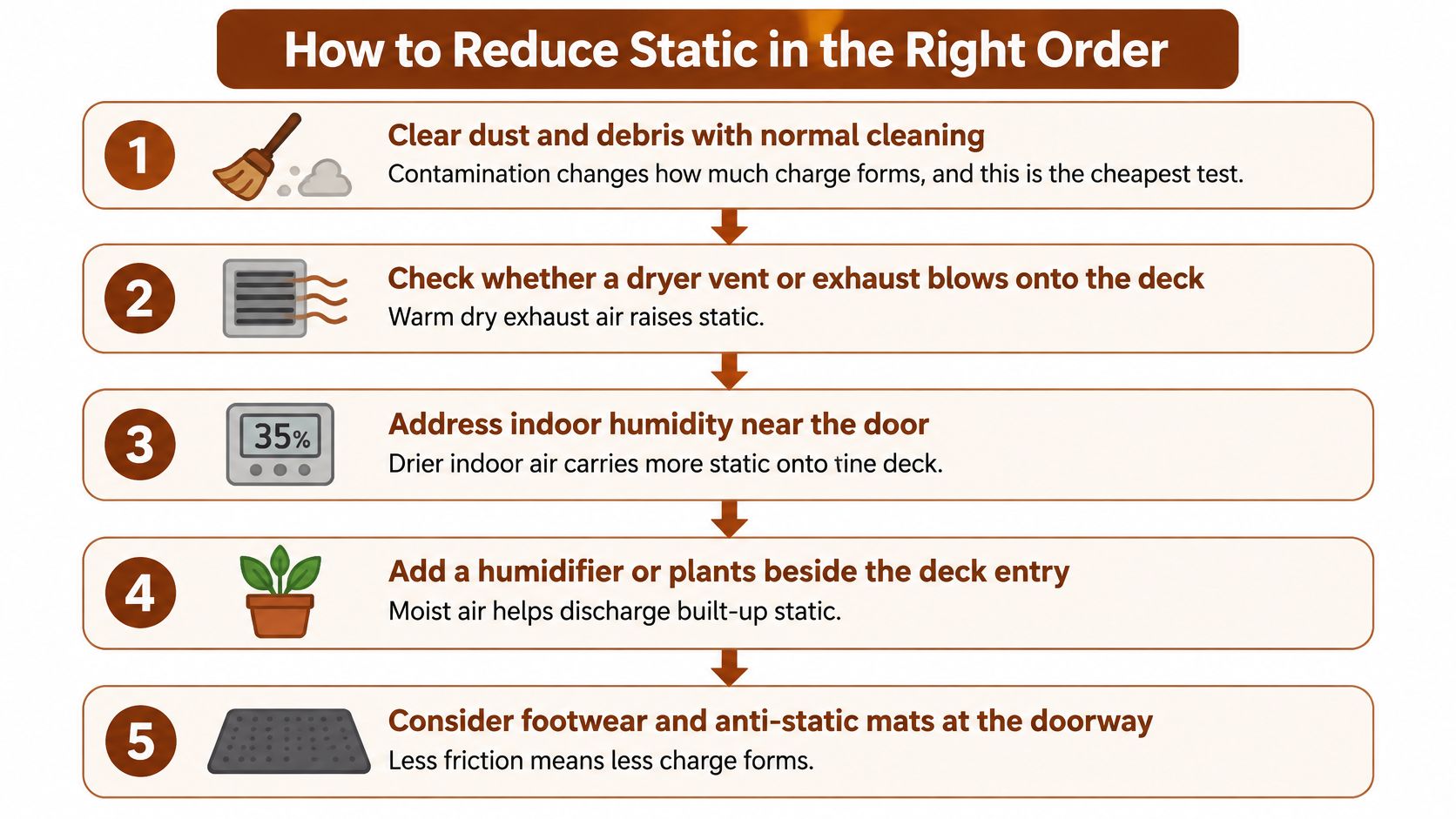
How to Reduce Static in the Right Order
Start with the simplest checks, then move to steps that involve equipment or electrical concerns. Dust and debris can affect the surface, so clean the deck first using the composite deck cleaning tips guide. A clean surface makes it easier to judge whether the shock returns.
- Clean the boards. Remove loose grit and debris with the recommended soap and brush routine.
- Check nearby exhaust. Notice whether a dryer or heat-pump vent blows onto the deck. If it does, ask a qualified technician about redirecting the exhaust.
- Try plain water. On a dry day, lightly dampen a small area and see whether the shock changes. Avoid soaking the boards, and keep the surface clear while it dries to reduce slip risk.
- Use an anti-static treatment only if the current board manual approves it. Follow the product label for dilution, and never mix treatments.
- Record the result. Note the date, weather, treatment, and whether the shock changed. That record helps separate a treatment effect from a change in conditions.
- Stop the DIY sequence if electrical warning signs appear. Tingling at fixtures, warmth, buzzing, or a burning smell calls for a qualified electrician.
Keep grounding rods, copper straps, wiring changes, conductive additives, and saltwater sprays off the list. Do not work inside a panel, outlet, or fixture. Bonding and grounding changes require an electrician who can assess the wiring and applicable code.
A water rinse or approved treatment may provide only temporary relief. Weather can change the result, and static may ease as boards wear in. Compare each new episode with your notes before deciding whether a treatment helped.
Common Questions About Deck Static
Can a Composite Deck Produce a Shock Without a Fault
A brief snap after walking across the boards is more consistent with static than a fault that causes persistent tingling or involves a fixture.
Can Grounding the Deck or Railing Stop the Shocks
If you suspect a grounding issue, note where the shock occurs and whether it happens when touching a fixture, railing, or door hardware. Give those details to a licensed electrician, who can assess the structure and wiring against local code.
Will Switching Brands or Moving to PVC Fix It
Changing boards alone may not resolve the problem because site conditions and footwear also affect static. If you are considering another material for separate design or performance goals, TimberTech decking includes advanced polymer and capped-composite options.
How Long Does a Treatment Last
Treatment life depends on the product and its use conditions. Keep the product name, application date, and manufacturer's reapplication guidance together so you can tell which care instructions apply to your deck.
Log the Pattern Before You Buy New Boards
Before considering replacement boards, record when and where the shock occurs. Note the date, weather, indoor humidity if known, footwear, deck location, vent direction, and whether the discharge happens at the railing, a door, or the boards. A few consistent details can make it easier to spot a pattern.
The Utah Deck Supply deck care tips explain routine care that can help keep the record useful. If you are still choosing boards, compare composite decking options after checking the site conditions. Samples let you see real boards at the West Jordan showroom.
Utah Deck Supply discusses exposure, traffic, pets, shade, snow, view lines, code needs, and maintenance expectations before recommending products. Bring your notes when you request a deck materials quote, or visit the West Jordan showroom to view materials in person. A written pattern gives the conversation a useful starting point.