
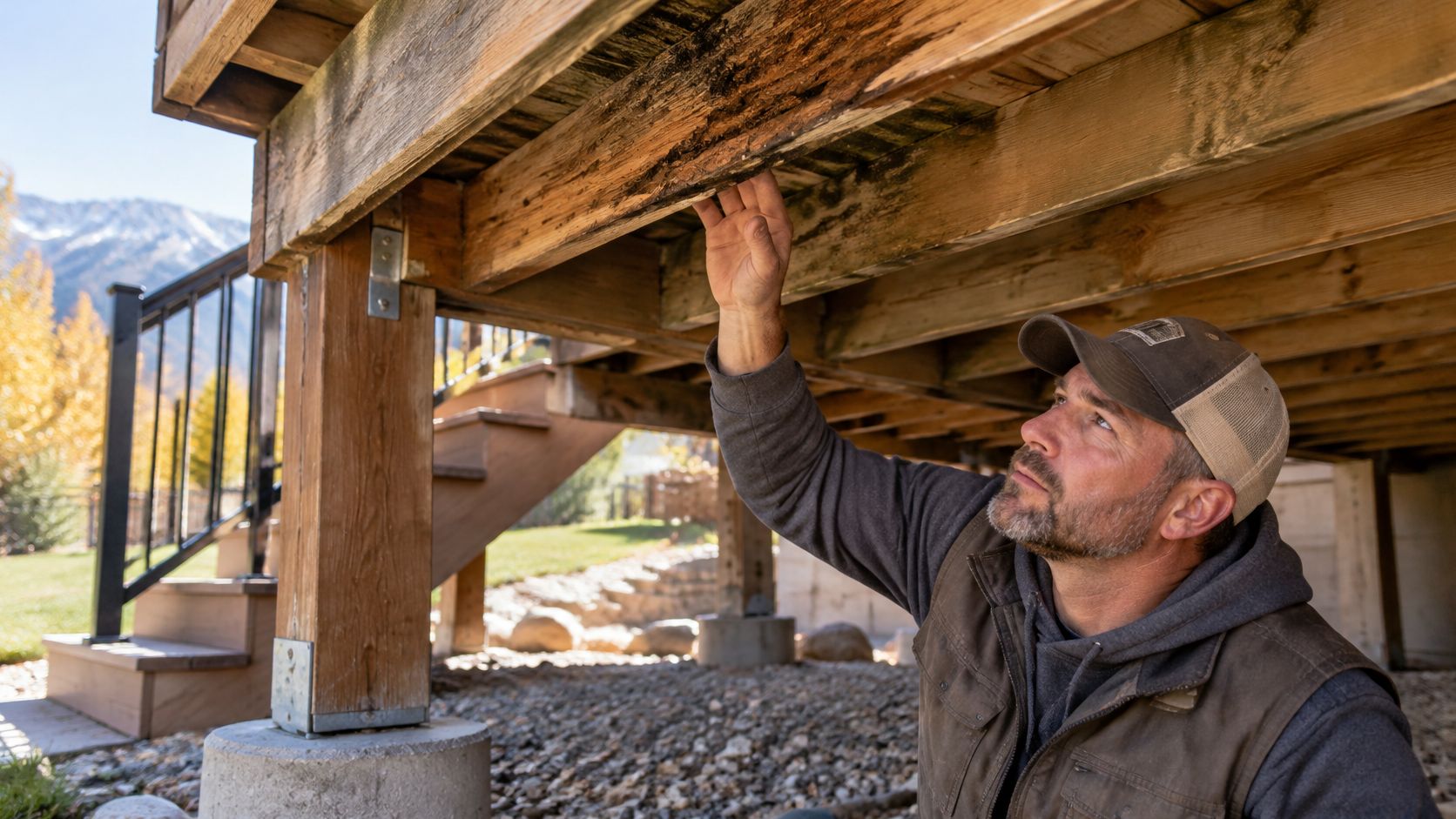
The joists under a deck can be failing while the surface still feels firm underfoot. Decking and bridging share load across neighbouring members, so one soft joist doesn't always announce itself as bounce or sag. That makes when should deck joists be replaced a question about the load path, not about how the deck feels or how many birthdays it's had.
The answer gets decided at the joist ends, the hangers, the ledger and the beam seats. Everything below is written for the homeowner or builder who wants to put new boards on an existing frame and needs to know whether that frame deserves them. Utah Deck Supply is a materials supplier and showroom in West Jordan, so the framing verdict sits with a qualified professional, not with the counter that quotes the boards.
Replace Joists Based on Condition, Not Age
Replace a deck joist when the member, or a connection carrying its load, can't do its job anymore. Age alone isn't the trigger. U.S. Forest Service testing of recovered residential CCA-treated deck components found service lives ranging from 13 to 27 years, with a mean service time of 17.7 years, and service length alone didn't determine chemical retention.
A 10-year-old joist that stays wet can be less reliable than a 20-year-old joist kept dry and properly detailed. Schedule a careful structural inspection as a deck approaches roughly 10 to 15 years, and sooner where joists touch soil, stay wet, lack flashing or joist protection, or show corrosion around fasteners.
Age tells you when to look. Condition tells you what to do.
Take a hypothetical deck built 14 years ago in Sandy. From above it looks tidy. Underneath, the hanger nails beside a planter bed are rusted and the joist ends are dark and soft. The birthday isn't the problem. The water and the connection are.
Three questions carry the rest of this decision: is the member sound, are its connections sound, and is its support verifiable. When a qualified professional does open framing up, blade choice matters on nail-embedded lumber, and this breakdown of a reciprocating saw blade for nail cutting explains why ordinary blades dull fast in that work.
Stop Conditions That Rule Out Reusing a Joist
Judge a joist by location, not by how weathered it looks. Gray surface fibre and mildew are cosmetic. Loss of section at a bearing point is structural. The Forest Service guidance on decayed deck framing puts replacement at the point where decay has reduced the member's structural section, especially at the ledger, joist hanger, beam bearing, post connection, notches or penetrations, because those spots transfer forces and collect moisture even when the middle of the joist looks sound.
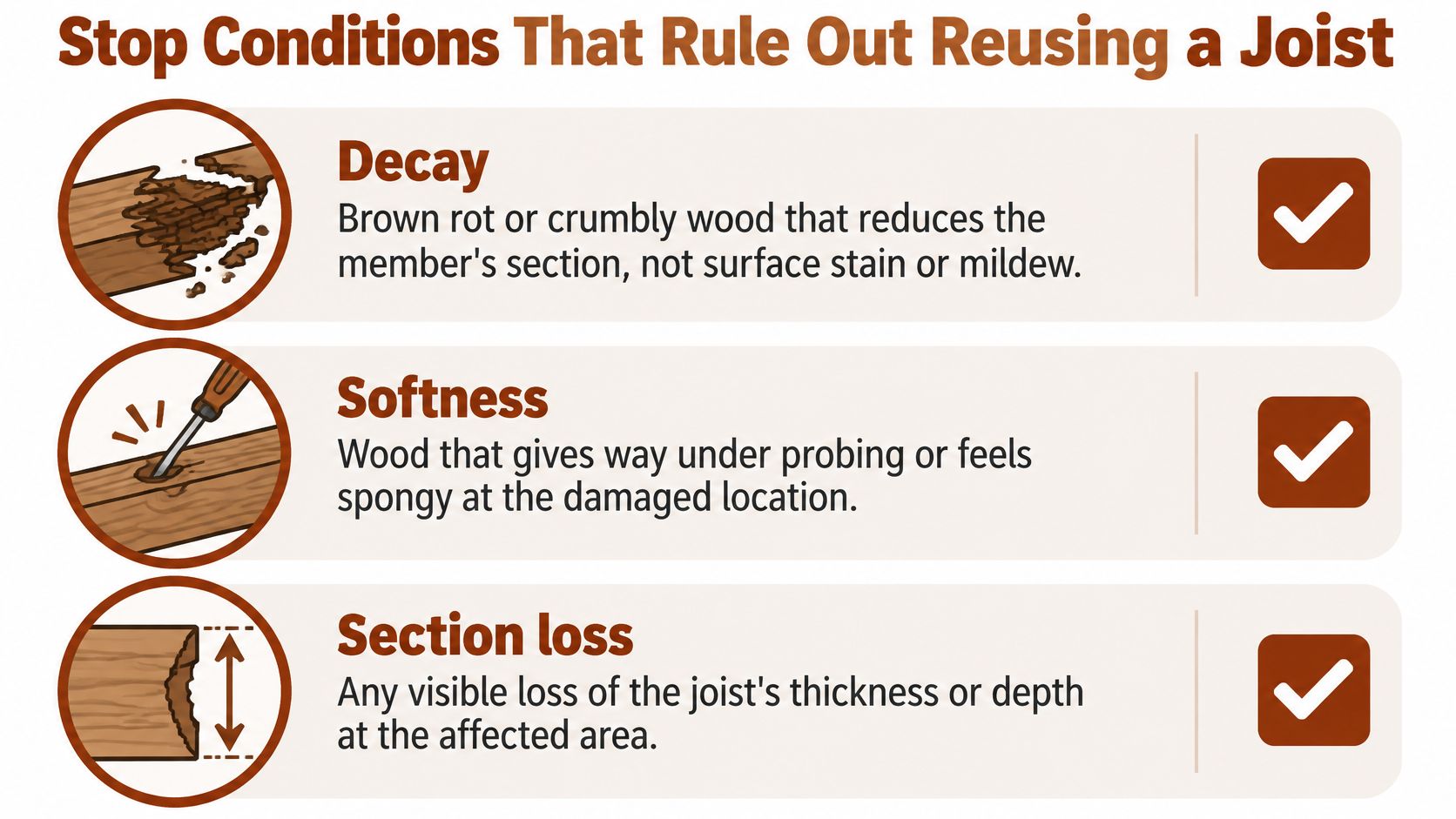
Five conditions that stop reuse
- Decay: brown rot or crumbly wood that thins the member. Rub the suspect area with a screwdriver tip and watch whether cubes of wood break loose rather than long splinters.
- Softness: the Currituck County deck safety inspection guide treats easy penetration of roughly 1/4 to 1/2 inch, a sliver that breaks away without normal splintering, or wood that feels soft and spongy as signs decay may be present.
- Splits: deep checks running through a joist end, a notch or a hanger seat, not the shallow surface checking that sun and dry air produce.
- Connector corrosion: hangers, nails or bolts that are rusted, loose, elongated in their holes or pulled away from the wood.
- Insect activity: exit holes, frass, hollow galleries or termite and carpenter ant evidence in the member or the blocking beside it.
Why the connection decides it
A joist that's soft where it sits in its hanger is a replacement or review candidate, not a sistering job. Adding a new member alongside doesn't restore a connection that can no longer transfer shear, and the old fasteners still carry the load into compromised wood.
Water is the thread running through all five conditions. Failed flashing, poor drainage, debris packed between joists and unprotected joist tops keep the same spots wet season after season. Replacing lumber without correcting the water entry just resets the clock on the same failure.
Don't cut or remove load-bearing members to get a look. Where access is blocked, a qualified professional should decide how to open the framing safely.
Stop rule: one stop condition anywhere in the load path means a qualified review before any replacement boards get ordered.
Ledger, Flatness and Unsupported Spans to Check
Three checks get skipped most often, and none of them are settled by walking the deck.
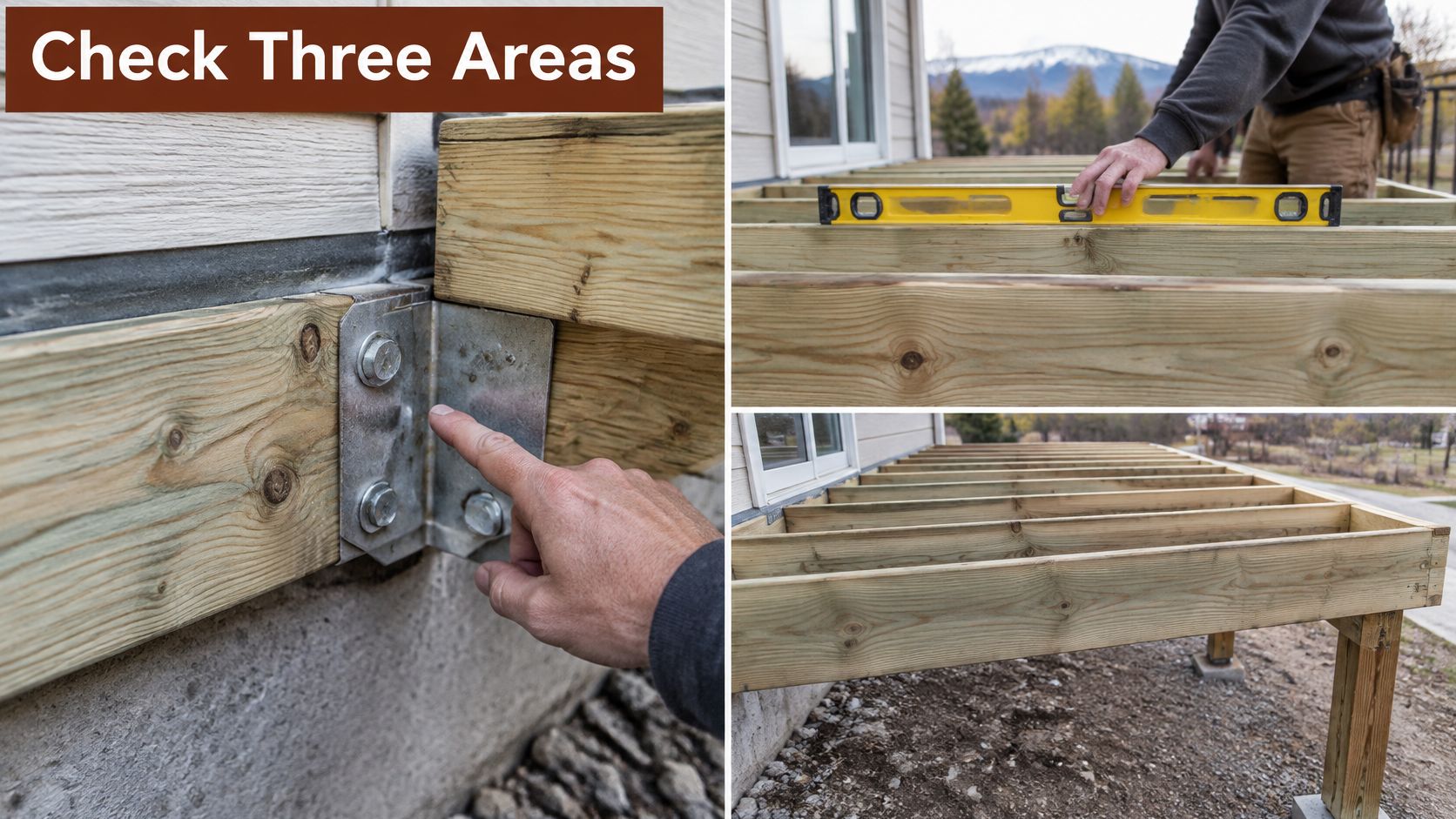
Unknown isn't the same as acceptable
If nobody can confirm how the ledger is attached, what flashing sits behind it, or whether the ledger itself is wet or soft, record that as unknown. Unknown doesn't pass. Fastener type, spacing and pilot hole practice all matter here, and ledger bolt spacing and pilot holes is worth reading before assuming an existing attachment is adequate.
Flatness is the second check. Lay a straightedge or run a string line across the joist tops and write down dips, humps and any bounce the surface doesn't explain. A crowned or crushed joist top won't give new boards a flat bearing plane, and rigid boards telegraph every irregularity.
Third, unsupported spans. If a joist runs past a support nobody can identify, is missing blocking, or has been cut or notched by a previous repair, don't reconstruct the span from memory. Original plans or a qualified reviewer are the only reliable sources.
Why a solid feel proves little
A USDA Forest Service study on vibration-based decay detection found measurements changed as simulated joist decay increased, but warned that decking and bridging can mask decay in only one or two joists. A deck that doesn't bounce isn't evidence of sound framing.
Work in this order:
- Drainage and flashing first, including gutters, planters and low spots that dump water onto framing.
- Joist ends, ledger areas, hangers and beam seats next.
- Remove boards where access is blocked, then probe suspect wood.
- Escalate to a qualified inspector when decay sits near a connection or bearing point.
Replacing a single bad joist depends on whether adjacent joists, blocking, the ledger, beam or rim joist share the same moisture path. Rust staining and recurring wetness point to a system problem, not a one-member problem.
Inspection, Engineering and Material Planning Are Different Jobs
These three jobs get blended together constantly, and blending them is how people end up with a pallet of composite on a frame that needed engineering.
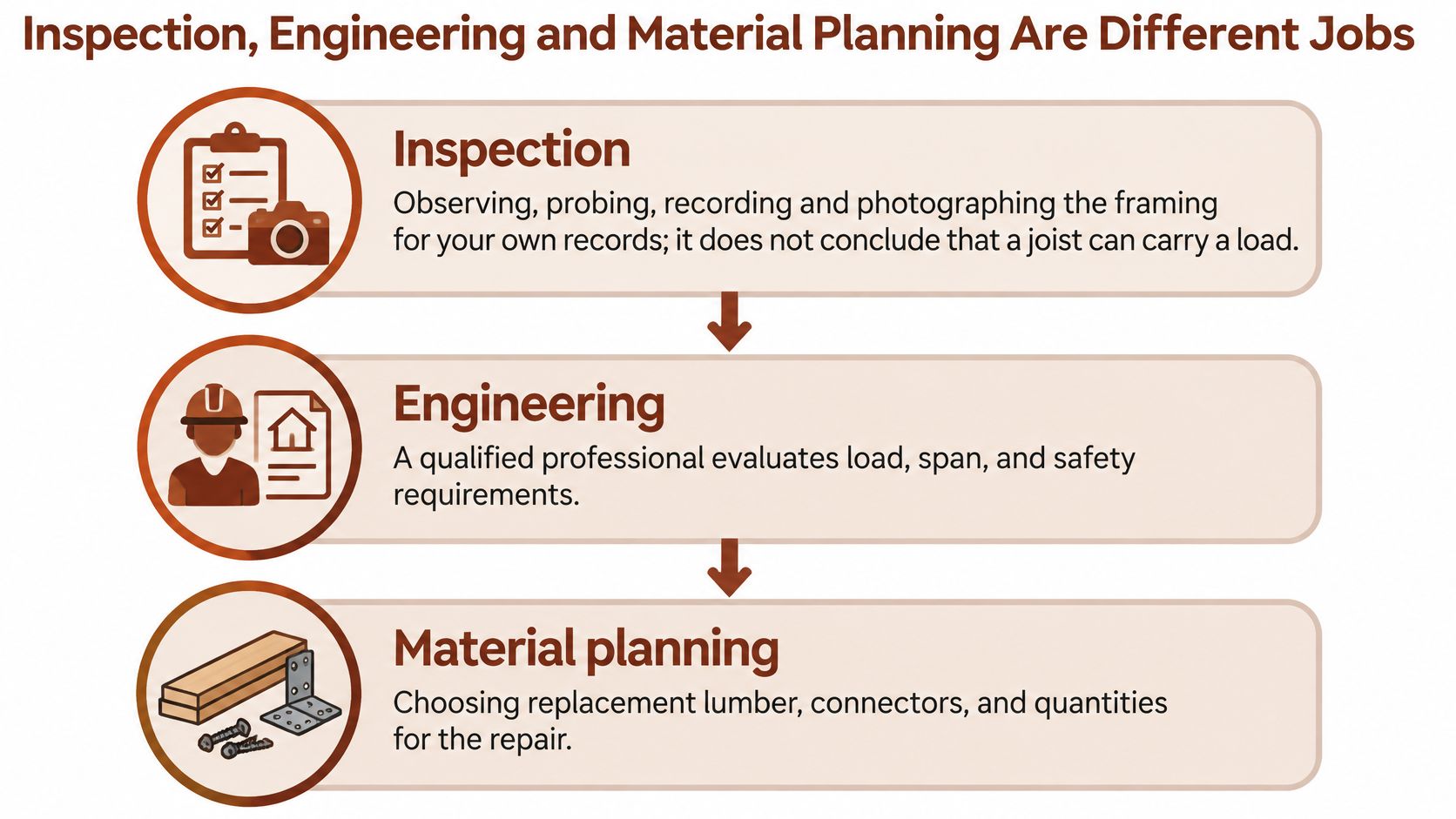
What each job decides
Inspection is observing, probing, recording and photographing framing for your own records. It produces a written account of what was found and where: probe depths, split locations, photos of corroded hangers, measurements of dips along a string line. That record is the input everything else depends on, and it's the part a homeowner can do well with time and a sharp awl.
Engineering or qualified professional review decides load capacity, whether partial or full joist replacement is needed, what size and grade the replacement members require, and which connectors suit the connection. That work follows the applicable building code and recognised deck construction guidance such as the American Wood Council's deck guide. A materials supplier can't settle it, and neither can a photo review from a distance.
Material planning is board profile, the board manufacturer's spacing and support requirements, fastener selection and joist protection. It comes last, after the framing route is clear. Building the hardware list for Utah deck builds is straightforward once someone has confirmed what the frame is allowed to carry.
The order matters. A joist-spacing decision made for a composite board means nothing if the joist underneath it is still unreviewed.
Permits sit with the city or county
Structural work involving joists or girders can require a permit. Check with the applicable Utah city or county building department before removing or replacing framing, since requirements differ between jurisdictions along the Wasatch Front.
Deciding Between Reuse and Professional Review
Use the worksheet as a routing tool, in this order:
- Expose the joist ends, the ledger area and the hangers, removing boards where access is blocked.
- Work through each row in sequence and write down what's observed, with a photo and a location for anything questionable.
- If any row is a yes, stop and arrange a qualified review before ordering boards.
- If every row is a no, move to the compatibility checks.
Framing reuse decision worksheet
| Check | Observation to record | If yes | If no |
|---|---|---|---|
| Decay | Brown, crumbly or fungal wood in any joist | Stop reuse; arrange professional review | Continue to next check |
| Softness | Probe sinks in or wood feels spongy | Stop reuse; arrange professional review | Continue to next check |
| Splits | Deep splits at joist ends, notches or hanger seats | Stop reuse; arrange professional review | Continue to next check |
| Connector corrosion | Rusted, loose or pulled-out hangers, nails or bolts | Stop reuse of that connection; arrange review | Continue to next check |
| Ledger uncertainty | Attachment or flashing behind the ledger cannot be confirmed | Professional review before any reuse | Continue to next check |
| Flatness | Dips, humps or bounce the surface does not explain | Professional review before reuse | Continue to next check |
| Unsupported span | Span or support under a joist cannot be identified | Professional review; do not assume support | Continue to compatibility checks |
A route, not a verdict
A yes never reads as a pass. It routes the project to someone who can evaluate capacity on site. Photos sent remotely can't replace hands and eyes on the framing, because probing and bearing checks require access.
A clean worksheet doesn't mean the framing is structurally sound either. It means nothing on this list blocked the next check. Span suitability, member grade, connector adequacy and the ledger attachment still need answers, and understanding beam spans for Utah decks shows the kind of information a reviewer works from.
Write down what the worksheet can't answer. That list becomes the scope of the professional review, instead of a vague request to "check the deck."
Re-Decking Compatibility Checks for Existing Framing
Once the framing route is clear, the second decision aid asks a narrower question: can this frame accept the specific board being ordered?
Re-decking compatibility checks
| Item | What to confirm | Where to confirm it | Sign it needs review |
|---|---|---|---|
| Joist spacing | Spacing suits the chosen board's maximum allowed span | Board manufacturer installation guide, AWC deck guidance and local code | Spacing wider than the board manufacturer allows, or spacing you cannot measure |
| Blocking | Blocking is present where the board manufacturer requires it | Board manufacturer installation guide and AWC deck guidance | Blocking missing, cut or undersized |
| Connector listing | Hangers and brackets have a listing that matches the joist and fastener | Connector technical documents for the exact product | Connector with no identifiable listing or a mismatched product |
| Fastener compatibility | Screws or nails are rated for the connector and any treated lumber | Connector and fastener manufacturer documents | Fasteners not rated for the connector or treated wood |
| Joist protection | Joist tape is compatible with the board system and framing material | Joist tape manufacturer instructions | Product not permitted for the framing or board system |
The rows that cause the most reuse mistakes
Spacing is the big one. Measure centre to centre in several bays, not once, because older frames often drift. Board profiles differ in stiffness, and a layout that worked under wood boards may sit outside the new board's allowed span. Diagonal layouts need particular care, so check the diagonal decking joist spacing guide before committing to a pattern.
Connector listings get assumed rather than read. A hanger has a specific listing tied to joist size, fastener type and fastener count. Mixing a screw that isn't rated for that connector, or filling holes with the wrong fastener, changes the connection regardless of how tight it feels. Keep the connector documents with the material plan so the board, joist size and fastener match before anything is ordered.
Joist protection is a compatibility decision once the frame is sound. Confirm that the tape or flashing system works with the chosen board and framing material, then plan where it will be installed. Joist tape is for sound or new tops and ends, not a way to carry a failed joist into a new deck.
Customers who share photos and measurements can talk through board profile, hidden fasteners, fascia coverage, joist tape, and whether the frame is ready for new decking. That conversation also covers framing connectors and hardware as part of the material list, especially where replacement joists or new fasteners change the original connection.
Product choice still has to fit the site. Utah Deck Supply talks through exposure, traffic, pets, shade, snow, view lines, code needs and maintenance expectations before recommending products. Those factors shape board and fastener choice. They don't replace a span check or a connector listing.
Numeric values in that table stay with the manufacturer documents and the local building department. A row nobody can confirm stays open.
Common Questions About Joist Replacement
Does joist tape or flashing fix existing rot?
No. Tape and flashing manage water on sound or new framing. They don't restore lost section, and covering decayed wood traps the problem out of sight. Confirm coverage and installation details with the manufacturer's instructions for the specific product.
Are new hangers needed when a joist is replaced?
Check the existing hanger for corrosion, an identifiable listing and fastener compatibility. Use the connector manufacturer's current technical documents for the exact joist size and fastener being installed, and let a qualified professional decide whether reuse is acceptable. A hanger that looks clean can still be the wrong model for the replacement member.
Can a sagging joist be reused?
Not on appearance alone. Sag can come from decay, overload, a missing or shifted support, or a board issue rather than the joist itself. Record the location, the amount of deflection and what sits above it, then arrange review before ordering boards.
Both decision aids stay useful here: the worksheet routes the framing question, and the compatibility checks settle whether the chosen board fits the frame that survives review.
Confirm the Framing Before You Order Boards
Keep the framing review and board selection tied to the same measurements. Record the planned board profile alongside joist spacing, worksheet findings and photos of suspect areas. Confirm compatibility against manufacturer documents and local code before committing to materials.
Check delivered decking separately. Learn to spot bowed or cracked boards so a board defect isn't confused with a framing problem.
For replacement boards on an existing frame, Utah Deck Supply uses your photos and measurements to discuss board profile, hidden fasteners, fascia coverage, joist tape and whether the frame is ready for new decking. Exposure, traffic, pets, shade, snow, view lines, code needs and maintenance expectations also shape product recommendations.
Once the framing review is complete, request a deck materials quote or visit the West Jordan showroom to compare profiles and hardware. The team can build the supply list around the reviewed frame, including decking, railing, screws, framing hardware, hidden fasteners, joist tape and flashing.
Bring the worksheet notes, spacing measurements, suspect-area photos and planned board profile to the review.