A lot of Utah homeowners start in the same place. They step onto an older wood deck, notice the checking, fading, and loose boards, then start searching composite deck boards reviews and get buried in brand claims that all sound similar.
That gets harder along the Wasatch Front. A deck in West Jordan, Sandy, Draper, Herriman, Lehi, Ogden, or Provo has to handle hard summer sun, snow load, and repeated freeze-thaw movement. The wrong board, or the right board on the wrong frame, can turn into an expensive lesson.
Choosing the Right Deck in a World of Options
Most deck failures don't start with the surface color. They start with a bad fit between the product, the frame, and the climate.
A homeowner replacing a worn wood deck in Salt Lake County usually wants the same three things. Less maintenance, a cleaner look, and confidence that the deck will still look good after several Utah winters. Contractors and remodelers usually want one more thing. A product line that gives clear upgrade paths instead of vague marketing tiers.
That's why composite and PVC decking have taken over so many replacement projects. They solve problems that wood keeps bringing back. Splinters, annual staining, surface wear, and weathering don't disappear entirely from the conversation, but they move from constant maintenance to product selection and installation details.
The problem is that generic reviews usually flatten the differences. They treat all capped boards as equal, skip over heat and moisture behavior, and almost never talk about substructure requirements.
The board matters. The cap matters. The frame matters just as much.
This guide stays practical. It looks at the major board families homeowners and builders ask about most often, then filters those options through Utah conditions instead of national talking points. The useful questions are simple:
- Will it handle sun well enough for the exposure level?
- Will the cap protect the core in wet and snowy conditions?
- Will the framing plan match the board layout?
- Will the long-term ownership experience justify the upfront cost?
Those are the questions that decide whether a deck feels like a smart upgrade or a regret.
Why Composite and PVC Decking Excel in Utah
Utah is hard on outdoor materials. High UV exposure, dry heat, snow, and winter moisture all work on a deck at different times of year. Wood can still make sense for some projects, but it asks for ongoing upkeep that many homeowners no longer want.
Composite decking, sometimes called plastic decking in customer searches, usually means a board made from wood fibers and plastic with a protective cap. PVC decking is different. It's a wood-free synthetic board built for stronger moisture resistance.
Why wood loses ground in this climate
Wood looks good when it's new, but Utah weather keeps pressing on it. Summer sun breaks down coatings. Winter moisture gets into openings and exposed cuts. Freeze-thaw movement adds stress over time.
Composite and PVC boards are built to reduce those pressure points. That's a big reason the category keeps expanding. The composite decks and railings market was valued at USD 3.0 billion in 2020 and is projected to reach USD 4.2 billion by 2026, with composites recouping nearly 65% to 70% of their initial cost. The same market report notes that brands like Trex use 95% recycled content (Stratview Research market report).
For homeowners comparing materials, that market growth isn't just industry noise. It reflects a clear buying pattern toward lower-maintenance outdoor structures.
Composite versus PVC in plain terms
A simple way to understand this:
- Composite boards give a familiar, wood-like feel and broad style range.
- PVC boards usually appeal most where moisture resistance and surface performance matter more than matching a traditional lumber feel.
In Utah, both categories can work well. The choice often comes down to exposure, budget, and how sensitive the project is to heat and moisture.
For a broader local overview, Utah Deck Supply's composite decking guide gives a useful Utah-specific starting point.
Bottom line: Homeowners who are tired of staining wood every season usually aren't just buying a new surface. They're buying out of a maintenance cycle.
That's why composite and PVC keep winning deck replacements from Ogden to Provo.
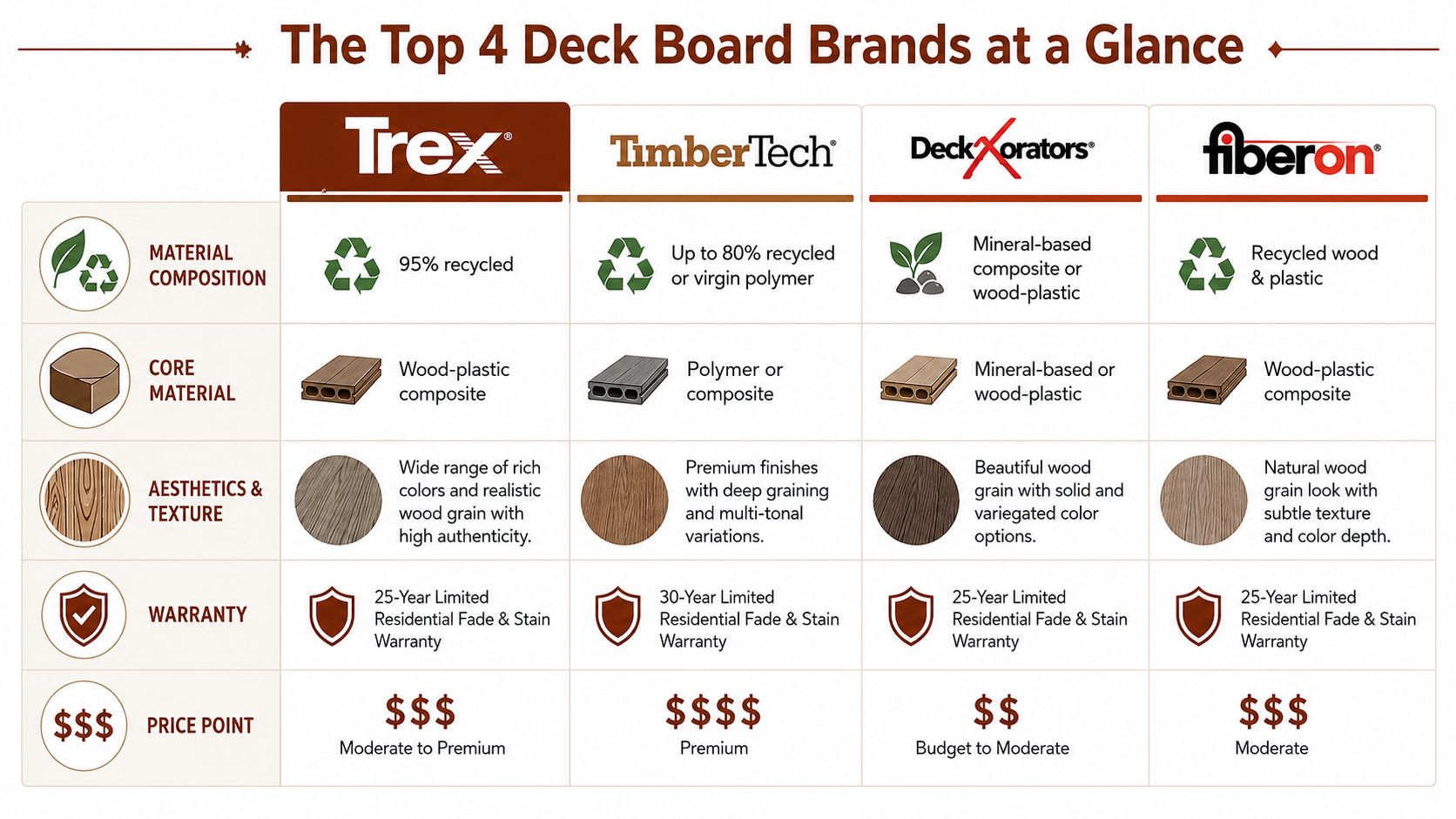
The Top 4 Deck Board Brands at a Glance
Most Utah shoppers narrow the field quickly. The conversation usually lands on four names because they cover the major buying priorities. Broad availability, premium cap technology, design flexibility, and value-focused performance.
The early question isn't which one is "best" in the abstract. It's which one fits the job.
Decking Brand Quick Comparison
| Brand | Best For | Key Feature | Price Point |
|---|---|---|---|
| Trex | Familiar composite options and broad lineup shopping | High recycled-content composite | Mid to premium |
| TimberTech | Premium buyers focused on cap technology and comfort | Strong capping and PVC/composite range | Premium |
| Deckorators | Style-driven projects and distinctive board choices | Design variety and specialty constructions | Mid to premium |
| Fiberon | Value-conscious upgrades with solid appearance options | Balanced cost and performance | Budget to mid |
What separates these brands in real use
Trex usually comes up first because it's the most familiar starting point for many homeowners. It has a straightforward lineup and strong recycled-material positioning.
TimberTech tends to attract buyers who care about premium finish quality, cap construction, and stepping into PVC when the project calls for it. That distinction matters because capping isn't a cosmetic detail. It's one of the main durability questions.
Consumer Reports tested composite decking for three years under severe conditions and confirmed that TimberTech's 4-sided capping significantly prevents mold growth and preserves the board's core compared to uncapped or 2-sided alternatives.
The fast read on each brand
- Trex fits shoppers who want a known composite brand with tiered choices.
- TimberTech fits projects where premium cap design and material options matter most.
- Deckorators fits custom-looking decks that need more visual character.
- Fiberon fits buyers who want a practical middle ground without jumping straight to a top-tier spend.
Some composite deck boards reviews focus too much on color cards. Long-term satisfaction usually comes from how the board handles moisture, framing conditions, and surface wear.
That's why side-by-side samples matter more than online color swatches.
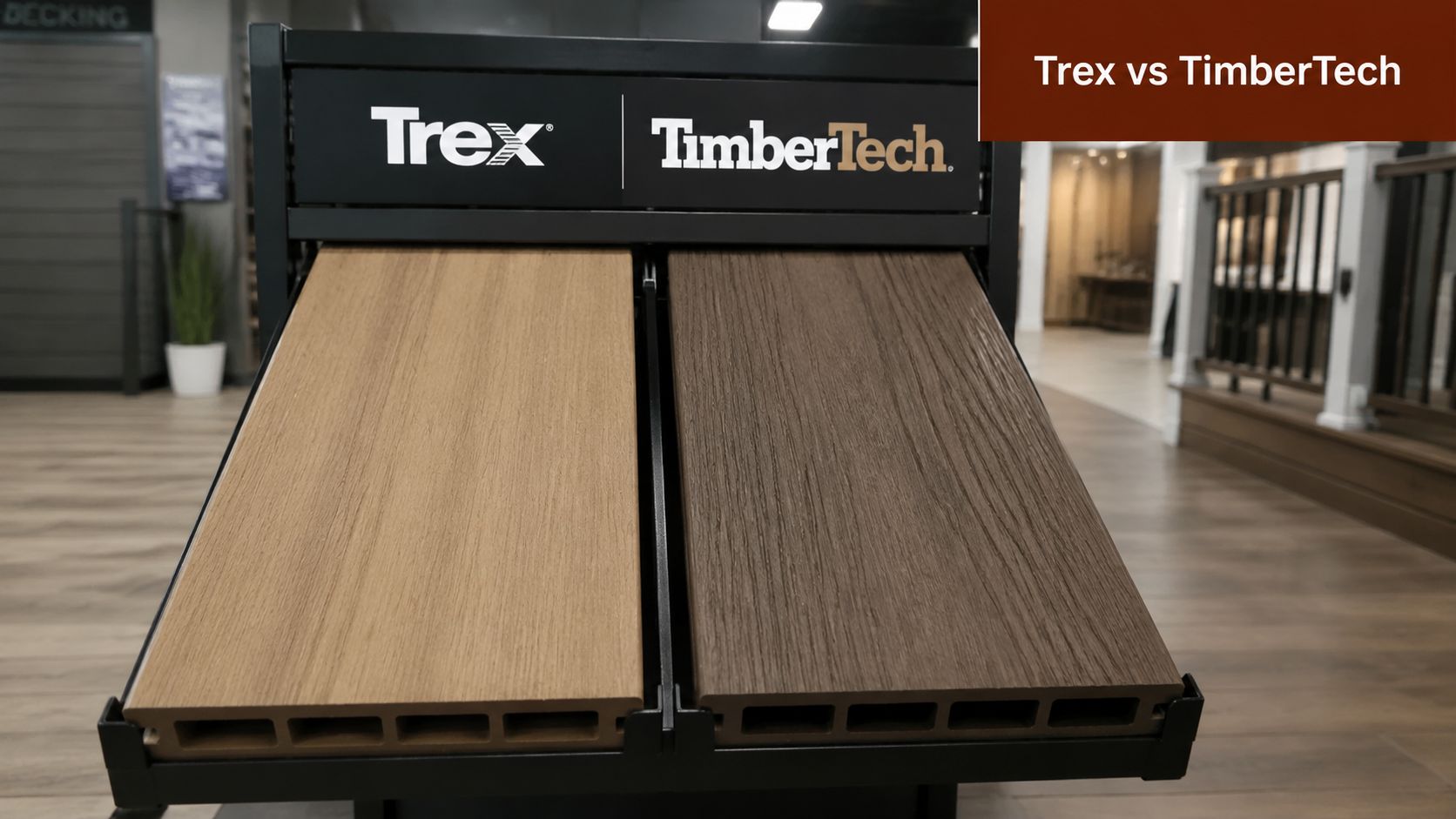
Deep Dive Review Trex vs TimberTech
For many projects, the primary decision is between these two. Both can work well in Utah. They just solve problems differently.
Where Trex makes sense
Trex is a common fit for homeowners who want a recognized composite system with clear steps from entry level to premium. It also appeals to buyers who value recycled-content messaging and a broad installed base.
For local budgeting, Salt Lake City pricing gives a useful reference point. Trex Select costs approximately $7 per square foot, Trex Enhance costs around $8 per square foot, and Trex Transcend costs between $9 and $10 per square foot, excluding labor.
That spread helps frame expectations. Moving up the line usually buys a better appearance package, stronger finish details, and a more premium feel underfoot and at the edge profile.
Where TimberTech stands apart
TimberTech usually wins attention from buyers who are more sensitive to surface quality and cap design. It also gives a cleaner path into PVC, which matters for projects where moisture behavior is a bigger concern.
The biggest practical distinction isn't the brochure language. It's the product architecture. A stronger wrap around the board gives more protection where water, debris, and seasonal exposure keep testing the material.
Practical rule: If the deck has heavy exposure, difficult drainage conditions, or a buyer who wants a more premium finish, TimberTech deserves a closer look.
Heat and comfort in Utah sun
Generic reviews frequently fall short here. They mention heat, then stop there.
Board temperature depends on color, sun exposure, airflow, elevation, and what the board is made from. In Utah conditions, that matters a lot. For homeowners comparing premium options, the more useful takeaway is simple. If heat mitigation is a top concern, TimberTech Vintage is the stronger option. It's the better fit for buyers who want a more comfortable board choice in direct summer sun.
That doesn't make every Trex line hot or unusable. It means this part of the decision should be considered carefully, especially on west-facing decks and open backyards with full afternoon exposure.
The practical buying split
A simple way to sort the choice:
- Choose Trex when the priority is a known composite line with recognizable tiers and a manageable material budget.
- Choose TimberTech when the project leans premium and the buyer cares more about advanced cap construction, refined finish, and better heat-related comfort options.
- Choose lighter colors in either line when the deck gets broad direct sun.
- Check the exact line, not just the brand name. Entry, mid-tier, and premium boards behave differently.
For a more product-focused local comparison, Trex vs TimberTech is a useful next read.
The mistake isn't choosing either brand. The mistake is assuming the logo decides everything and the specific board line doesn't matter.
That's where many composite deck boards reviews fall short.
Deckorators and Fiberon When to Choose Them
Not every project needs to land on the two biggest names. Some decks are better served by choosing for design goals or value balance instead of brand familiarity.
Choose Deckorators if visual distinction matters
Deckorators tends to fit projects where the deck isn't meant to disappear into the backyard. It's a good lane for homeowners and builders who want stronger texture, more unique color variation, or a less common finished look.
That matters on custom homes, feature decks, and remodels where the old structure is being replaced with something that should look intentionally upgraded, not just newer.
A practical fit for Deckorators often looks like this:
- Custom-forward builds where the deck is a visible design element.
- Homeowners bored by flat-looking samples and looking for more character.
- Projects pairing decking with upgraded railing and lighting where finish cohesion matters.
For shoppers who want to browse that category directly, Deckorators composite decking options are worth reviewing.
Choose Fiberon when value discipline matters
Fiberon usually makes more sense when the goal is a smart upgrade with cleaner long-term ownership than wood, but without pushing every material choice to the premium end.
That can be the right answer for a lot of Utah remodels. Backyard decks in established neighborhoods often need to balance boards, railing, hardware, stairs, and framing corrections all in one budget. In that situation, over-spending on the surface can squeeze the parts of the project that matter just as much.
A balanced project usually performs better than a premium board installed on a compromised frame.
A simple decision filter
If the project lead says the deck needs to look different from what everyone else has, Deckorators deserves a look.
If the conversation keeps coming back to practical value, reliable appearance, and keeping the whole materials list under control, Fiberon is often the easier answer.
That's the useful role both brands play. They give buyers real alternatives when the project goals don't line up perfectly with the most common head-to-head comparison.
Planning Your Deck Project Cost Installation and Protection
A Utah deck can look great on install day and still turn into a callback problem two winters later if the planning was loose. I see that most often when the board selection gets handled carefully, but the framing layout, fastening method, and moisture protection get treated like minor details.
Cost means more than board price
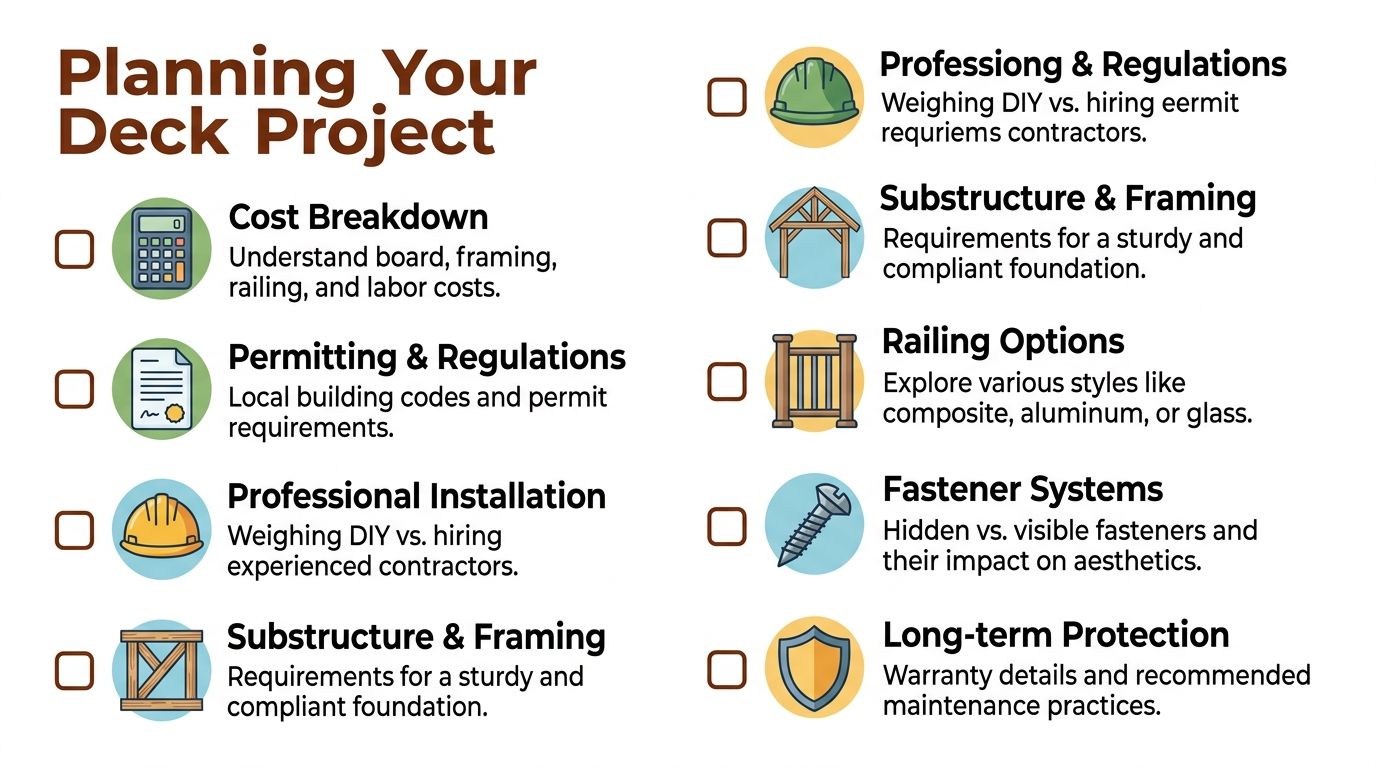
The board budget is only one line on the material list. On many remodels along the Wasatch Front, the main cost shift comes from what the existing frame needs before new decking can go down. Joists may be out of plane, stair framing may not match the new board system, and railing can take a bigger share of the budget than homeowners expect.
Composite usually costs more up front than pressure treated wood. That part is straightforward. The practical question is whether the project budget covers the full assembly, including substructure corrections, fascia, stairs, railing, fasteners, flashing, and the labor needed to install it cleanly.
That is where a lot of online reviews fall short. They compare board prices and skip the parts that decide how the deck performs after a few Utah summers and freeze thaw cycles.
Two planning details generic reviews miss
Joist spacing comes first.
A standard straight lay pattern may work on 16-inch centers, depending on the board and the manufacturer instructions. Diagonal layouts usually require tighter framing. If the design calls for a diagonal pattern, picture-frame border, or stairs with narrower cut pieces, verify the joist layout before materials are ordered. Good-looking patterns can feel soft underfoot if the frame was built for a basic straight run and never adjusted.
I tell contractors and homeowners the same thing in the showroom. Diagonal decking changes the framing math, and Utah's temperature swings make any flex more noticeable over time.
The second detail is protection at the frame level. Composite and PVC boards shed water differently than wood, but they still let moisture sit on top of joists and around fastener penetrations. Snowpack, spring melt, and repeated freeze thaw exposure are hard on unprotected framing. Joist tape, proper flashing, and the right connectors are part of the build, not add-ons at the register. For framing-related planning, this deck framing hardware guide helps organize what needs to be specified before material pickup.
Installation choices affect long-term results
Fastener selection matters more than many reviews admit. Hidden fasteners give a cleaner surface, but they also lock you into the edge profile and installation method the board was designed for. Face fastening can be the better call on stairs, board replacements, or areas where serviceability matters. Neither method is automatically better. The right choice depends on the board line, the frame condition, and how the deck will be used.
Shade planning belongs in this stage too, especially on west-facing backyards in Utah. Surface temperature changes how often the deck gets used in July and August. If overhead coverage is part of the plan, sort that out before the build is finalized so footings, posts, and attachment points are accounted for. For design ideas on that side of the project, this premium deck shade pergola guide is a practical resource.
Utah Deck Supply in West Jordan serves homeowners and contractors across West Jordan, Salt Lake City, South Jordan, Sandy, Draper, Herriman, Lehi, Ogden, Provo, and the broader Wasatch Front. The practical advantage of working through the material list early is simple. The frame, boards, hardware, stairs, and protection details get planned as one system instead of being pieced together later.
Your Next Step See the Materials for Yourself
A board that looks right on a phone screen can disappoint fast once it sits in a Utah backyard. Bright sun pulls different undertones out of the color. Snow glare changes how the finish reads in winter. Surface texture that seems minor online becomes obvious the first time you walk it barefoot in July or shovel it in January.
That is why final board selection should happen in person.
What to check in a showroom
A useful showroom visit is less about picking a favorite color and more about checking whether the board fits the build.
Look at these points side by side:
- Surface feel under hand and foot, especially if the deck will get full afternoon sun.
- Color in natural light, because Utah UV and snow reflection can make some tones look flatter or harsher than expected.
- Edge profile and fastening method, since that affects serviceability, stair detailing, and board replacement later.
- Framing fit, especially if the layout includes diagonals, picture framing, or stairs that may require tighter joist spacing than a straight run.
For local browsing, West Jordan deck supplies is a practical place to start before the order is finalized.
The part many reviews skip
The deck board is only part of the system. If the framing plan is wrong, a good board will still feel springy, hold water where it should not, or create problems at stairs and transitions. Diagonal layouts are a common example. They often need tighter joist spacing than homeowners expect, and generic product reviews usually skip that detail.
Frame protection matters too. Joist tape is required if you want the substructure to last the way the surface is expected to last. A clean composite deck over exposed framing is still a short-lived assembly in freeze-thaw conditions.
Maintenance choices also matter after installation. This guide on how to clean composite decks is worth reviewing because the wrong cleaning method can dull the finish or leave the surface looking uneven.
Bring your short list, compare the actual boards, and verify the framing details before you order. That step clears up more uncertainty than another round of online reviews.
Utah Deck Supply in West Jordan is available for homeowners, contractors, and remodelers who want to sort through samples, fastening options, and material fit before committing to a board line.