
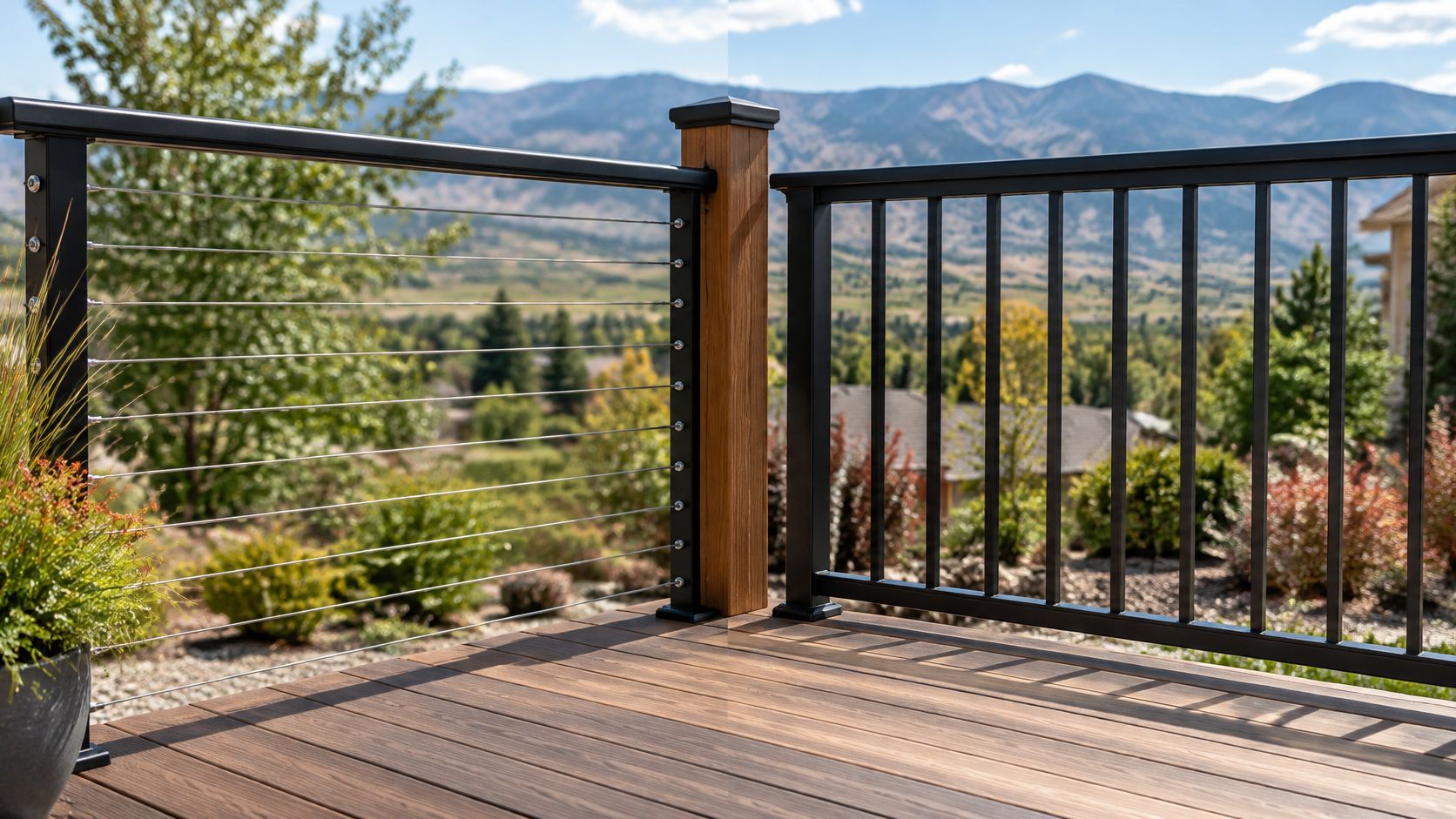
Stronger metal doesn't settle Cable Railing vs Aluminum Railing. A guard passes or fails as a complete documented system, with posts, rails, infill, fasteners and deck attachment working together. That's why a well documented cable system can be more reliable than a picket system with poor spacing or anchorage, and vice versa.
The Short Answer on Cable and Aluminum Infill
For most Utah decks, sightlines and upkeep decide cable versus aluminum picket infill, not which metal sounds stronger. Cable keeps views open across deck railing systems, while pickets create a rigid barrier that's easier to check visually and deflects less under pressure.
This comparison covers infill only. Posts and frames in aluminum, steel or composite are chosen separately, so stainless cable mounted in aluminum posts isn't the same product as an aluminum picket system. Readers researching other transparent barriers can also explore frameless glass balustrades for context on how different infill types affect views.
Utah Deck Supply doesn't sell aluminum decking boards or planks. Aluminum railing is a railing lane it carries, and that's the subject here.
Sightlines and upkeep decide most cable versus picket choices, and the documented system decides compliance.
Infill Decision Matrix and Daily Living
The matrix below rates only the infill. Posts, top rails, brackets and deck attachment must be engineered alongside either choice, because the frame carries the guard loads into the deck structure.
Both infills face the same baseline. Required guards must not let a 4-inch-diameter sphere pass through, and Boise's cable guard policy requires cable calculations for a 50-pound infill load and a deflection criterion of span length divided by 120 (L/120). Tension is what makes cable work, and it's also what makes cable spacing change under pressure.
Cable and picket infill compared on the criteria that decide the purchase
| Criterion | Cable infill | Aluminum picket infill | Choose cable when |
|---|---|---|---|
| Sightlines | Least visual obstruction; wire lines recede from view | More solid visual mass; pickets read as a repeating pattern | Open views matter more than a solid look |
| Cleaning | Each cable, fitting and post face needs wiping; dust and road salt collect at fittings | More faces to wipe, but visual checks and rinsing are straightforward | You accept wiping wire and fittings |
| Corners | Each corner adds a terminal and a tension point that must be documented | Rigid rails and brackets carry the corner; the corner detail is still documented | The system drawings show the corner detail clearly |
| Stairs | Cable follows the rake and must be tensioned along the slope | Pickets are cut to the rake and held in a rigid frame | The stair run is short or the manufacturer documents it |
| Snow and road salt | Tension may shift with temperature swings; check the manual's schedule; fittings need rinsing | Coatings need checks for scrapes; surface oxidation is still possible | You will run seasonal checks |
| Pets and children | Gap set by cable spacing; horizontal cable can act as a climbing aid | Gap set by picket spacing; rigid members hold their spacing | Cable spacing meets the limit in the documentation |
| Tension maintenance | Periodic checks against the manual's schedule | Fasteners and coatings checked; little tension adjustment | You will keep a tension routine |
| Deflection under load | Greater; flexible infill needs deflection checks | Lower; rigid infill behaves more predictably | Long runs are documented for deflection |
| System documentation | Evaluation covers cable, posts and terminals together | Evaluation covers picket or panel infill and the frame | The complete system is documented, not only the infill |
Treat the matrix as a starting point, not a verdict. A deck in Draper with a valley view and no small children points one way. A busy family deck in Herriman with dogs, snow storage and several corners can point the other way, even with the same deck boards.
Utah Deck Supply carries railing from Trex, TimberTech, Fortress, RDI, Cinch, and RailFX, covering cable, aluminum, steel and composite lanes. Manuals and evaluation reports get revised, so confirm the current edition before quoting spacing, loads or maintenance steps from any document. Additional railing guidance for Utah deck projects helps narrow finishes and frame styles before measurements begin.
Pets and Children in Daily Use
The sphere limit is a child safety baseline, not a pet rule. Code doesn't set a pet-specific gap, so owners need to judge the installed opening a dog could push against, not just the unloaded spacing on a drawing. Rigid pickets hold their clear gap. Horizontal cables can spread when pushed and can also act as a climbing aid for young children, which matters even when spacing meets the documented limit.
Consider a hypothetical 30-foot back run with a large dog and two toddlers. The picket layout is checked by measuring clear gaps between members, under the bottom rail and around posts. The cable layout needs those same checks plus cable spacing, post spacing and deflection under pressure, because a dog leaning into the middle of a span tests a different condition than a tape measure on an unloaded cable.
A Simple Showroom Check
Hold a cable sample and a picket sample at deck height and look through each while seated and standing. Cable nearly disappears at some angles and catches light at others. Pickets create a steady rhythm that some owners find calmer and others find busy. That seated view often matters more than a product photo taken above rail height.
Winter, Road Salt and Tension Upkeep on Wasatch Front Decks
On north-facing Wasatch Front decks, snow can linger against lower rails while freeze-thaw cycles and road salt expose the full railing assembly to repeated wetting. The key comparison is how the infill, posts, fittings and mounting connections hold up together, and how readily you can inspect them. Neither cable nor aluminum infill should be treated as corrosion-proof.
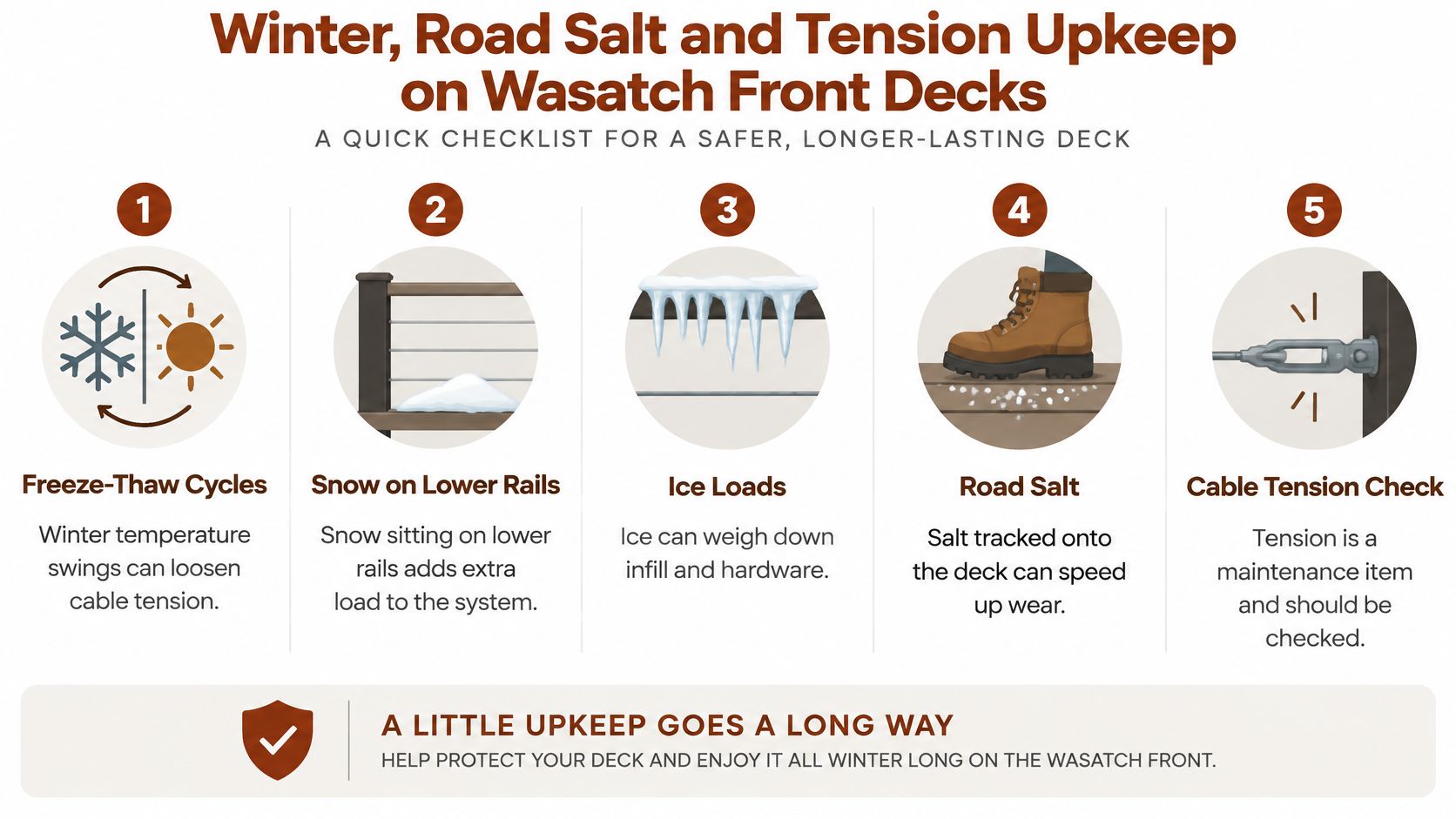
Cable requires periodic tension checks. Follow the manufacturer's schedule, and inspect each run in spring and fall for slack, sag or movement at a fitting. Because tension loads the end posts continuously, a loose post connection may show up as cable movement. Review Utah cable railing code considerations before comparing specific systems.
Aluminum pickets do not need retensioning, but still need inspection. Check fasteners, look for coating scrapes from shovels, and watch for surface oxidation where salt and meltwater collect. If you use an electric snow shovel, compare specs and prices and choose a clearing method that avoids gouging the railing finish or deck boards.
Seasonal Checklist
- Check cable tension after a cold snap. Use the inspection method in the product manual.
- Check posts and fasteners for movement. Movement at a base or bracket can affect how the infill behaves.
- Rinse salt from rails and fittings. Use fresh water and only cleaners allowed by the manual.
- Clear snow from post bases. Snow piles can hold meltwater against connections.
- Look for coating scrapes and corrosion spots. Address visible damage before it spreads.
- Check that meltwater drains away. Slush should not remain trapped at rails, posts or stair transitions.
A north-facing run in Salt Lake County can stay snow-covered for weeks. The practical trade-off is whether you will keep up with the seasonal checks cable requires, or prefer rigid pickets that avoid retensioning but still need cleaning and finish inspections. If cables are slack or posts move, stop using the railing and have a qualified installer or engineer inspect it. Structural repairs are not a DIY task.
Corners, Stairs and Gates Where Infill Gets Harder
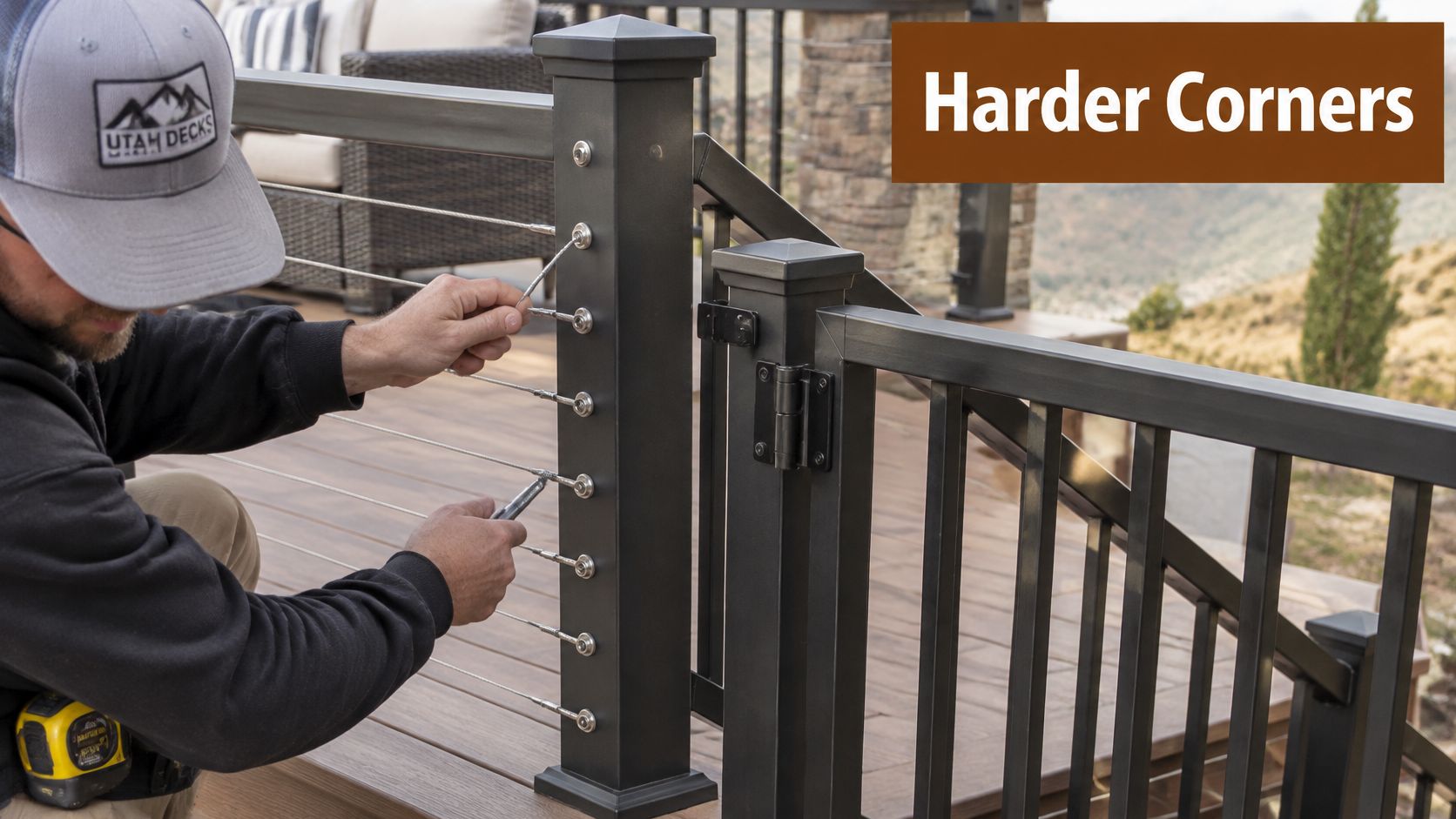
The infill often dictates the details at corners, stairs and gates, even when the posts and frame stay the same. Cable needs clear termination and tension points; aluminum pickets rely on rigid rails, brackets and properly cut panels.
Corners and Stair Transitions
Each cable run must terminate at a corner or end post, adding hardware and a point where tension is managed. Picket rails meet corners with rigid rails and brackets, but the post connection and panel cut still need to match the system documentation. Request the manufacturer's corner detail, not a generic sketch.
On stairs, cable follows the rake, so the sloped run and its transitions need specified terminals and tensioning details. Pickets are cut to the rake within a rigid frame, which can make their spacing easier to verify. Review the details and compare railing options for deck stairs before finalizing the layout.
The structural check applies to both infill types. A 2024 RDI Avalon cable railing code-compliance evaluation specifies a 200-pound concentrated load at the top rail for residential applications and requires infill to resist a 50-pound horizontal load applied over 1 square foot. The practical distinction is deflection: cable is flexible, while aluminum pickets or panels are relatively rigid.
Gates
A cable gate needs a rigid frame and hardware suited to its cable layout to limit racking. A picket gate needs a frame sized for its picket arrangement. For either type, show the hinge-side post, latch clearance and swing direction on the drawing.
Consider a deck with a 90-degree corner, a four-step stair and a gate at the top. The corner requires cable terminals or a documented picket connection; the stairs need a raked transition, and the gate needs a suitable frame and hinge-post detail. Confirm these conditions in the system documents, then check the adopted code edition and amendments with the local building department.
Pre-Quote Checklist for Runs, Stairs and Mounting Surfaces
Bring measurements that let a supplier price the complete system, not just linear feet of infill. To prepare a quote, customers can bring dimensions or a rough sketch, photos of access, stairs, railing, and height, and choose two or three board lines to compare. For railing, narrow the same visit to two or three documented systems.
Pre-quote checklist for railing measurements and documents
| Item | Record before you quote | Why it changes the quote |
|---|---|---|
| Run lengths | Length of each straight run and post locations | Longer runs raise deflection and post-load questions |
| Corners | Number of corners, their angles, and the corner post type | Each corner changes terminals, brackets, or panel cuts |
| Stairs | Rise, run, number of stair sections, and landings | Stair rake changes infill length and transition details |
| Gates | Gate width, swing side, and hinge post location | The gate frame must match the infill system |
| Deck height | Height above grade at each run | Guard requirements depend on height; confirm with your building department |
| Mounting surface | Rim joist, blocking, post base, or concrete, plus access photos | Post attachment must reach structural framing; confirm with the manufacturer |
| Infill spacing | Target opening and cable or picket spacing | The installed opening must meet the limit in your permit documents |
| Documentation | Installation manual, evaluation report, and code edition | Confirms the complete system is documented for your jurisdiction |
Mounting Surface and Documents
Post attachment must reach structural framing. Record whether each post lands on a rim joist, added blocking or a concrete base, and photograph access from below where that's possible. Confirm the attachment with the manufacturer and a qualified person. This checklist doesn't replace engineering, and it shouldn't be used to justify structural changes.
Request the current installation manual and evaluation report for the complete system. Note the code edition the report cites, then confirm which edition and local amendments apply in the project city. The Utah Deck Supply spacing guide can help organize post locations before that conversation.
Record deck height at each run because height affects whether a guard is required and which details the permit may review. A quote is only as complete as its measurements. Missing a gate, landing or stair transition can change posts, hardware and price later.
Common Questions About Cable and Aluminum Infill
Do Cable Railings Need Tension Checks?
Cable railing needs periodic tension checks. Follow the manufacturer's manual for inspection timing and temperature guidance. If cables look slack, fittings have moved, or posts feel loose, have a qualified person inspect the system before adjusting hardware.
Is Aluminum Railing Automatically Code Compliant?
Code compliance depends on the documented railing system, including post spacing, attachment, infill spacing, and the code edition adopted locally. An aluminum label alone does not establish that a particular layout complies.
Can a Child or Pet Fit Through Either Infill?
Check the finished openings in their installed condition, including gaps beneath rails and beside posts. A child-safety assessment and a pet owner's practical assessment may differ, especially if a dog can push flexible cable outward.
Does Utah Deck Supply Install Railing?
Utah Deck Supply supplies railing materials and offers a free quote for decking, railing, hardware, and outdoor structures. For a specific project, follow the manufacturer's manual and confirm applicable requirements with the local building department.
Choose the Infill for Your Deck and Request a Quote
Choose cable for view-facing runs where open sightlines matter and you are prepared to follow the manufacturer's tension and inspection instructions. Choose aluminum pickets when you prefer a rigid infill and a simpler visual check, especially around corners, stairs, and gates.
A mixed layout can suit a deck with different needs on different sides. For example, cable can keep a view side open while pickets provide a consistent infill on the stairs. Confirm that each section is documented as part of the complete railing system.
Railing can be a major cost swing: aluminum, steel, composite, cable, glass, vinyl, and gates all price differently. Compare complete systems, not just the infill. For a broader enclosure project, deck screening budgets in Northeast Georgia offer a general budgeting reference, but those figures do not transfer directly to Utah pricing.
Utah Deck Supply offers a free quote for decking, railing, hardware, and outdoor structures. Bring run lengths, photos of corners and stairs, mounting details, and two or three railing systems to compare. The showroom has real samples of railing finishes, hardware, and trim to view together, helping you plan a materials list around the deck's actual layout.