
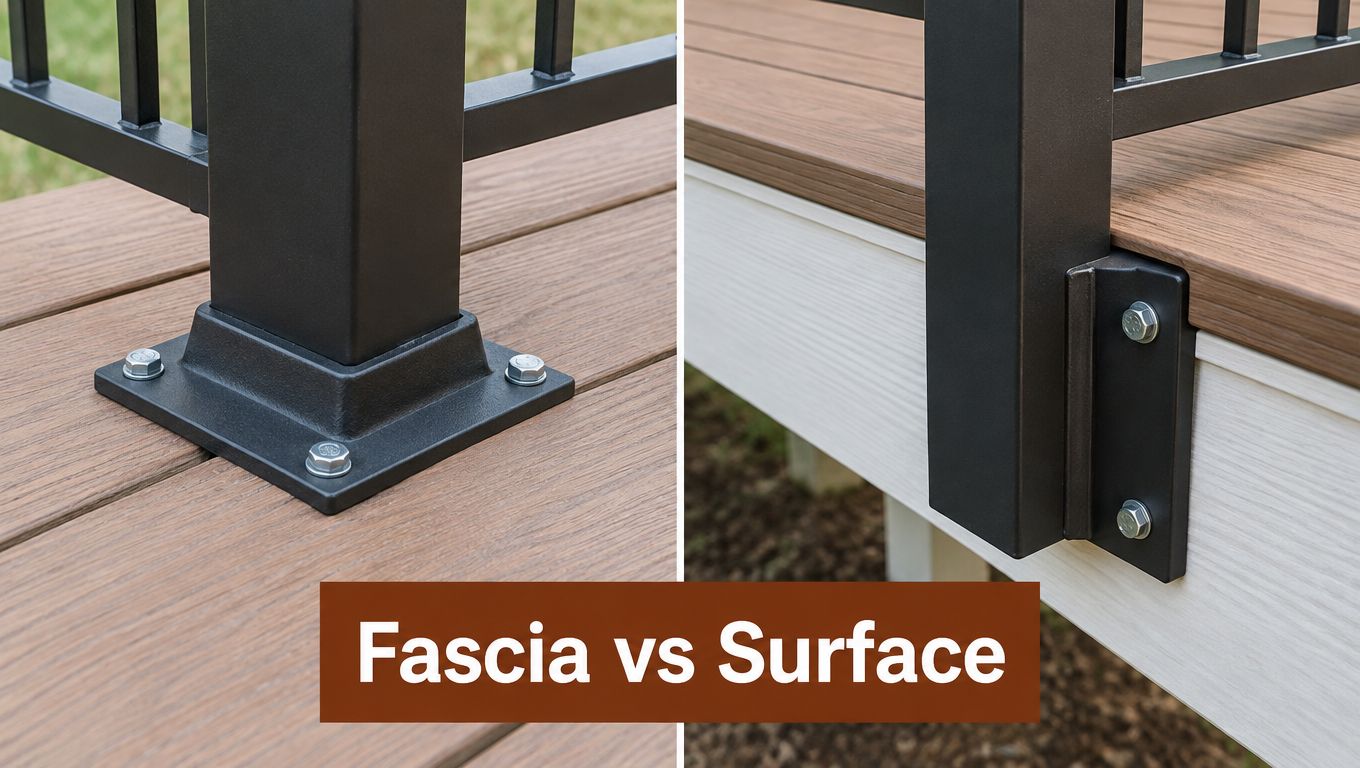
The railing order is usually where a deck project stops being theoretical. The boards are picked, the color is set, and then the question lands on the table, fascia mount or surface mount. That choice is not about which bracket looks cleaner. It is about where the load goes, what is behind the edge, and whether the deck frame can take the connection.
| Criterion | Fascia Mount | Surface Mount |
|---|---|---|
| Usable deck area | Keeps the walking surface clearer | Uses part of the deck surface for the base plate |
| Edge framing | Needs strong rim framing or blocking at the outside edge | Needs joists or blocking directly under the post |
| Waterproofing | Keeps fasteners off the walking surface, but edge sealing still matters | Penetrates the top surface, so flashing and sealing are critical |
| Trim conflicts | Can clash with fascia build-up, picture-frame edges, and stair detailing | Can interfere with board ends and visible base plates |
| Post geometry | Sits outside the framing line | Sits on top of the deck plane |
| Stair transitions | Often helps preserve tread width at the edge | Can crowd stair landings and top-post locations |
| Inspection access | Side access can be harder after finish work | Easier to inspect and service from above |
| System compatibility | Must match a tested side-mount assembly | Must match a tested top-mount assembly |
Utah homeowners and contractors who get this right early avoid the usual mess of rework, extra blocking, and bracket swaps after the decking is already down. Utah Deck Supply in West Jordan handles railing materials, hardware, and takeoff planning for projects across the Wasatch Front, so this is the exact kind of decision that should happen before the order goes out.
How Each Railing Mount Connects to Your Deck
The deck boards are about to go on, the railing line is marked, and somebody has to decide whether the posts live on top of the deck or out on the edge. That's the split. The mounting style only matters because it changes how the post reaches the structure below.
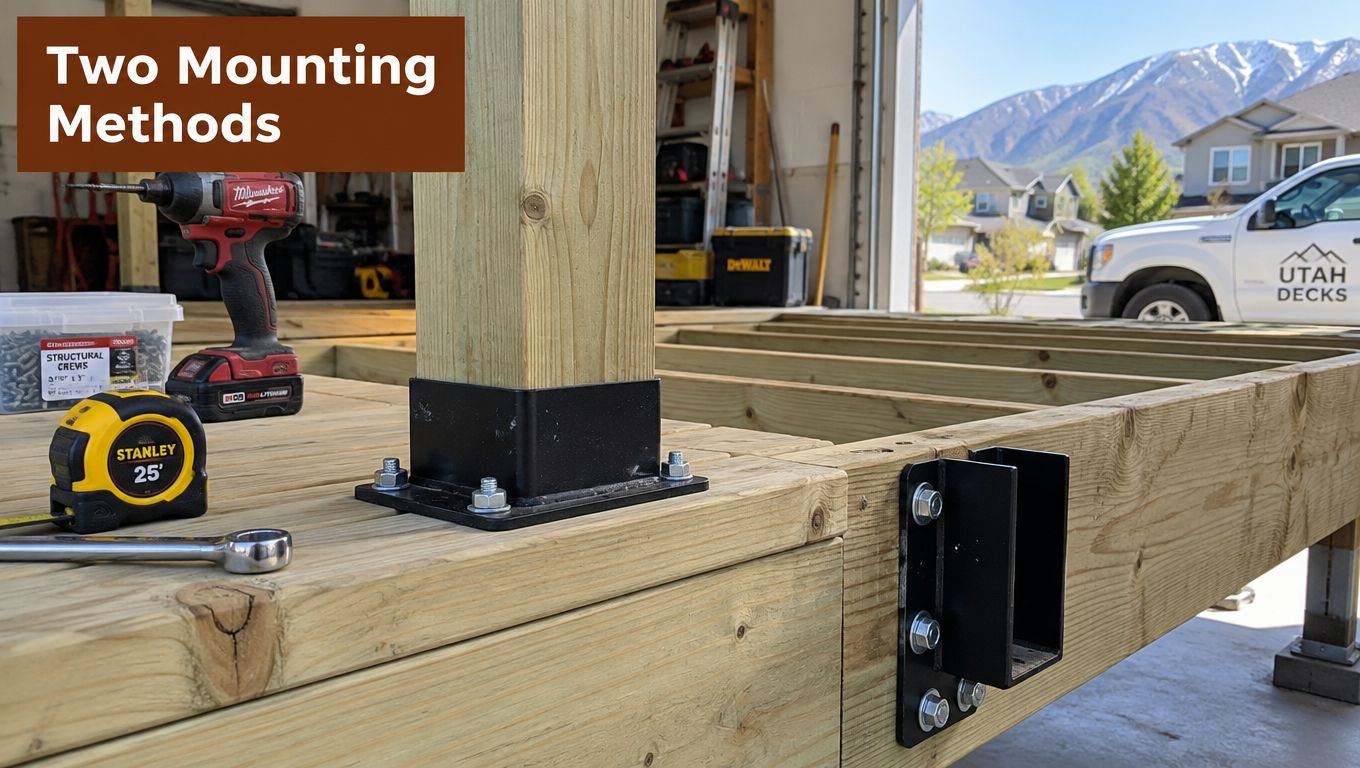
Surface mount means the post bears on the deck plane
A surface-mounted post sits on top of the deck and transfers force straight down through a base plate into framing below. That can work well when the post lands over joists or solid blocking and the installer can fasten into real structure, not just decking. It also means the post base occupies part of the walking surface, so the layout has to be clean before the boards are cut.
Fascia mount means the post bears from the outside face
A fascia-mounted post sits on the vertical outside face of the rim joist, so the railing stays outside the walking surface. That preserves deck width, but the load now pushes outside the framing line, which is why the connection has to be more deliberate. A decorative fascia board alone is just trim, not structure.
Practical rule: if the fastener doesn't reach framing, blocking, or another verified structural member, the bracket location doesn't matter.
For readers comparing styles visually, the article on fascia mount deck railing pros and cons gives a helpful overview of the trade-offs, but the deciding factor on a real deck is still the frame behind the bracket. For a side-mounted option in the Utah Deck Supply railing lineup, the Cinch fascia mount post is the kind of product that only makes sense when the edge framing is already right.
Load Paths and What the Code Actually Demands
The code question is simple. The post has to carry a real guard load into the deck structure, and the structure has to resist it without rotation or pullout. Under the 2021 IRC guard provisions summarized in the sources, guards must resist a single concentrated 200-pound load at the top rail, and infill components must also resist a 50-pound horizontal load over a 1-square-foot area (Nails and Numbers).
Why the path matters more than the look
A surface mount sends that load through the base plate into joists or blocking below. A fascia mount sends the load through side fasteners into the rim assembly, which means the rim joist, blocking, and fastener schedule all become part of the design. That's why a fascia bracket can't be treated like a decorative add-on.
The historical record behind the guard-load benchmark reinforces that the modern railing isn't judged by appearance, it's judged by documented performance and opening limits, including the 4-inch sphere requirement discussed in the code review source (Deck guard history and IRC review). The old carpentry instinct of “looks stout enough” doesn't cut it anymore.
A fascia mount can save space and still fail if the rim joist is weak, split, or poorly blocked.
What that means on a Utah deck
On a remodel, the existing edge often decides the method before anyone talks style. If the rim board is shallow, damaged, or interrupted by stairs, surface mounting may be the cleaner path. If the outside edge can be reinforced during framing, fascia mounting can work well, but only as a listed system with the correct bracket and fasteners.
For permit and inspection context, the Utah Deck Supply article on Utah Deck Supply on deck permits is a useful next read before anyone starts drilling holes.
Fascia Mount vs Surface Mount at a Glance
Choose the mount based on the edge framing already on the deck. Fascia mounting only makes sense when the rim assembly can take side-loaded hardware cleanly, with room for a listed bracket and proper clearance behind the trim. Surface mounting is the better call when the deck already has sound joists or blocking directly under each post and the layout needs a straightforward top-side connection.
The split shows up on retrofit work versus new builds. On a new frame, fascia mounting can be planned into the edge details before finishes go on. On an existing deck, surface mounting usually wins when the fascia is shallow, damaged, or full of trim conflicts that would force awkward hardware placement.
A quick field check settles it fast. Before ordering, inspect what sits behind the fascia, confirm where the load will land, and verify that the chosen system matches the post geometry at corners and stair transitions.
Real screening test: ask what the post will actually bite into, not which bracket is cheaper in the catalog.
That check matters more than appearance. A clean fascia line looks tidy, but it fails if the rim board has no real bearing, the side fasteners miss solid framing, or the bracket package does not match the deck edge in front of you. Surface mounting looks more exposed, yet it is often the safer path when the framing is already open and accessible.
That is the decision point on a Utah project. Use deck railing systems only after the mount type lines up with the structure, not before. If the edge cannot support the connection you want, the system choice is already made.
Pre-Order Measurement Sheet for Post Locations
Order the railing only after the edge has been measured on site. Plan drawings hide a lot, especially on retrofit decks. Rim depth, blocking, fascia build-up, and stair geometry all change what can be fastened safely.
What to record on site
- Deck edge thickness: Measure the actual thickness at the rim and any added fascia build-up. Decorative trim is not structure, so the number that matters is the structural edge behind it.
- Rim and joist layout: Mark where the joists land and whether blocking already exists under each planned post. If the post misses framing, the connection plan has to change.
- Post locations and corners: Note exact post centers, outside corners, inside corners, and where the rail turns at stairs. Those points often concentrate load and leave less room for hardware.
- Approved hardware: Record the exact bracket, fastener diameter, embedment, and listed assembly from the chosen system. Generic screws are a bad substitution.
One parallel worth noting, substrate conditions control what can be anchored, as the guide to residential foundation concrete shows for a different assembly.
The checks that actually matter before ordering
Inspect the rim for rot, splitting, and offset framing before any bracket goes in. Pressure-treated wood is still wood, and old fastener holes or poor repairs can make a side-mount detail a bad call. On retrofit work, the post has to reach sound structure without compromising the edge; whether a bracket fits the photo is irrelevant.
For tight perimeter layouts, the Utah cable railing layout tips article is a useful reference because post spacing and stair transitions need to be mapped before the materials order is locked in.
Material Compatibility and Utah Climate Notes
The mount style has to match the railing system, not just the deck. Composite, PVC, and aluminum railing families each use their own tested post and bracket details, and the wrong mix is a bad order even if it looks close enough in the warehouse. The correct hardware schedule is the one in the manufacturer's listed assembly.

Utah weather makes bad edge details worse
Freeze-thaw cycles and strong UV exposure punish any connection that lets water sit at the edge. That makes flashing, sealing, and coating compatibility more important on the Wasatch Front than on a dry mock-up in a showroom. If the fastener coating or bracket finish doesn't suit the environment, corrosion becomes a maintenance problem fast.
The product mix also matters on remodels. Aluminum railing uses its own bracket families and fastener schedules, while composite and PVC posts still rely on solid structural backing behind the finish layer. If the frame is shallow, split, or offset by a decorative fascia, the easier-looking method may not be the one that fits.
For readers sorting through railing material choices in Utah weather, which railing suits Utah winters is a natural companion read. It pairs well with the hardware pages on deck hardware and framing hardware when the goal is to match the bracket to the site conditions.
Pros and Cons by User Scenario
The right mount depends on who's building and what the deck already has. A new build with open framing is a different project from a remodel with old fascia, stair cuts, and questionable blocking.
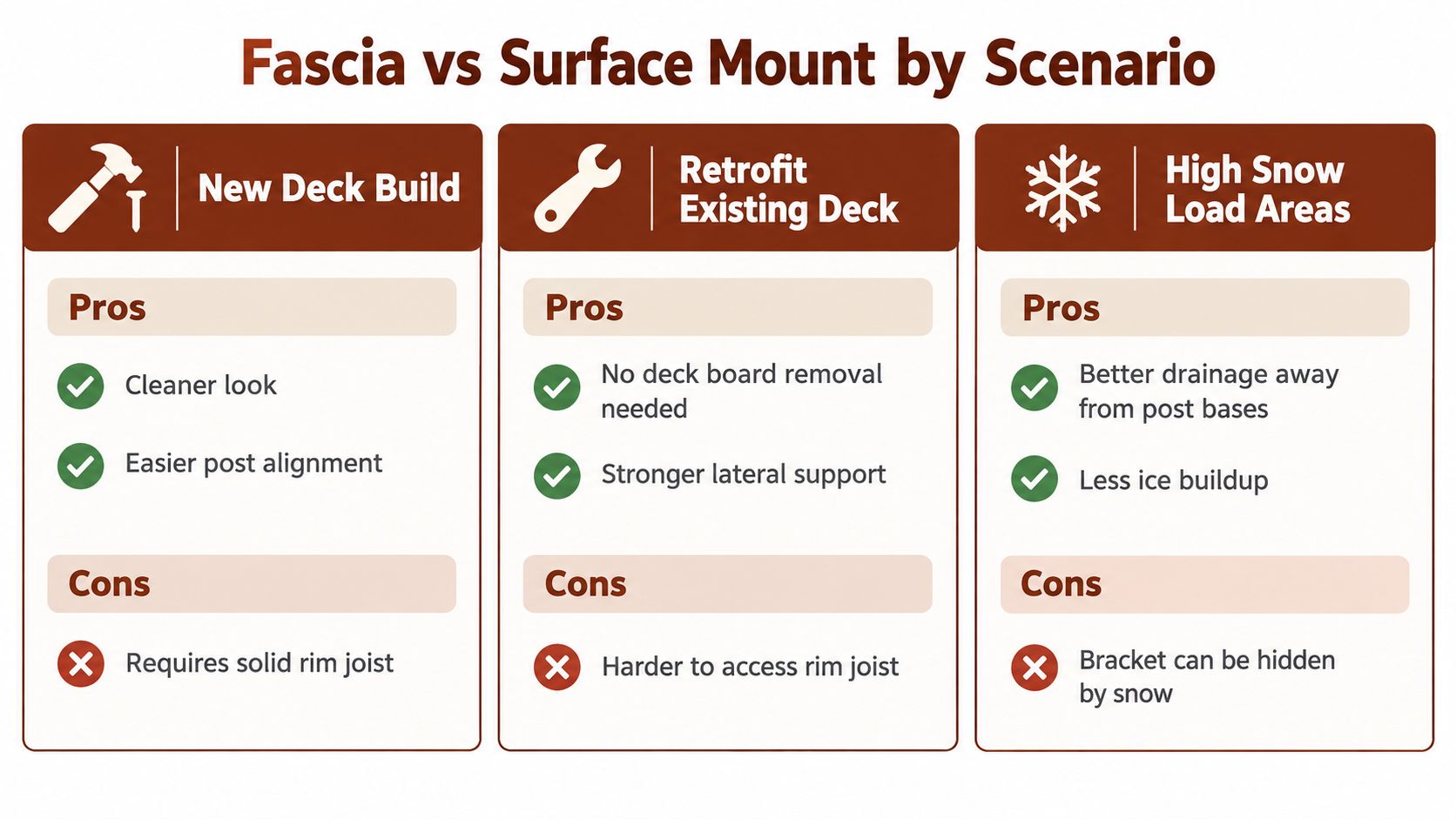
New deck build
Fascia mount is attractive on a new deck when the builder wants a cleaner outside edge and the frame can be blocked correctly during construction. Surface mount is still easier to lay out, and it usually gives the installer more direct access for fastening and inspection. On a fresh build, the best answer often comes down to whether the designer wants reclaimed edge width or simpler framing.
Retrofit existing deck
Surface mount is usually the practical path when the rim joist is shallow, damaged, or hidden behind old trim. Fascia mount can be ruled out fast if the edge doesn't have the structural material needed for side fastening. On older decks, the easier system is the one that reaches sound framing without opening up half the perimeter.
High snow load areas
Either method can work if the system is engineered and the edge detail is right. Fascia mount keeps the base hardware outside the walking surface, which can help reduce ice buildup around post bases. Surface mount keeps the connection more visible and often easier to clear or inspect after a storm.
Bottom line: new construction favors flexibility, retrofit work favors reality, and the frame always gets the final vote.
For stair-heavy projects and wider build-outs, the decking category is often the right place to coordinate railing placement with board layout before any post line gets fixed.
Decision Checklist, Cost Note, and Next Steps
The last check is straightforward. Is there structural material behind the fascia at every side-mounted post? Is there joist support or solid blocking under every surface-mounted post? Are the flashing, coating, and fastener choices matched to the site? Is the selected bracket the manufacturer's listed assembly for that exact mounting method?
What to expect on cost
Once blocking, brackets, and fasteners are counted, the two methods often end up closer than people expect. The cost driver is usually framing labor, access, and any rim-joist upgrade needed on a remodel. A cheap bracket doesn't matter if the edge has to be rebuilt to accept it.
Exact blocking and fastener specifications follow the selected listed system, not a generic diagram. Local Utah code enforcement and the manufacturer's installation manual are the two documents that should govern acceptance. That's the part people skip, and it's usually the part that creates the headache later.
For readers who need to move from comparison to ordering, the cleanest next step is to get a decking quote or walk the showroom in West Jordan with photos, edge measurements, and the intended railing style in hand. That gets the post system, hardware, and decking layout reviewed before the order is locked.
Utah Deck Supply helps homeowners and contractors line up railing systems, hardware, and deck materials before the order goes in. For fascia mount vs surface mount deck railing decisions, that means matching the bracket to the frame, not guessing from a picture. Visit Utah Deck Supply to plan the railing package, compare materials, and keep the project moving with the right parts from the start.