
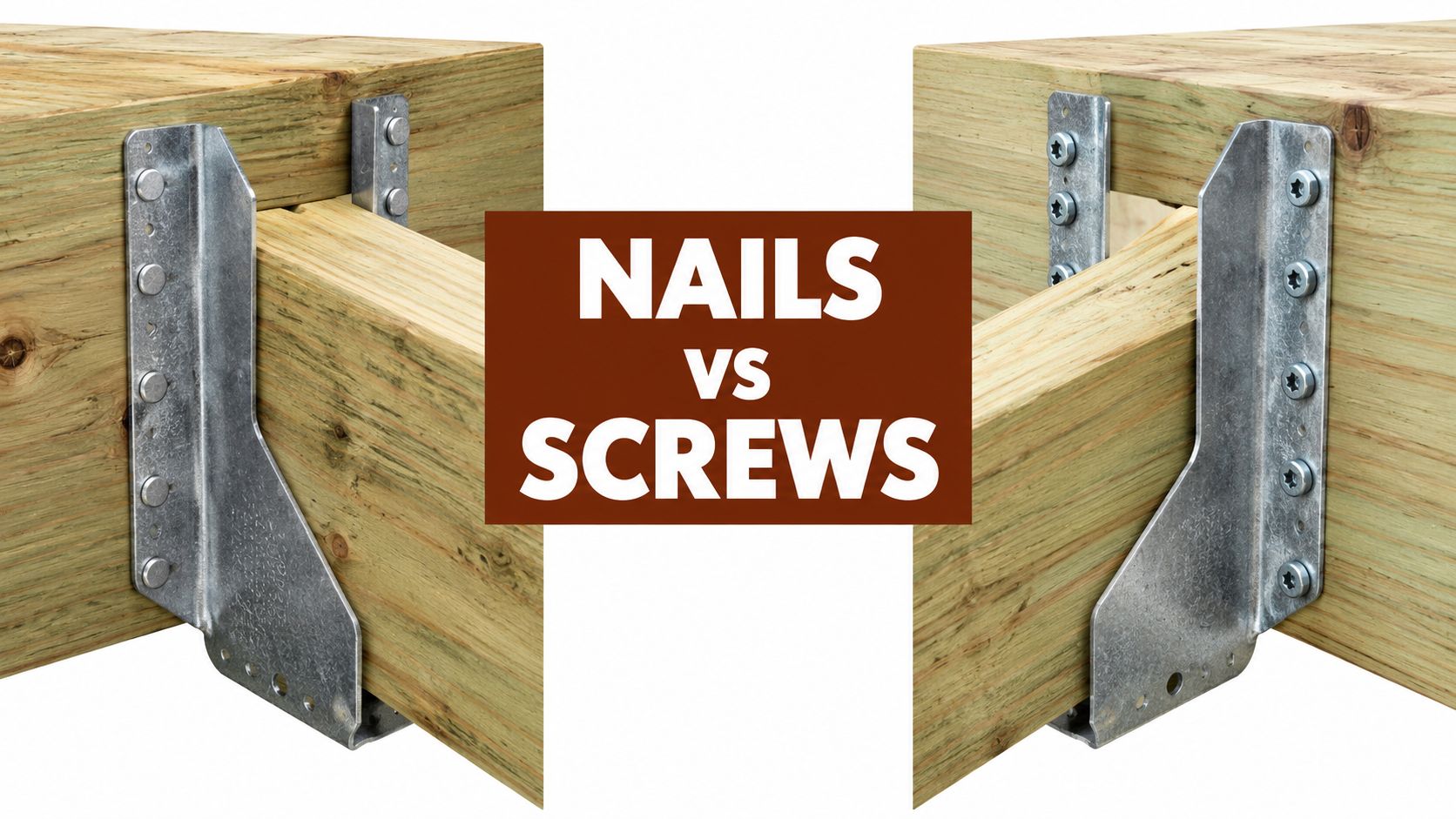
Most advice on deck joist hanger nails vs screws starts with the wrong premise. Screws aren't automatically stronger, and nails aren't automatically old fashioned. A hanger connection works only when the specific fastener is listed for that specific hanger, installed in the specified holes.
Why the Question Is Not Really Nails or Screws
A thicker looking deck screw can produce a weaker connection than a correctly specified hanger nail. The reason is simple. The hanger manufacturer tested one assembly, not every fastener that fits through the hole.
That tested assembly includes the hanger model, fastener diameter, length, quantity, penetration, lumber species, corrosion protection, and load direction. Changing one part changes the connection, even if the finished hanger looks fully filled.
The controlling question isn't nails or screws. It's whether the fastener in hand appears in that hanger's current load table.
This distinction matters in both directions. A hanger rated for connector nails shouldn't be converted to screws without an approved alternative. A hanger listed for a proprietary structural connector screw shouldn't receive a generic construction screw that happens to have a similar head.
What to Read Before Buying
- Connector label: Confirm the exact model, joist size, and carrying member it fits.
- Fastener schedule: Match type, diameter, length, quantity, and hole pattern.
- Evaluation report: Check whether a screw substitution is listed.
- Local code adoption: Confirm which code edition the Utah jurisdiction applies.
A useful purchase starts with those four items together. Generic claims about holding power don't replace them, and a fastener that feels heavy in the hand doesn't prove tested capacity.
For Utah buyers across West Jordan, Salt Lake City, and the Wasatch Front, the practical approach is straightforward. Bring the hanger model number to the counter, match the listed fastener, and don't let convenience at the shelf override the table.
The Three Fastener Categories You Will See on the Shelf
Three very different products often sit within a few feet of each other. Treating them as interchangeable creates most of the trouble.
Connector Nails
Connector nails are specified by designations such as 8d, 10d, and 16d, with diameter and length set by the hanger table. Exterior versions are commonly hot-dip galvanized or stainless. They're the standard high speed option when the hanger is rated for them, and every required hole matters.
Manufacturer Listed Connector Screws
Structural connector screws, including Simpson Strong-Tie SD9 and SD10 screws and comparable listed MiTek options, are engineered and tested for connector holes. They're alternatives only where the manufacturer names them. A screw of this type is turned in with a driver, not struck like a nail.
Ordinary Deck, Wood, and Drywall Screws
Ordinary screws aren't tested as a hanger system. Drywall screws aren't structural connector fasteners, and generic wood or deck screws can't claim a hanger's published load just because they're exterior coated. Simpson Strong-Tie states that the specified fastener quantity, type, and size must be installed in the correct holes to achieve published loads, as explained in its connector holes and fastener types guidance.
That guidance also warns against mixing nails and SD connector screws in one connection unless the load table specifically permits it. Category identification comes first. Matching to the hanger comes second.
What the IRC and ICC-ES Require of a Hanger Fastener
Ask a plan reviewer which fastener belongs in a joist hanger and the answer is never "nails" or "screws." It is whatever the load table lists. The code framework behind that answer explains why inspectors reject casual substitutions. Joist hangers must be fastened according to the hanger manufacturer, and the two fastener families sit under different referenced standards in the IRC Section R507 deck material. That material requires helical or annular nails complying with ASTM F1667, while bolts and screws comply with ANSI/ASME B18.6 and the National Design Specification.
The same material lists example hanger capacities of 350 pounds for 2-by-6 joists, 600 pounds for 2-by-8 joists, 700 pounds for 2-by-10 joists, and 800 pounds for 2-by-12 joists. It also specifies stainless grade 304 or 316 within 300 feet of a salt water shoreline, a condition that rarely fits Utah projects but shows how directly exposure drives material choice.
The 2009 Withdrawal Rule
The 2009 IRC and IBC stated that an exterior deck attachment to a wall couldn't rely on nails loaded in withdrawal, as discussed in the Structure Magazine lateral load path analysis. That provision required an approved method for the specific loading condition. Screws in every hanger were never the mandate.
ICC-ES evaluation criteria add another control. The ICC-ES AC13 draft material describes independent testing of fastener quantity, size, type, installation method, failure mode, direct load capacity, and torsional capacity. A proprietary screw rating therefore doesn't transfer to a lookalike screw pulled off the same shelf.
A general timber to timber joist hanger installation guide can help visualize basic placement, but Utah projects still answer to the hanger table and the locally adopted code. Bring the connector label to the counter when comparing deck joist hangers. The label and evaluation report control the connection, and everything else is opinion.
Comparing Nails and Screws on Real Performance Numbers
Withdrawal is where listed screws often show a clear advantage. One analyzed assembly used 10 fasteners into the ledger and six into the joist, reporting 750 pounds withdrawal design capacity for #9 stainless steel structural screws versus 150 pounds for 10d common nails, as reported in the JLC lateral load anchor analysis.
That fivefold difference applies to that analyzed configuration. It isn't a universal rating for every hanger, species, or fastener. The same account notes smooth nail withdrawal capacity can decline during moisture cycling to 25% of the National Design Specification tabulated value, which matters where snowmelt and freeze thaw repeatedly wet and dry framing.
| Metric | Connector Nails | Listed Connector Screws |
|---|---|---|
| Withdrawal | Lower in the analyzed assembly | Higher when listed and tested |
| Shear | Defined by hanger nail schedule | Defined only for the named screw |
| Speed | Fast to drive | Slower, driver installed |
| Substitution | Use specified size and type | Use only the listed alternative |
| Mixing | Don't combine without table permission | Don't combine without table permission |
Simpson gives narrow substitution rules. Its SD screw substitution guidance identifies SD10 screws as replacements for 16d common and N16 nails in face mount hangers and straps, while SD9 screws replace certain 8d, 10d, 1 1/2-inch, and 16d sinker nails. SD screws must be turned with a driver and must not be driven with a hammer or palm nailer.
Speed favors nails. Withdrawal can favor the correct screw. Neither fact overrides the table, a point reinforced by the Utah Deck Supply nail recommendations.
Corrosion, Treated Lumber, and Utah Exposure
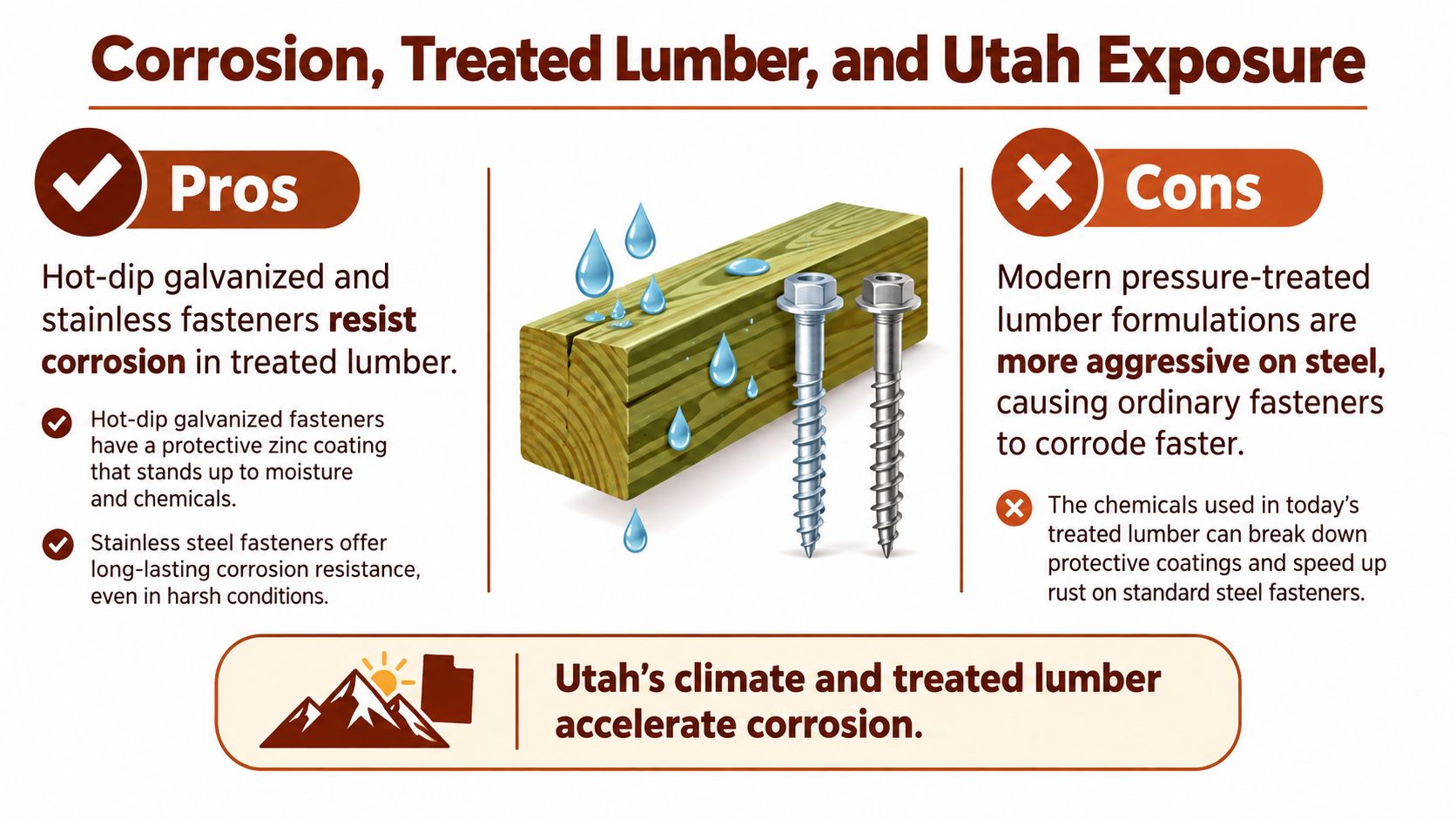
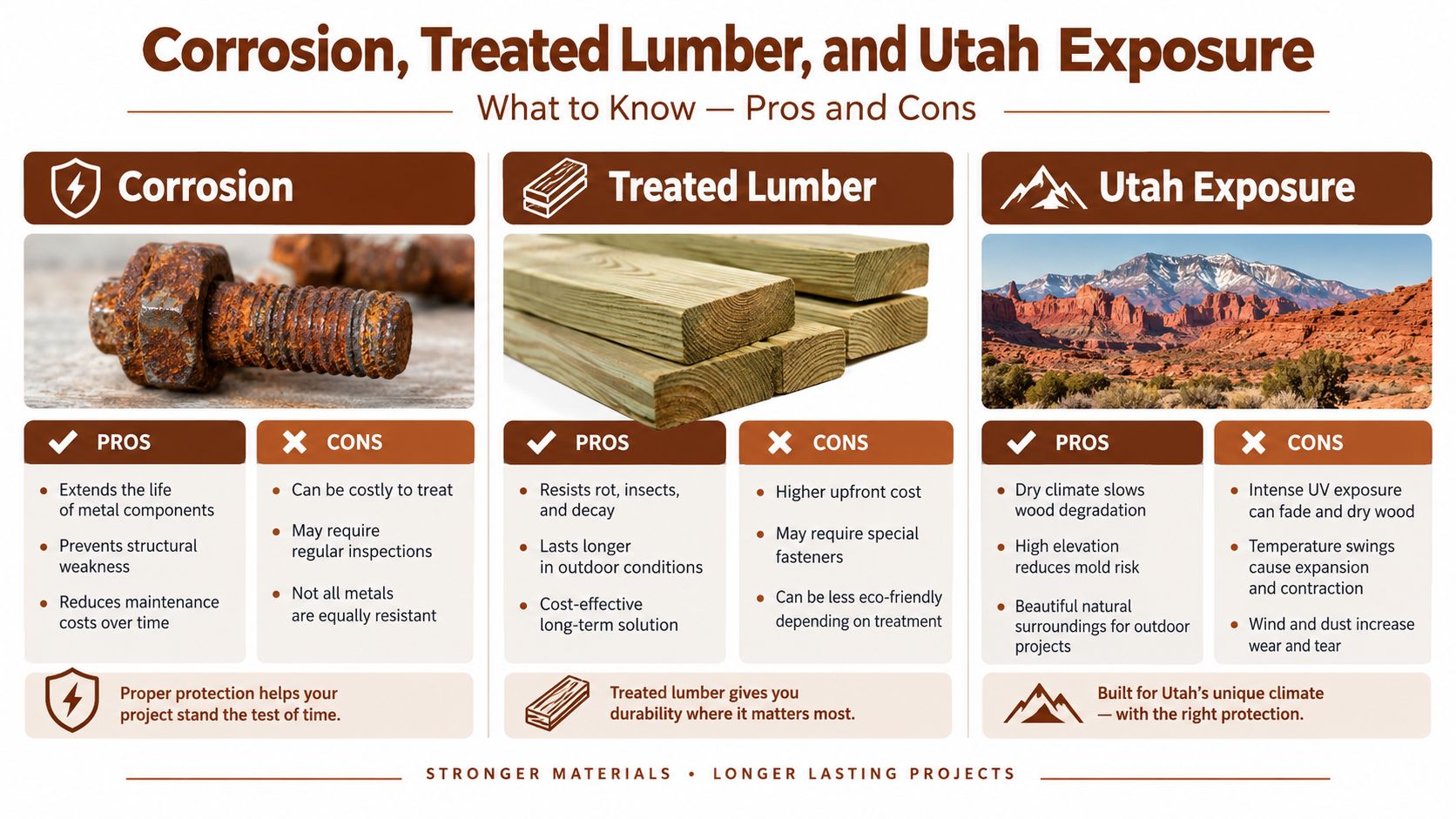
Head style gets attention because it's visible. Coating compatibility often decides whether the connection stays sound. Ordinary carbon steel can corrode in treated wood, and electroplated fasteners may not be accepted for exterior treated lumber use.
Deck guidance commonly calls for hot-dip galvanized or stainless fasteners matched to the connector system, as shown in the Johnson County deck construction guidelines. That match matters more than a bright finish. A correctly specified galvanized nail can be the safer choice over a stainless looking screw that isn't the listed connector fastener.
Utah Conditions That Wet the Joint
- Ledger snow: Snow piled against the house keeps end grain and hardware wet during melt periods.
- Irrigation overspray: Lawn systems in Sandy, Draper, Herriman, and Lehi can wet low framing repeatedly.
- Splash back: Rain and meltwater bounce from grade onto lower connectors.
- Freeze thaw: Moisture moves into joints, then expands and contracts across seasons.
Mixing metals needs manufacturer approval. A stainless hanger with galvanized fasteners, or the reverse pairing, isn't a decision to make from appearance. Corrosion may show first as staining, section loss, or loosening rather than sudden failure.
The deck screw guide for Utah builders is useful background for deck board screws, but hanger fasteners still begin with the connector manufacturer's coating and treated lumber compatibility requirements.
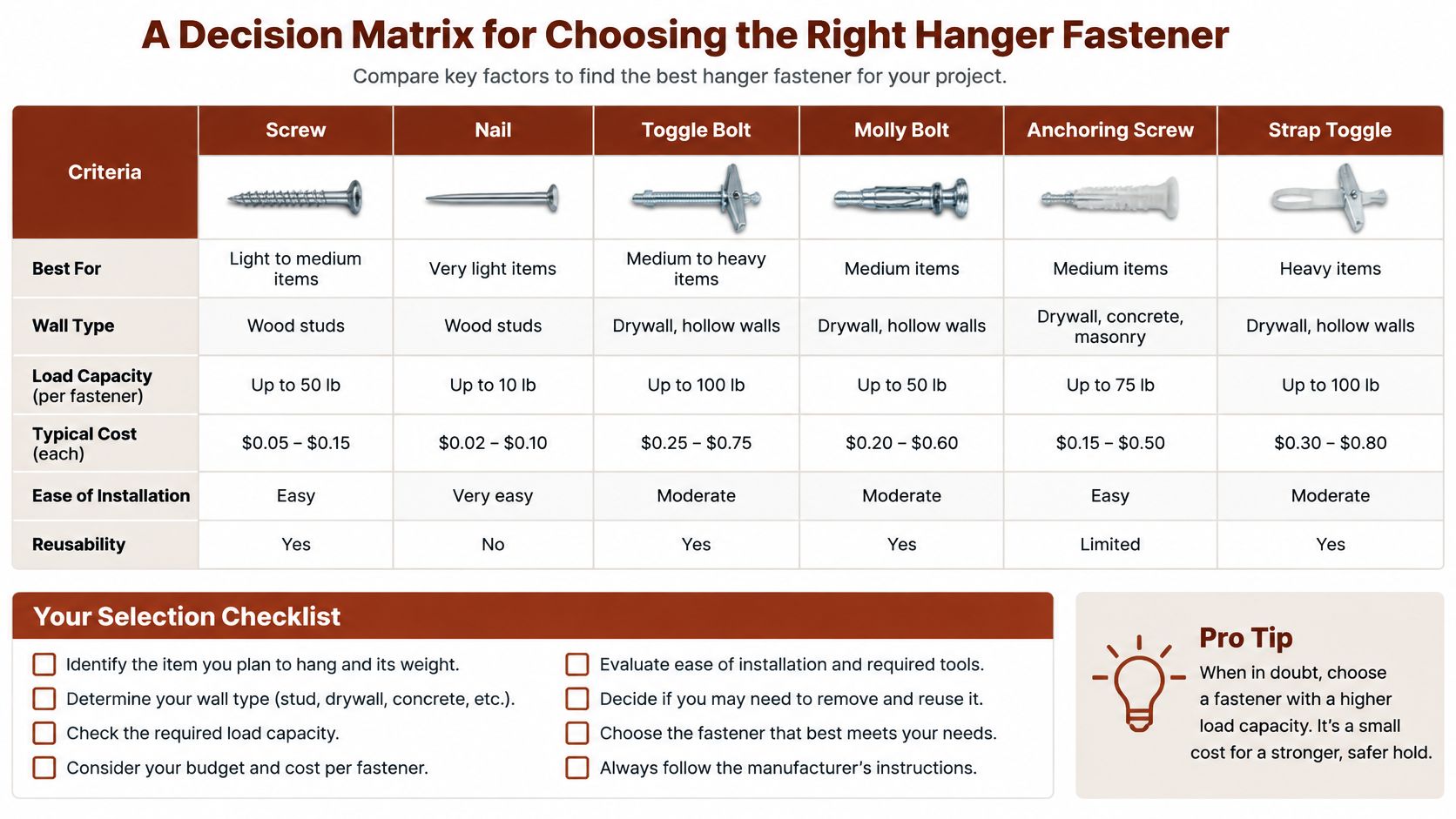
A Decision Matrix for Choosing the Right Hanger Fastener
A matrix helps keep four checks together. Start with the connector label, identify the connection face, confirm exposure and treatment, then select only from the fasteners that remain eligible.
Some deck guidance requires manufacturer recommended screws for hangers attached to a ledger or flush beam while permitting nails elsewhere, as stated in the Roanoke County residential deck guide. That isn't a universal Utah rule. It shows why ledger side and joist side holes shouldn't be treated as one generic pattern.
| Connection Face | Listed Fastener on Label | Exposure / Treatment | Choose |
|---|---|---|---|
| Ledger side | Nail only | Treated lumber, exterior | Specified corrosion resistant nail |
| Ledger side | Nail or named connector screw | Treated lumber, exterior | Either listed option, compatible coating |
| Joist side | Double shear nail or screw | Dry or treated framing | Full specified length and angle |
| Any face | No generic screw listed | Any exposure | Do not substitute a deck or drywall screw |
Length shortcuts change capacity. Simpson specifies minimum 2 1/2-inch nails or 2 1/2-inch SD screws for double shear nailing in its LUS hanger product information. In one configuration with a 2-by carrying member, smaller header nails reduced allowable load to 0.64 of table value, or 0.77 in another configuration.
A hanger can look completely filled and still miss its published load because the header fastener is short, undersized, or placed in the wrong direction.
Read the matrix from left to right. Never start with the fastener and work backward.
Jobsite Verification Checklist Before You Drive the First Fastener
A five minute check in the driveway prevents most fastener mistakes. It also gives the inspector a clear trail from product label to installed connection.

- Confirm the model number: Match the stamped hanger and box label to the manufacturer's current catalog entry.
- Pull the load table: Verify lumber size, carrying member thickness, species assumptions, and allowable loads.
- Read the fastener schedule: Check diameter, length, quantity, head type, shank type, and required holes.
- Verify coating compatibility: Match fastener and hanger material to the preservative treatment and exposure.
- Check installation geometry: Use angled joist fasteners where specified. One evaluation approach summarized in the Carleton Place 2025 deck guideline allows screw substitution only with equivalent structural capacity and equal or greater length and diameter, which still doesn't replace the hanger listing.
- Ask the inspection question: Confirm the Utah jurisdiction, adopted code edition, and whether the evaluation report should stay on site.
Where a table requires an angled joist fastener, the specified direction can be 30 to 45 degrees from normal. That detail should come from the connector document, not habit. Keep packaging and tables with the hardware checklist for Utah deck projects until inspection is complete.
Broader planning still matters around the framing. Readers adding outdoor features can review deck fireplace safety tips as separate project context, while keeping structural hardware decisions tied to manufacturer and code documents.
Showroom Questions and Your Next Step
Bring information, not just a joist measurement. The counter conversation gets accurate quickly when the hanger model, lumber treatment, and exposure are known.
Four Questions Worth Asking
- Which hanger fits this joist and carrying member: Ask for the exact Simpson Strong-Tie or MiTek model, not a close size.
- What fastener does its current table list: Confirm nail and approved screw alternatives separately for each face.
- Which coating system matches the lumber: Ask whether G-185 galvanized or stainless fits the treatment and exposure.
- What paperwork should stay on site: Keep the load table or evaluation report available for inspection.

The rule to remember is narrow. Deck joist hanger nails vs screws isn't a contest between two shelves. It's a matching exercise between one connector, one listed fastener, one lumber treatment, and one exposure condition.
Homeowners and contractors can call 385-993-5492, request a deck materials quote, or visit the Utah Deck Supply showroom in West Jordan to review framing hardware alongside decking, railing, lumber, and fasteners before purchase.
Bring the hanger model, joist size, lumber treatment, and exposure details to Utah Deck Supply for help matching listed connector fasteners with the rest of the deck materials list. The West Jordan supplier and showroom serves Utah homeowners and contractors who want the hardware decision checked before the cart is loaded.