
Buying the board with the strongest fire label doesn't, by itself, make a deck wildfire ready. That's the popular shortcut, and it's misleading. A label usually describes how one product behaved in one test. It doesn't describe what happens when embers collect in board gaps, leaves build up under framing, or flames reach combustible storage below the deck. Choosing fire resistant decking materials in Utah starts with a different question. How does the complete assembly behave, and what documentation proves it?
Why Fire Resistant Is Not the Same as Fireproof
Fireproof suggests a material won't burn. Most decking products don't meet that test, even when marketing language makes them sound close. Fire resistant generally means a product resisted ignition or slowed surface burning under specific laboratory conditions. Change the exposure, and the result can change.
That distinction matters because wildfire reaches a deck in more than one way. Embers can lodge between boards, direct flame can come from vegetation or stored items, and heat can attack the underside. A board that performs well in a surface-burning test may still be part of a vulnerable assembly if its joists, skirting, stairs, or house connection create another ignition path. Guidance summarized in wildfire research fact sheets on decks separates ember ignition, direct flame behavior, and secondary pathways through framing and adjacent materials for this reason.
Testing also shows that common wood decking shouldn't be treated as ember proof. In NIST experiments using a continuous firebrand flux of 17.1 grams per square meter per second, cedar reached flaming ignition in an average of 437 seconds, Douglas-fir in 934 seconds, and redwood in 756 seconds, according to NIST parcel vulnerability research on decks and related features. The species changed the time, not the eventual outcome under sustained exposure.
A fire label is a starting point for questions, not proof that the finished deck is protected.
Readers should therefore separate three ideas from the start. The board surface is one component. The structure supporting it is another. The site conditions around and beneath it are a third. A cautious buying decision addresses all three before price, color, or brand preference enters the discussion.
Understanding Fire Ratings and Test Standards
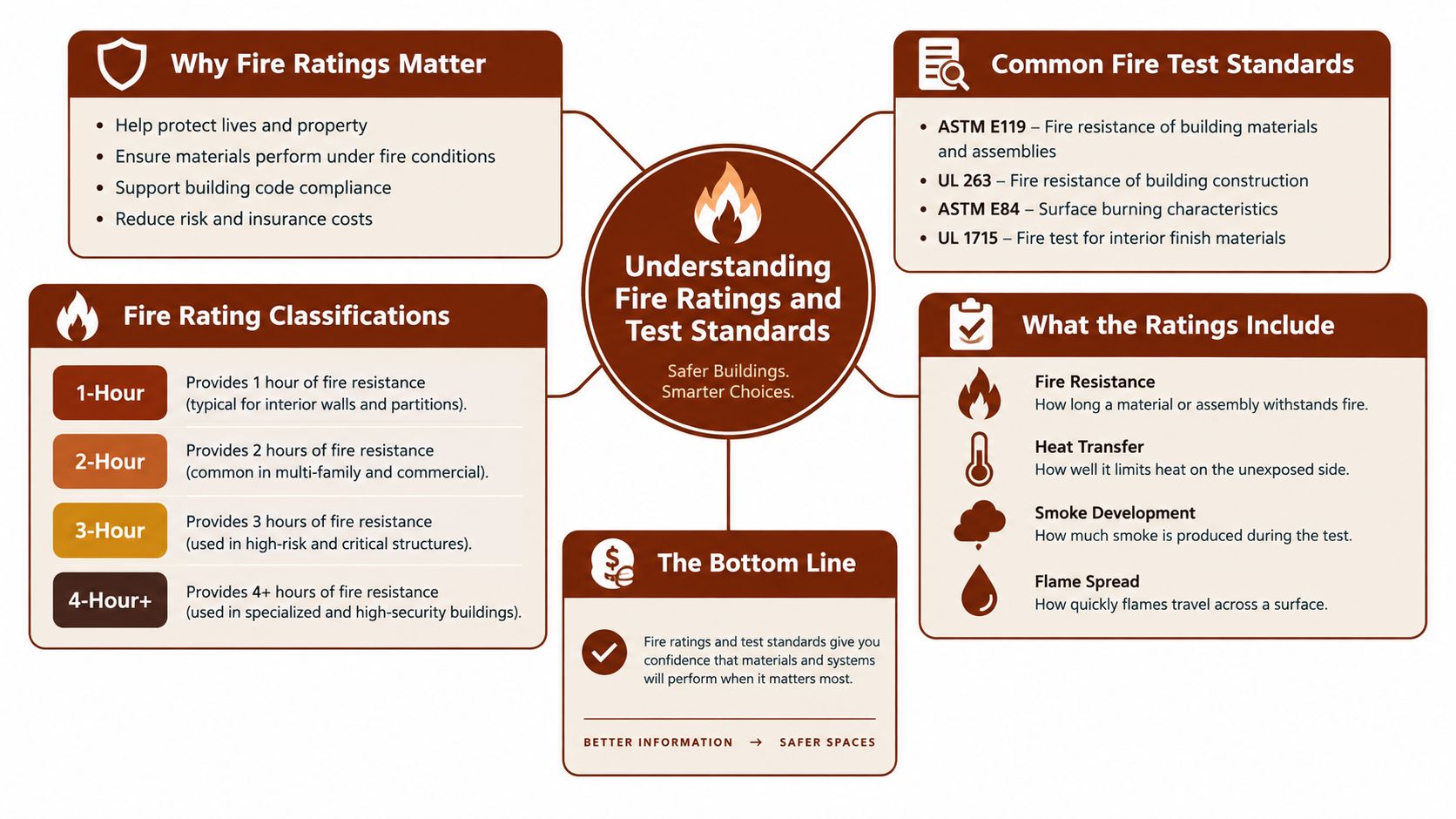
Product sheets often place several standards side by side, which creates confusion. Each standard answers a different question, so the test number matters as much as the passing language.
Surface Burning Versus Deck-Specific Tests
UL 723 and ASTM E84 characterize surface burning behavior, commonly expressed through a flame-spread index. That's useful information, but it doesn't fully describe an assembled deck exposed to burning brands or fire underneath. The U.S. Forest Service identifies ASTM E2632 for under-deck fire response and ASTM E2726 for a deck structure's response to burning brands in its technical discussion of exterior decking fire tests.
A simple analogy helps. ASTM E84 asks how fire travels across a surface. The deck-specific tests ask what happens when the threat arrives as embers on the assembly or as fire below it. A Class A, Class B, or Class C reference shouldn't be accepted until the underlying standard, tested product, and installation conditions are identified.
Code Categories Readers May Encounter
The International Wildland-Urban Interface Code uses Class 1 for extreme severity, Class 2 for high severity, and Class 3 for moderate severity, with stronger deck requirements generally applying in Class 1 and Class 2 areas, according to Building America guidance on wildfire-resistant decks. Those code classes aren't the same thing as a product's surface-burning class, despite the similar wording.
NFPA code material provides another screening framework. It identifies deck boards made from noncombustible material, exterior fire-retardant-treated wood, an ignition-resistant material, or decking tested to ASTM E2632/E2632M as categories that may satisfy ignition-resistant construction requirements, as stated in NFPA 1144 code material on ignition-resistant deck boards. Local acceptance still depends on the adopted code and the authority having jurisdiction.
Comparing Decking Material Categories
Category names don't guarantee a rating. Two products described as composite can have different formulations, test results, and approved assemblies. The comparison below is therefore a screening guide, not a claim that every board in a category qualifies for a wildfire application.
- Capped composite: Wood fibers and plastic are combined under a protective cap. Buyers reviewing composite deck boards should request the exact fire documentation for the collection and profile under consideration, not rely on the broader category name. Performance varies by product.
- PVC and capped PVC: These plastic decking products contain no wood fiber, but that fact alone doesn't make them noncombustible or code approved. The relevant question is what the specific board achieved under the cited test and whether that result applies to the intended assembly.
- Fire-retardant-treated lumber: Treatment is intended to improve ignition-related performance compared with untreated wood, but the product remains wood. Its approval depends on the treatment, intended exterior use, dimensions, and documentation.
- Pressure-treated wood: Pressure treatment and fire-retardant treatment aren't interchangeable terms. Readers who want background on common treated-wood terminology can consult the XTREME EDEALS INC. wood guide, then confirm separately whether a proposed board carries any fire-related listing.
- Dense hardwoods: Higher density may affect ember ignition behavior, but species alone doesn't establish local code compliance. Documentation is still required.
- Fiber-cement, concrete, and stone pavers: These options are often considered where a noncombustible walking surface is required or preferred. Weight, support structure, drainage, edges, and transitions still need project-specific review.
Utah Deck Supply's deck-board lanes are composite, PVC, and wood, and not every stocked board should be assumed to carry a wildfire-related rating. The company does not sell aluminum decking boards or aluminum deck planks. Aluminum is relevant to its railing offerings, not its deck-board inventory.
How to Verify a Claim Before You Buy
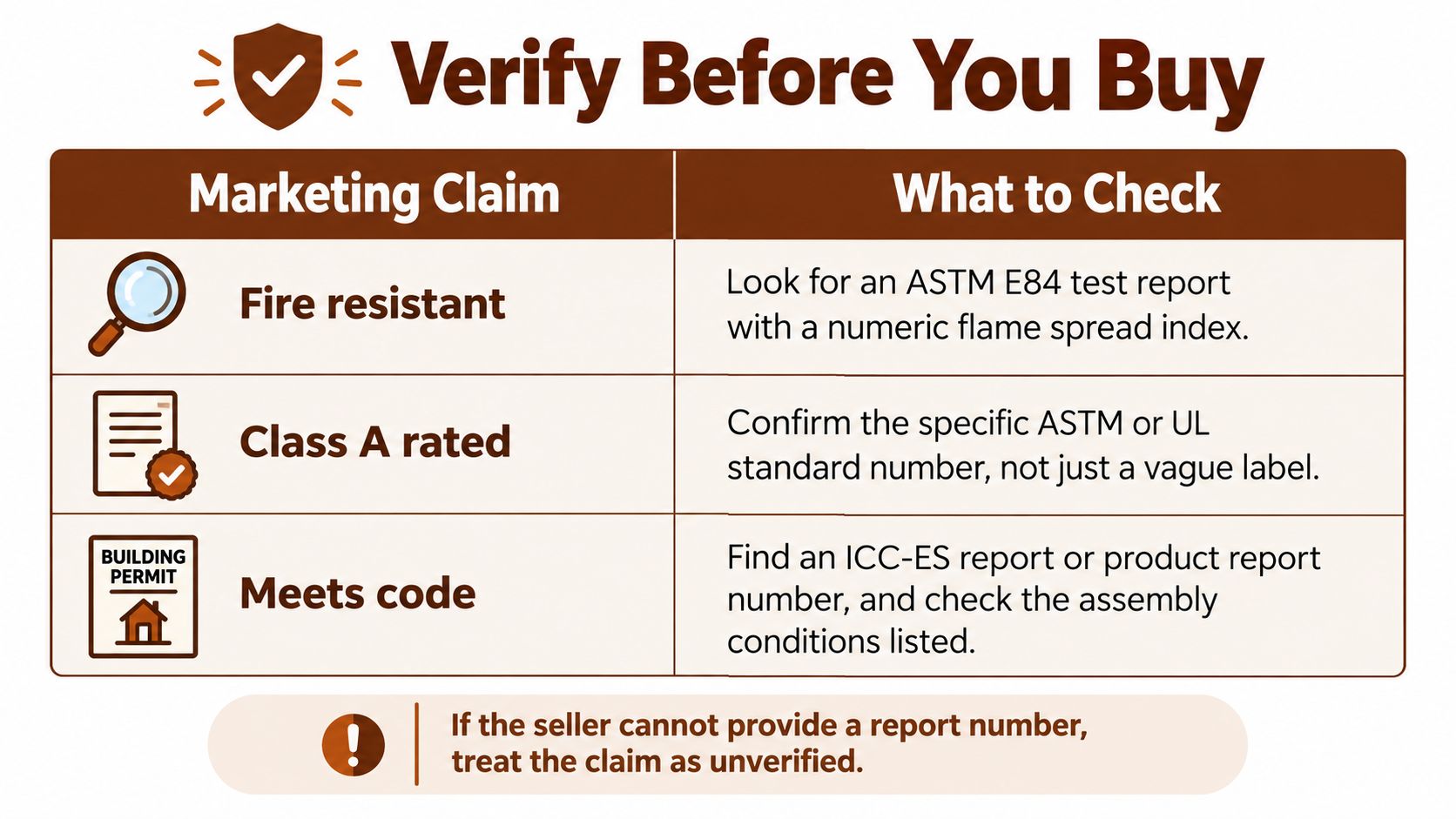
A brochure phrase becomes useful only when it can be traced to a report. Buyers should ask for the standard number, the exact product tested, any ICC-ES or other product report number, the approved assembly, and the installation limits. If those details don't match the planned deck, the claim shouldn't be transferred casually.
Deck Fire-Claim Verification at a Glance
| Claim Type | What to Ask For | Why It Matters |
|---|---|---|
| Fire resistant | Named ASTM or UL standard and test report | Identifies the exposure that was actually tested |
| Class A rated | Standard, index or result, and tested product name | Prevents a surface-burning result from being treated as whole-deck approval |
| Ignition resistant | Product report and applicable code category | Connects the claim to a recognized compliance path |
| Meets code | Report number, assembly conditions, and jurisdiction acceptance | Adopted requirements and approvals vary by location |
Samples help with color, texture, and heat checks at home, and the Utah Deck Supply sample guide explains that hands-on process. A sample can't verify a fire claim, though. Documentation should be collected before ordering, while the product, framing approach, fasteners, and permit path can still be changed without wasted materials.
Practical rule: If a seller can't identify the report behind a fire claim, the claim should be treated as unverified.
Wildfire Details That Change the Outcome
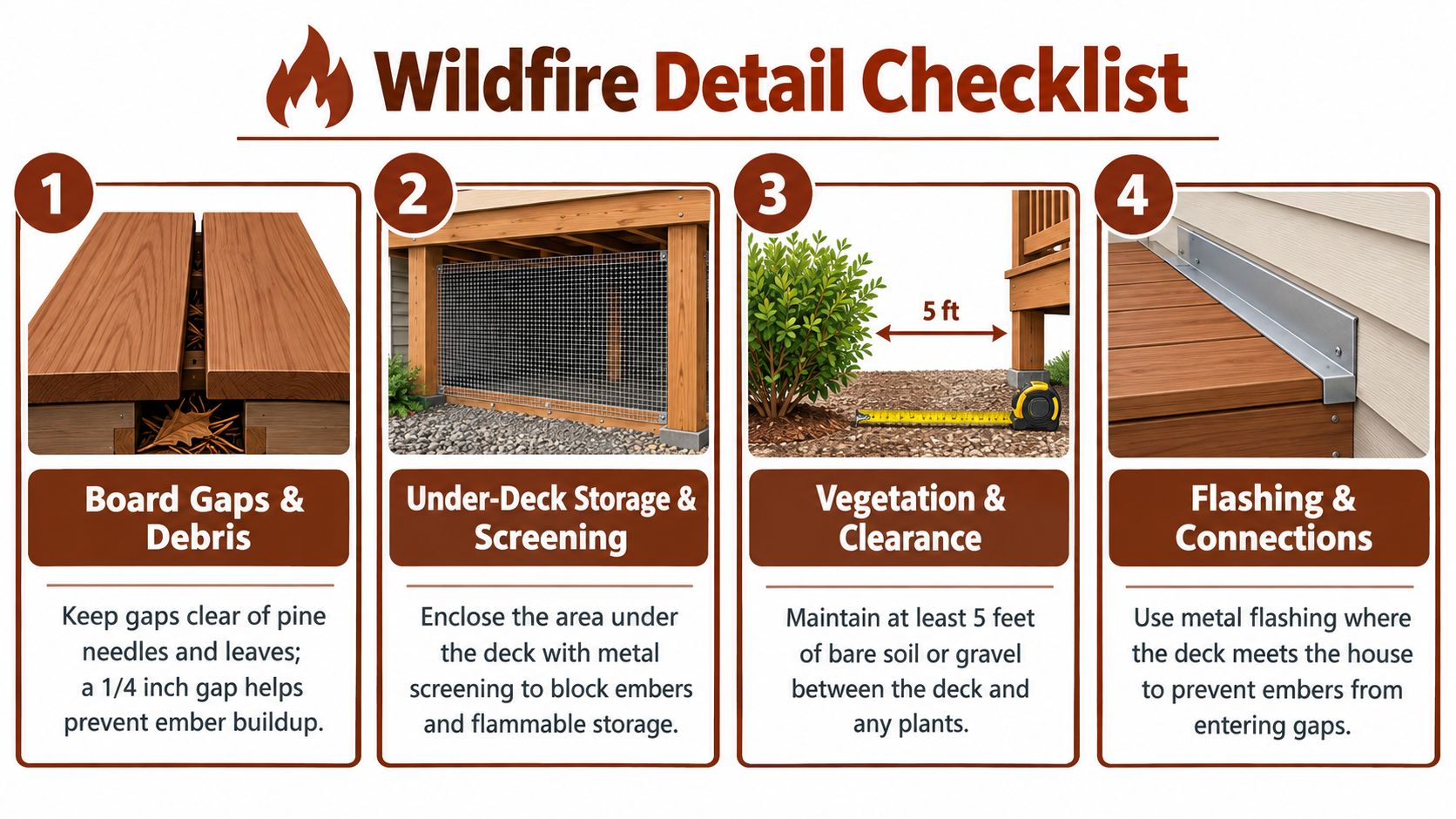
A tested board can lose much of its value if the surrounding details collect embers or fuel. IBHS reports that embers commonly lodge in gaps at joist crossings, where debris can smolder and ignite combustible framing, in its research on deck vulnerability to embers and flames. Once a joist is involved, heat can attack the underside of the walking surface for an extended period.
Wildfire-Detail Checklist
- Board gaps and debris traps: Keep gaps, corners, stair treads, and the deck-to-wall area clear of leaves and needles. Cleaning access should be planned, not improvised after construction.
- Joist protection: Ask whether foil-faced self-adhering flashing tape, noncombustible framing, or another manufacturer-supported detail is appropriate. A resistant surface doesn't compensate automatically for exposed combustible joists.
- Under-deck storage: Don't store firewood, fuel, cushions, or other flammable materials below a raised deck. NFPA also recommends 1/8-inch metal mesh screening between low-profile decks and the ground in its wildfire home ignition zone checklist.
- Vegetation and nearby fuels: Remove dead vegetation beneath and around the deck, and review mulch, fences, and plantings that could carry flame to the structure.
- Flashing, screens, and adjacent siding: The ledger area, wall base, skirting, vents, and under-deck enclosure deserve the same scrutiny as the boards. Compatible metal flashing and screening details should follow manufacturer guidance and local requirements.
- Documentation file: Keep product reports, installation instructions, permit records, and maintenance notes together for inspectors, insurers, and future repairs.
For wood decking, IBHS-related guidance in the research above also reported reduced fire growth when gaps increased from 1/8 inch to 1/4 inch and joist spacing increased from 16 inches to 24 inches. Those dimensions shouldn't be copied without structural design and manufacturer approval, because spacing affects strength and walking-surface performance as well as fire behavior.
Utah Wildfire Codes and Defensible Space
Utah projects near foothills, brush, or other wildland vegetation need location-specific review. Requirements can depend on the city, county, fire district, adopted code edition, hazard classification, and whether the work is new construction or replacement. A product accepted for one project shouldn't be assumed acceptable for another address.
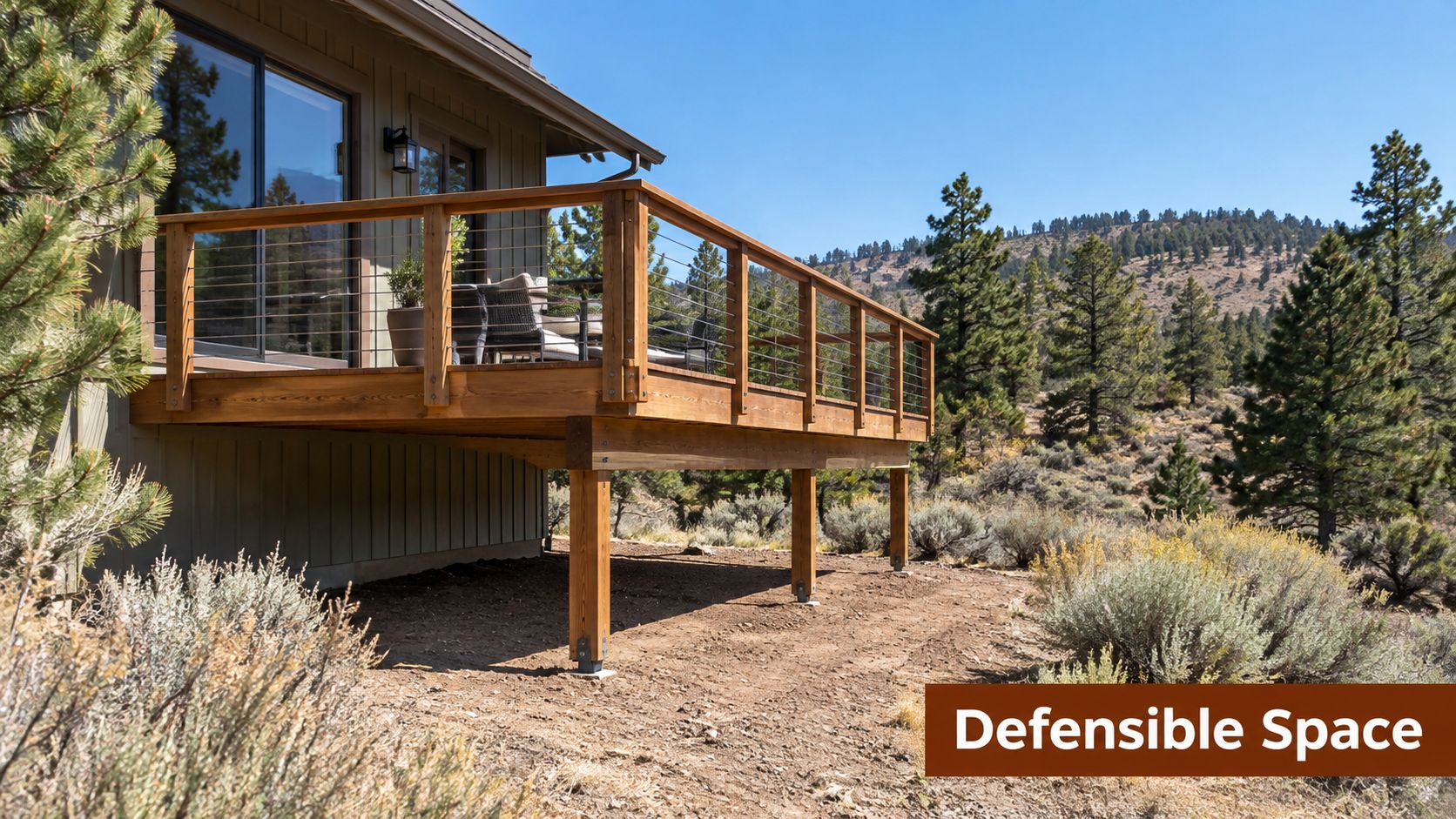
NIST wildfire research identifies decks as parcel-level vulnerabilities alongside fences, sheds, woodpiles, landscaping timbers, mulch, and leaf litter, all of which can increase local exposure to fire and embers and help spread fire through communities. That context explains why defensible space and deck materials should be planned together. Clearing one feature while leaving continuous fuels beside or beneath the deck leaves an obvious weak point.
Vegetation rules also vary outside Utah, so out-of-state examples shouldn't be used as local permission. Material on bushfire-prone tree clearing entitlements illustrates how jurisdiction-specific clearing frameworks can be, but Utah owners still need direction from their own building department or fire authority before removing trees or changing site conditions.
Early permit research prevents expensive reselection. The Utah Deck Supply permit guidance offers a starting point for understanding the approval process, while the local department remains the source for current requirements. Product reports, drawings, framing details, and under-deck treatments should be confirmed before a materials order is finalized.
Cost, Durability, and Aesthetic Trade-offs
Price comparisons become misleading when one quote covers only boards and another includes different framing, flashing, screening, railing, or under-deck work. Fire documentation should be the first filter. Cost, appearance, and maintenance can then be compared among products that fit the project requirements.
Composite and PVC generally shift spending toward the board itself while reducing some routine wood finishing tasks, although cleaning and debris removal remain necessary. Wood may offer a familiar appearance and workability, but exterior exposure, finishing, and fire-related documentation need closer attention. Dense hardwoods can be heavy and may require compatible fasteners and careful detailing. Concrete, stone, or fiber-cement surfaces can change structural loads, drainage, edges, and transitions, so their installed cost can't be judged from the surface material alone.
Utah sun, snow, foot traffic, and shade also affect long-term satisfaction. Color and material influence surface heat, while texture affects the feel underfoot. Readers comparing categories can use the resource on comparing composite decking for Utah to organize those secondary priorities after fire documentation is settled. General budget frameworks, including guidance telling readers to plan your deck budget in Tyler, can help list cost categories, but Utah pricing and scope should come from a local materials takeoff rather than another market's estimate.
The least expensive board isn't a bargain if its documentation, framing, or detailing fails the project's requirements.
Planning Your Next Steps
The sound sequence is straightforward. Confirm the property's wildfire and permit requirements, identify products with reports that match the intended assembly, then detail the joists, gaps, flashing, screening, vegetation, and under-deck area. Only after those decisions are documented should color, railing, fasteners, and final quantities be locked in.
Homeowners and contractors can visit a decking showroom in West Jordan to compare composite, PVC, and wood options in person and discuss the documentation needed for a specific product. For a materials list based on project dimensions, readers may request a deck materials quote or call 385-993-5492. Utah Deck Supply serves as a materials supplier and showroom, not primarily as the installation contractor.
For help comparing documented decking options, framing hardware, flashing, fasteners, and railing for a Utah project, visit Utah Deck Supply or stop by the West Jordan showroom. The team can help organize a materials list around manufacturer documentation and local code questions, so the next step is based on verified product details rather than a label alone.