
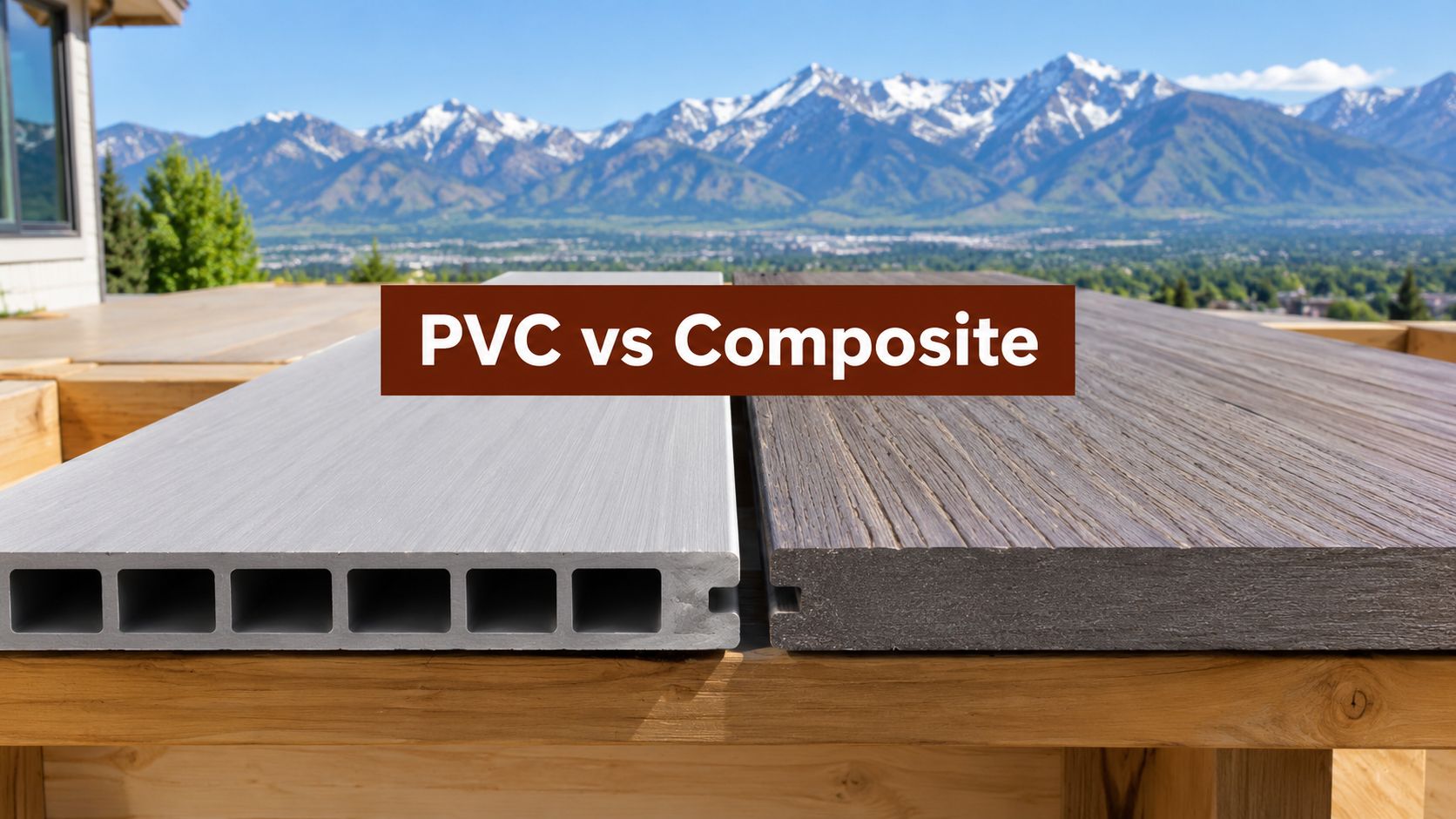
A Utah homeowner can choose a beautiful deck color in the showroom, then discover that the same board feels too hot in July or moves more than expected after a winter of snow and freeze-thaw cycles. A contractor may face a different concern, such as whether the selected fasteners, joist spacing, and expansion gaps match the board line.
The right answer to PVC vs composite decking for Utah weather depends on exposure, shade, snowmelt, surface comfort, and installation details. PVC and capped composite are both practical alternatives to wood, but they don't respond to moisture, heat, and seasonal movement in exactly the same way.
Why Utah Weather Changes Deck Board Choices
A deck along the Wasatch Front can experience intense afternoon sun, dry dust, snow accumulation, and repeated freeze-thaw exposure. A south-facing deck in Draper won't behave like a shaded deck in Ogden, and an exposed deck near Lehi or Provo may feel very different from one beneath a pavilion.
Utah's elevation and strong sun make surface temperature and UV exposure important parts of the material decision. Winter adds another stress: snow melts into joints and around framing, then freezes again as temperatures fall. The board itself is only part of the system, but its moisture response and thermal movement influence how carefully the rest of the deck must be planned.
A general national comparison often reduces the choice to maintenance and appearance. Those factors matter, but Utah homeowners and builders also need to ask:
- Where will water collect during snowmelt?
- How much direct afternoon sun will the deck receive?
- Will bare feet regularly contact the boards?
- Does the selected product require specific gaps, fasteners, or joist protection?
- Will the deck sit in open high-elevation sun or under planned shade?
| Utah condition | What to evaluate | Material implication |
|---|---|---|
| Snowmelt and wet-dry cycles | Moisture response and drainage | PVC has an advantage where moisture exposure is the dominant concern |
| Freeze-thaw exposure | Board movement, framing, and installation gaps | Either material can work when manufacturer requirements are followed |
| High-elevation UV | Cap technology, color, and fade provisions | Modern capped composite and PVC options deserve product-specific review |
| Dry summer heat | Surface temperature and shade | Lighter colors and heat-focused PVC lines may improve comfort |
| Full shade | Moisture drainage and cleaning | Color and heat may matter less than water management |
| Open elevation | UV, wind, snow, and temperature swings | Product selection and fastening details become more important |
The history of composite decking also matters. Recycled-plastic-and-wood-fiber products emerged in the late 1980s, and first-generation composite decking reached the market in the early 1990s. By 2009, manufacturers had introduced stiffer PVC-mixture products and co-extruded caps intended to improve weather performance and resist color change, as described in this history of composite decking technology.
Practical rule: A board that performs well in Utah isn't selected by name alone. Exposure, color, framing, drainage, and installation instructions all belong in the decision.
For homeowners and contractors comparing decking materials, local conditions should be treated as design inputs rather than afterthoughts.
Understanding Composite and PVC Decking Differences
After a Wasatch Front winter, snowmelt can reach board ends, fastener holes, and drainage points. The board's construction affects how those details respond.
Capped composite decking typically combines wood particles and plastic in its core, then surrounds that core with a protective polymer shell. The shell helps protect against weather, but the board is not synthetic throughout. Advanced PVC decking is fully synthetic, so moisture resistance extends through the board rather than depending on an exterior cap.
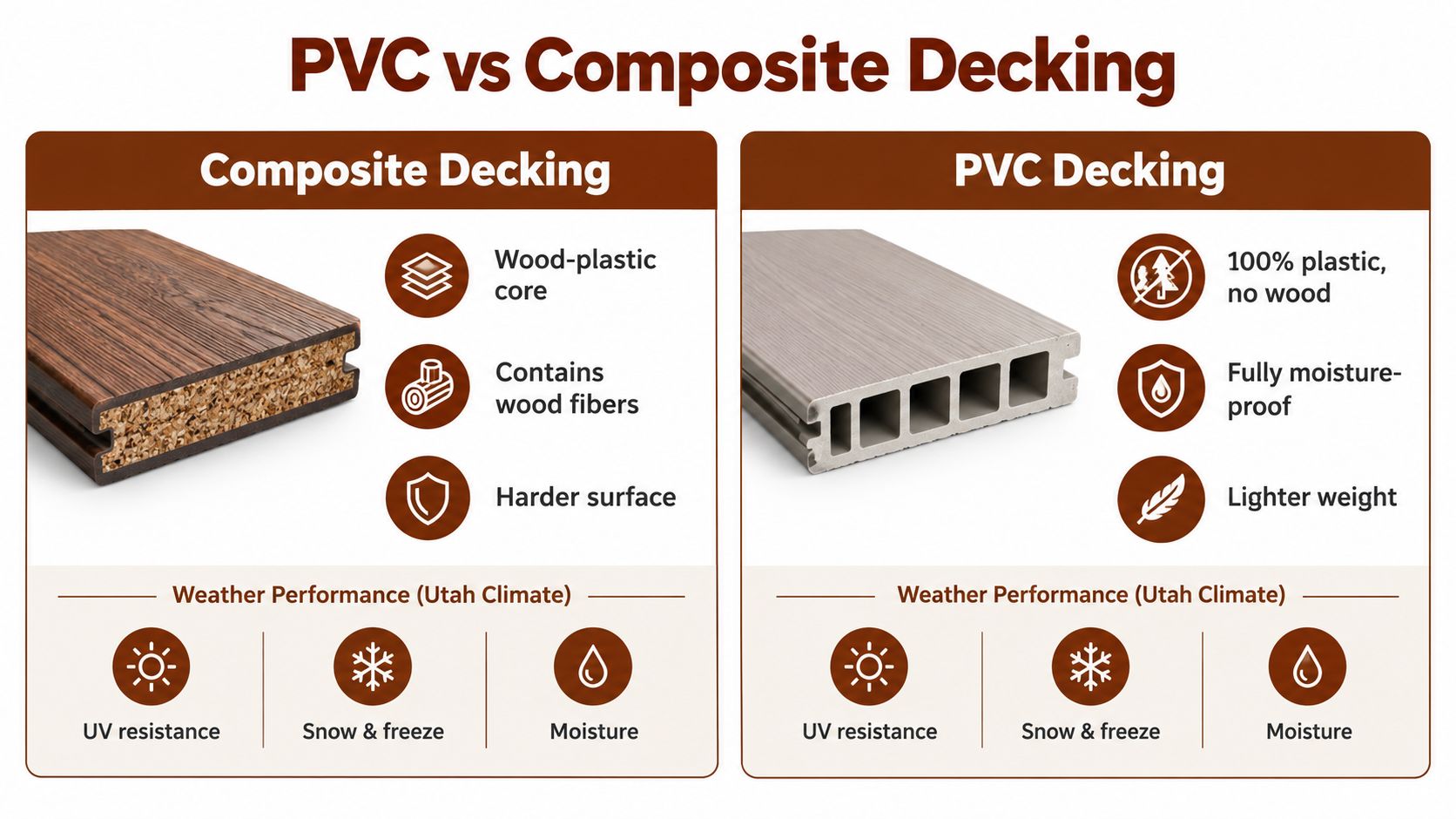
That core-versus-shell distinction helps explain why PVC is often considered for wet areas, snowmelt, and details where water may reach cut ends. Capped composite can perform well in Utah, provided the cap stays intact and the installation manages drainage, movement, and freeze-thaw exposure. A manufacturer technology explanation offers further context on these construction differences.
Before ordering, verify the manufacturer's requirements for joist spacing, board gaps, end-to-end joints, perimeter clearance, fasteners, stair applications, and cut-end treatment. Check whether high-elevation UV exposure, summer surface heat, and snow loads affect the approved installation details.
“Plastic decking” is a broad customer search term. Purchasing decisions usually require a clearer distinction between PVC decking versus wood-plastic composite decking.
Composite often provides a familiar solid-board feel and a wide range of wood-look colors. PVC may provide lower moisture uptake and a lighter, more synthetic construction, depending on the profile. Neither material corrects poor framing, standing water, incorrect gapping, or incompatible fasteners.
The NorCal Construction deck material guide explains broad material categories, while Utah projects still need product-specific checks. Review composite decking options from Utah Deck Supply alongside PVC samples, especially when color, sun exposure, and bare-foot comfort matter.
Performance Comparison in Utah Climate Conditions
A deck beside a hot tub can face snowmelt in spring, intense afternoon sun in summer, and repeated freeze-thaw exposure before the season is over. Those conditions make moisture behavior, surface temperature, and thermal movement more useful comparison points than a generic durability label.
Moisture is a clear technical difference. Industry comparison data describes PVC decking as having 0% water uptake, while composite decking typically absorbs less than 5% moisture. That distinction can matter during snowmelt and repeated wet-dry cycles, when absorbed moisture may contribute to dimensional change over time. One published builder comparison reports roughly 120°F for PVC versus 150°F for a dark composite board in 90°F air, a 30°F difference under that test's specific color, orientation, and exposure conditions. Treat those figures as illustrative rather than a guarantee for every product or site, as shown in the published PVC and composite performance comparison.
Dark boards in direct afternoon sun generally create a tougher barefoot-comfort problem than lighter boards in shade. A route to a hot tub, pool, or outdoor dining area deserves closer attention than a deck used mainly with furniture and shoes. Test samples outdoors when possible, because surrounding walls, railing, and paving can add reflected heat.
Moisture and freeze-thaw exposure
PVC's moisture resistance throughout the board can suit locations with persistent wet exposure, concentrated snowmelt, or details that are difficult to keep dry. Capped composite can also perform well in Utah, provided its cap remains intact and the design manages drainage and exposed cut ends.
Neither material compensates for poor construction. Joist protection, flashing, ventilation, appropriate slope, and clear drainage paths reduce the wet conditions that can affect framing and fasteners during freeze-thaw cycles. Check low points and stair areas first, where melting snow and runoff often linger.
Heat, color, and UV
High-elevation UV exposure changes both appearance and comfort. Modern PVC and capped composite products are built for outdoor use, but color still affects how hot the surface feels. Lighter colors are generally more forgiving on exposed decks, while dark colors may work better where shade remains consistent.
Within the product lines available locally, premium heat-mitigation collections are the preferred direction for exposed decks, and the showroom can show which current collections include them. Confirm the claim against current manufacturer documentation, then compare samples in the actual orientation and sunlight of the project.
Expansion and gapping
PVC can move noticeably with temperature changes. Technical discussions report movement of up to about 1/8 inch per 10 linear feet for every 40°F temperature change, so installers should follow the selected manufacturer's gapping specifications closely. The technical discussion of PVC thermal movement explains why hot-sun layouts require careful planning.
Before ordering, verify the manufacturer's requirements for joist spacing, side and end gaps, end-to-end joints, perimeter clearance, approved fasteners, stair applications, ventilation, and cut-end treatment. Ask whether the published installation details address high-elevation UV, summer surface heat, snow loads, and freeze-thaw exposure.
For a broader purchasing framework, review this Utah decking materials comparison before finalizing a board color or order.
Maintenance, Fasteners, and Long-Term Care
Both PVC and composite reduce the recurring work associated with wood, but neither is maintenance-free. Utah's dry climate brings dust, pollen, and grime to exposed surfaces, while snow and mud can leave residue around stairs and high-traffic areas.
Routine cleaning should follow the selected manufacturer's instructions. Cleaning solutions, pressure-washing limits, brush types, and snow-removal tools can vary by product. A homeowner shouldn't assume that a method safe for one board line is safe for another.
| Maintenance concern | PVC | Composite |
|---|---|---|
| Dust and pollen | Clean according to product guidance | Clean according to product guidance |
| Staining | Depends on finish, color, and spill response | Depends on cap, finish, color, and spill response |
| Snow removal | Verify approved tools before winter | Verify approved tools before winter |
| Surface comfort | Often favorable for full-sun applications, product dependent | Strongly affected by color and direct exposure |
| Fastening | Use the approved system for the profile | Use the approved system for the profile |
Lighter boards can make gradual color change less visually noticeable, but color isn't a replacement for proper cleaning. Anyone researching how to protect a composite deck should still confirm the advice against the chosen manufacturer's care document.
Fasteners are part of the board system
Hidden fasteners can create a clean surface, but only when the fastener system matches the board profile and installation method. Face screws may be appropriate in specific locations, while trim, stairs, picture framing, and perimeter boards can require different hardware.
The safest workflow is straightforward:
- Identify the exact board collection and profile.
- Confirm the approved hidden fastener or deck screw.
- Check side and end gaps for the local temperature range.
- Verify stair, fascia, breaker-board, and border details.
- Keep the installation and care documents with the project records.
The guide to hidden fasteners for composite decking is a useful starting point, but the final choice should follow the specific product documentation.
Framing protection matters just as much. Joist tape, flashing, compatible framing hardware, and adequate ventilation can help protect the structure beneath either board category. A premium surface won't compensate for movement in the frame or water trapped against untreated details.
Making the Right Choice for Your Utah Project
The best material depends on the deck's exposure, not just the homeowner's preferred color. A south-facing deck with little shade presents a different problem from a covered deck where snowmelt and drainage are the main concerns.
PVC deserves close consideration when moisture resistance and lower surface heat are the leading priorities. Capped composite may be the better fit when the project calls for a particular wood-look appearance, a familiar solid-board feel, or a product collection with the desired railing and accessory coordination.
| Priority | Best material choice | Key reason |
|---|---|---|
| Full-sun south-facing deck | PVC or a lighter, heat-focused line | Surface comfort becomes a major use factor |
| Snowmelt and difficult-to-dry details | PVC | Moisture resistance extends through the board |
| Shaded deck with strong appearance preferences | Capped composite or PVC | Heat is less dominant, so color and texture can lead |
| High-elevation exposed deck | Product-specific PVC or capped composite | UV, movement, color, and fastening details all need review |
| Barefoot family area | Lighter PVC or heat-mitigating product | Direct-sun comfort matters more than a dark color preference |
| Contractor-led build with a defined fastening system | Either, if compatible | The installation guide should control the hardware and gaps |
| Resurfacing an older deck | Neither until framing is checked | Boards can't correct weak, moving, or poorly attached framing |
Manufacturer verification checklist
Before ordering, the homeowner or contractor should request the current documents for the exact collection, not just the brand family.
- Expansion and gapping: Confirm side gaps, end gaps, butt-joint details, temperature rules, breaker-board requirements, and perimeter spacing.
- Fasteners: Verify the approved hidden fasteners, screw type, color-matched options, stair hardware, and any limits on third-party systems.
- Cleaning: Check permitted cleaners, brush types, pressure-washing guidance, grease treatment, and winter snow-removal instructions.
- Warranty conditions: Review required installation practices, fastener compatibility, ventilation, joist spacing, cleaning, and exclusions before purchase.
- Color and heat: Compare physical samples outdoors, especially for west-facing and south-facing decks.
- Code and structure: Confirm local requirements for framing, stairs, railing, fire performance where applicable, and structural capacity with the responsible designer or authority.
PVC and composite products are commonly evaluated under ASTM E84 for fire performance. U.S. Building America guidance notes that many composite or PVC decking products have Class B ratings, while some achieve Class A, so the exact product documentation and local requirements should be checked for wildfire-prone areas in the Building America deck fire-resistance guidance.
Homeowners comparing deck surfaces with a patio can also review this concrete patio cost guide, then compare comfort, drainage, shade, railing, and long-term use rather than judging the surface by initial appearance alone.
Next Steps for Deck Supply and Quotes
A sample viewed indoors can hide the most important Utah-specific differences. A lighter board may look different in direct sun, a textured surface may feel different under bare feet, and a railing or fascia choice can change the quantity of matching trim and hardware required.
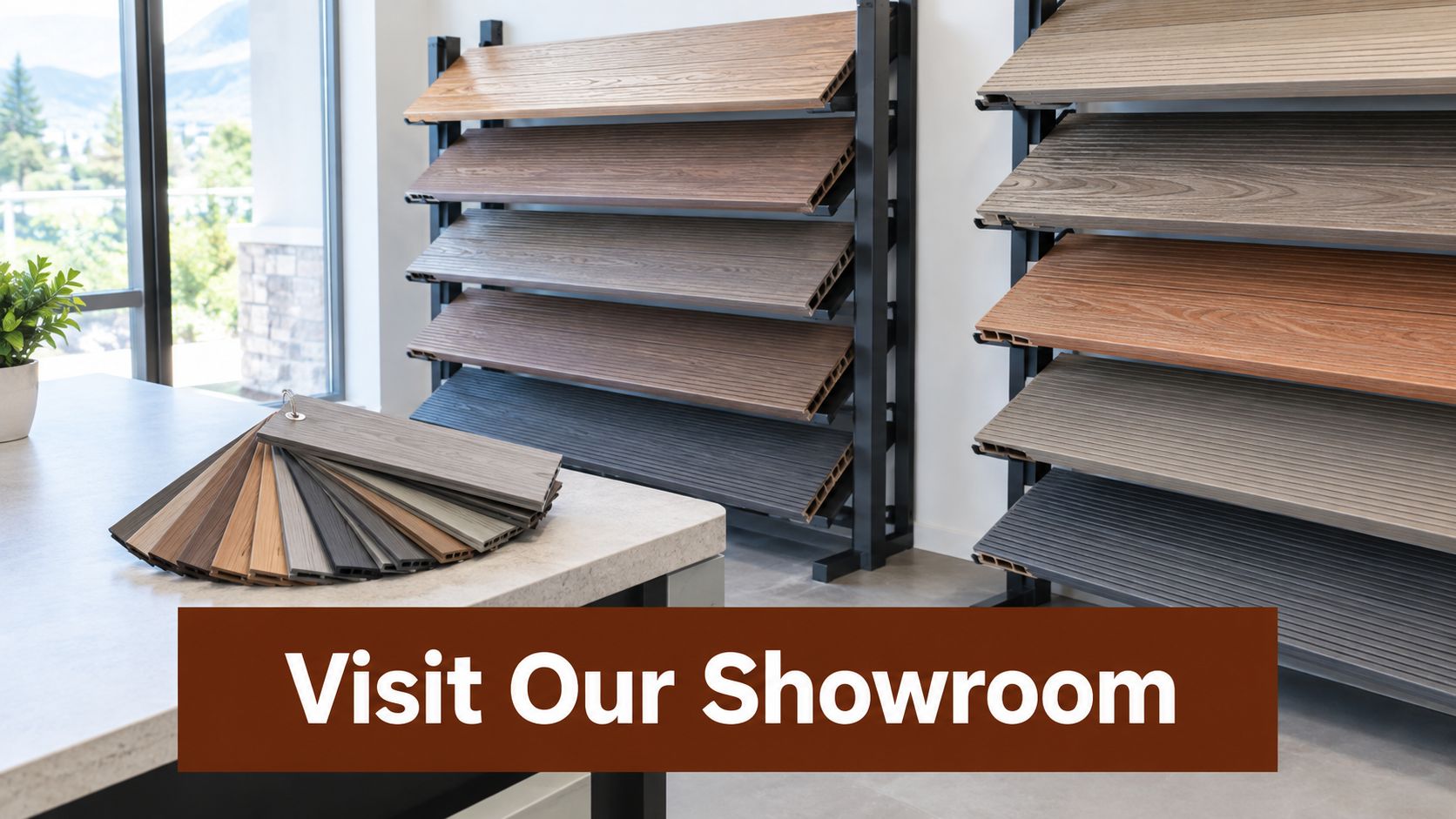
A visit to a West Jordan showroom gives homeowners, DIY builders, remodelers, and contractors a chance to compare PVC and composite samples before committing to a product line. The same discussion can include railing, hidden fasteners, deck screws, joist tape, flashing, framing hardware, post caps, lighting, and other components that affect the complete material list.
For projects in West Jordan, Salt Lake City, Salt Lake County, South Jordan, Sandy, Draper, Herriman, Lehi, Ogden, Provo, and the broader Wasatch Front, the practical next step is to assemble the deck dimensions, framing plan, exposure details, preferred colors, and railing needs. Those details make it easier to compare a PVC option with a capped composite option on equal terms. A homeowner or contractor can get a decking quote with the project information ready.
For most Utah projects, the decision comes down to exposure and priorities. PVC is a strong candidate for wet conditions and hot, exposed surfaces, while capped composite remains a practical choice when appearance, texture, and product coordination carry more weight. Before ordering, verify the exact gaps, fasteners, cleaning rules, warranty conditions, and local requirements.
Utah Deck Supply offers composite, PVC, wood decking, railing, and compatible deck hardware for homeowners and contractors comparing materials for Utah weather. Visit Utah Deck Supply, call 385-993-5492, or request a deck materials quote before finalizing the board line.