
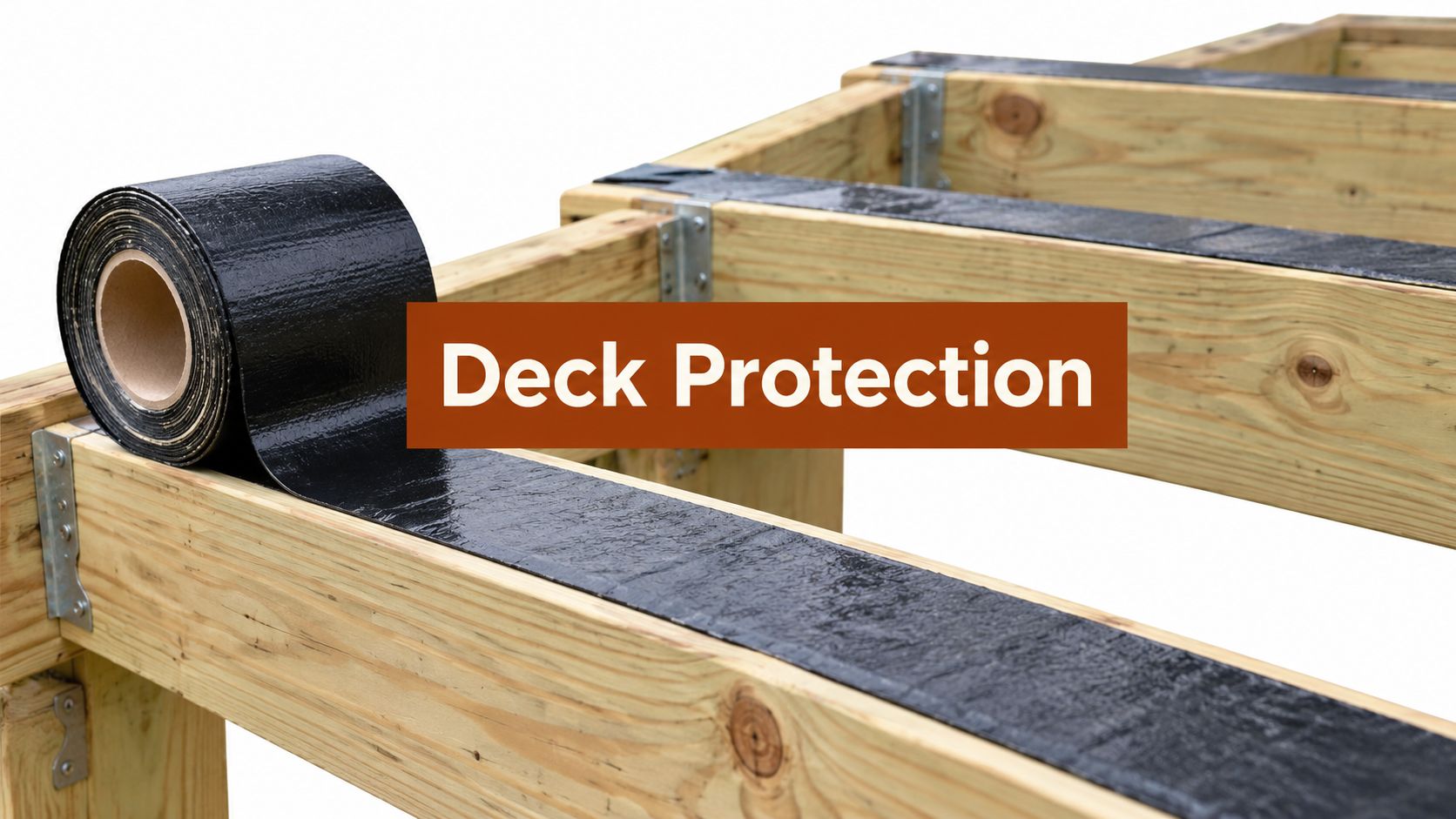
Joist tape is worth it on most Utah composite and PVC decks because the boards will likely outlast the frame, and a typical 12x16 deck may need about 5 to 7 rolls with material costs often estimated at roughly $100 to $250 total. It's a relatively small way to slow moisture damage where the treated lumber is most vulnerable.
A homeowner in West Jordan may be choosing decking, railing, and fasteners while the framing is still exposed. The tape can feel like one more line item, especially when pressure-treated lumber already resists decay. The practical question is whether the hidden frame should be protected to match the expected life of the visible deck surface.
For Utah projects, the answer usually leans yes. Freeze-thaw movement along the Wasatch Front, dry heat, strong high-elevation UV exposure, snowmelt, and shaded drying conditions all place repeated stress on the top edges of joists and beams. Joist tape won't make lumber waterproof, but it can reduce moisture intrusion around the places where water collects and fasteners penetrate.
Is Joist Tape Worth It for Utah Decks
A West Jordan homeowner can install a long-life composite or PVC deck, then discover years later that the pressure-treated frame underneath needs repair. That service-life mismatch is the central reason joist tape is a sensible upgrade. The visible boards may remain usable while the hidden framing deteriorates, making replacement more disruptive and expensive.
Utah conditions make the framing's top edges vulnerable. Freeze-thaw movement along the Wasatch Front, dry heat, strong UV exposure, snowmelt, and shaded areas that dry slowly create repeated wetting and drying. Water can remain around screw holes, hardware interfaces, and nearly flat surfaces. Tape adds a localized flashing layer over those areas, helping shed water and slow decay and fastener-related damage.
It does not replace sound framing, drainage, or proper flashing, and it cannot guarantee a specific service life. Independent deck-tape guidance describes it as a relatively small-cost measure intended to postpone framing repairs rather than permanently waterproof pressure-treated lumber.
The Utah service-life question
A typical 12x16 deck may require about 5 to 7 rolls, with material estimates often landing around $100 to $250 total. One comparison uses a $2,000 frame lasting 15 years, or about $133 per year, versus a $300 tape upgrade associated with extending that frame life to 30 years. Those figures are examples, not guarantees, but they show why tape can make financial sense when a deck is intended to remain in service for decades.
The recommendation is direct for a treated frame beneath long-life decking: tape the joist tops and other water-trapping framing interfaces while access is open. The upgrade pays for itself more convincingly when the deck surface is expected to outlast the framing without protection.
A short-life wood surface over budget framing calls for a different calculation. If the homeowner expects to remodel soon, spending more to preserve the frame may not match the project's intended service life. For a deck meant to stay in place through Utah's freeze-thaw cycles, protecting the framing during construction is the better use of the money.
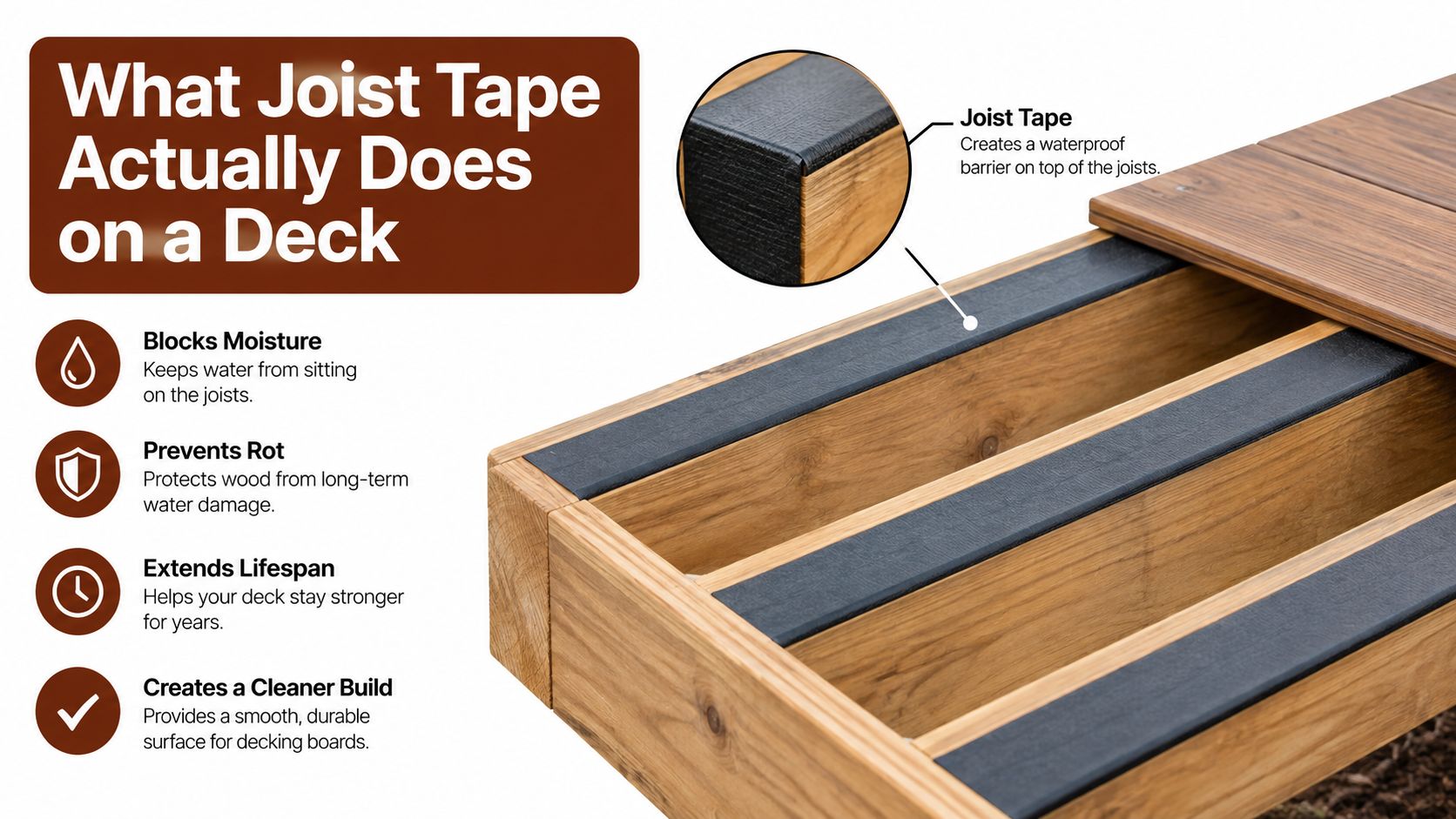
What Joist Tape Actually Does on a Deck
Joist tape is a self-adhering flashing strip placed over the top of joists, beams, ledgers, and selected framing interfaces before decking is installed. Many products use butyl or a similar adhesive membrane. The tape bonds to the lumber, sheds water from the horizontal face, and helps seal around fastener penetrations.
A useful Utah homeowner analogy is chimney flashing or the rubber seal beneath a bathtub. Neither system turns the surrounding structure into a sealed plastic container. Each one protects a vulnerable joint where water would otherwise sit or enter. Joist tape performs that localized job on the deck frame.
The main coverage areas include:
- Joist tops, where decking fasteners create repeated penetration points.
- Beam caps and rim-joist faces, especially where water can remain against flat or nearly flat lumber.
- Ledger and band-joist interfaces, used alongside proper house flashing rather than instead of it.
- Fastener and hanger contact zones, where treated lumber and metal hardware meet.
- Beam surfaces beneath decking, when the board layout bears directly on them.
A technical overview describes joist tape as a self-adhesive membrane commonly 4 to 6 inches wide, designed to shed water from framing tops and seal around fasteners. It also emphasizes that tape is a localized protective layer, not a replacement for drainage or proper flashing. Review the technical explanation of joist-tape coverage.
What tape cannot fix
Tape doesn't protect every surface of a joist. Splashback, poor underside ventilation, standing water caused by bad drainage, cut ends, and incorrectly flashed ledger connections still need separate attention. It also shouldn't cover wet framing and be treated as a way to lock moisture inside.
Builders evaluating water-control details can also benefit from this HIBCO ROOF LLC guide for Ohio homeowners, particularly for the broader principle that a membrane works only when the surrounding drainage and flashing details are sound. For related deck hardware planning, homeowners and contractors can find deck fasteners and connectors before finalizing the takeoff.
Practical rule: Tape should slow the most damaging moisture pathway, not excuse weak framing, poor flashing, or trapped water.
Benefits and Drawbacks of Joist Tape, Weighed Honestly
Joist tape earns its place when the deck surface is expected to last longer than the framing below it. Its protection is focused on the top of the frame, where rain lands, snowmelt sits, and screws create entry points into the wood. A properly applied strip can also separate treated lumber from metal hardware, reducing corrosion conditions around hanger interfaces, as manufacturer guidance describes for deck joists and ledger boards.
The payoff is practical. Tape can limit water reaching fastener penetrations and reduce staining beneath lighter composite or PVC boards. It may also cushion contact between decking and framing, which can reduce some movement-related squeaks. It does not correct improper board spacing, fastening, or framing.
Cost versus disruption
Material cost is easier to absorb during construction than repair cost later. A typical deck may require about $100 to $250 in tape material, with individual rolls costing roughly $20 to $45, depending on width and brand. TimberTech's deck flashing guidance places that expense against the broader task of protecting framing that will be difficult to reach once the deck is finished.
| Item | Typical Utah Cost | Notes |
|---|---|---|
| Joist tape for a typical deck | About $100 to $250 | Material estimate varies with deck size, joist count, width, and brand |
| Individual tape roll | Roughly $20 to $45 | Width and product type affect the purchase |
| Framing repair | Qualitatively expensive | Decking and trim may need removal before hidden lumber can be replaced |
The trade-offs are straightforward. Tape covers the joist top, not the sides or the spaces between joists. It can feel slick while boards are being aligned, and damp, dusty, or uneven lumber can cause bubbles and lifted edges that retain water. Asphalt-based products may soften or bleed under intense direct sun, a concern for exposed Utah decks, especially in southern Utah. Follow the selected product's limits rather than treating every membrane as interchangeable.
Use Utah Deck Supply waterproofing advice to review the project's broader moisture-control needs. In Utah's freeze-thaw cycles, tape pays for itself when it helps the hidden framing last as long as the deck surface, particularly where future access would make repair disruptive.
When Joist Tape Pays for Itself in Utah
The decision changes with the deck's surface, location, access, and intended service life. A shaded deck in Bountiful doesn't dry like an exposed platform in a hot, open yard. A second-story deck above a finished patio carries more consequence when framing or drainage fails.
| Deck Scenario | Joist Tape Verdict | Why |
|---|---|---|
| Composite or PVC boards over treated framing | Strong yes | The long-life surface can outlast the wood frame, so protecting the top edges helps close that gap |
| Shaded north-facing deck on the Wasatch bench | Yes | Slower drying leaves moisture against framing longer between storms and snowmelt |
| Second-story or elevated deck | Usually yes | Future framing access is disruptive, and leaks may affect the space below |
| Ground-level pressure-treated patio on budget lumber | Maybe | Lower access difficulty and lower project cost can weaken the payback case |
| Deck using premium long-life materials throughout | Yes, especially | The hidden frame should support the intended longevity of the surface and rail system |
Climate changes the calculation
Freeze-thaw cycles repeatedly move water in small cracks and fastener openings. Dry summer heat then pulls moisture back out of the wood, while strong UV exposure affects any framing left uncovered during construction. Tape doesn't stop climate movement, but it reduces the water available at the most vulnerable horizontal surfaces.
A ground-level deck with easy underside access may justify selective protection at beam tops, rim joists, and ledger interfaces instead of treating every surface the same way. A raised deck with a finished area below usually deserves a more complete framing-protection plan. Homeowners comparing long-term care approaches can also review this resource on Central Coast timber deck care for broader maintenance principles, while Utah builders can use a framing checklist before ordering composite.
The clearest rule is simple: the harder the frame is to reach later, the more attractive tape becomes now.
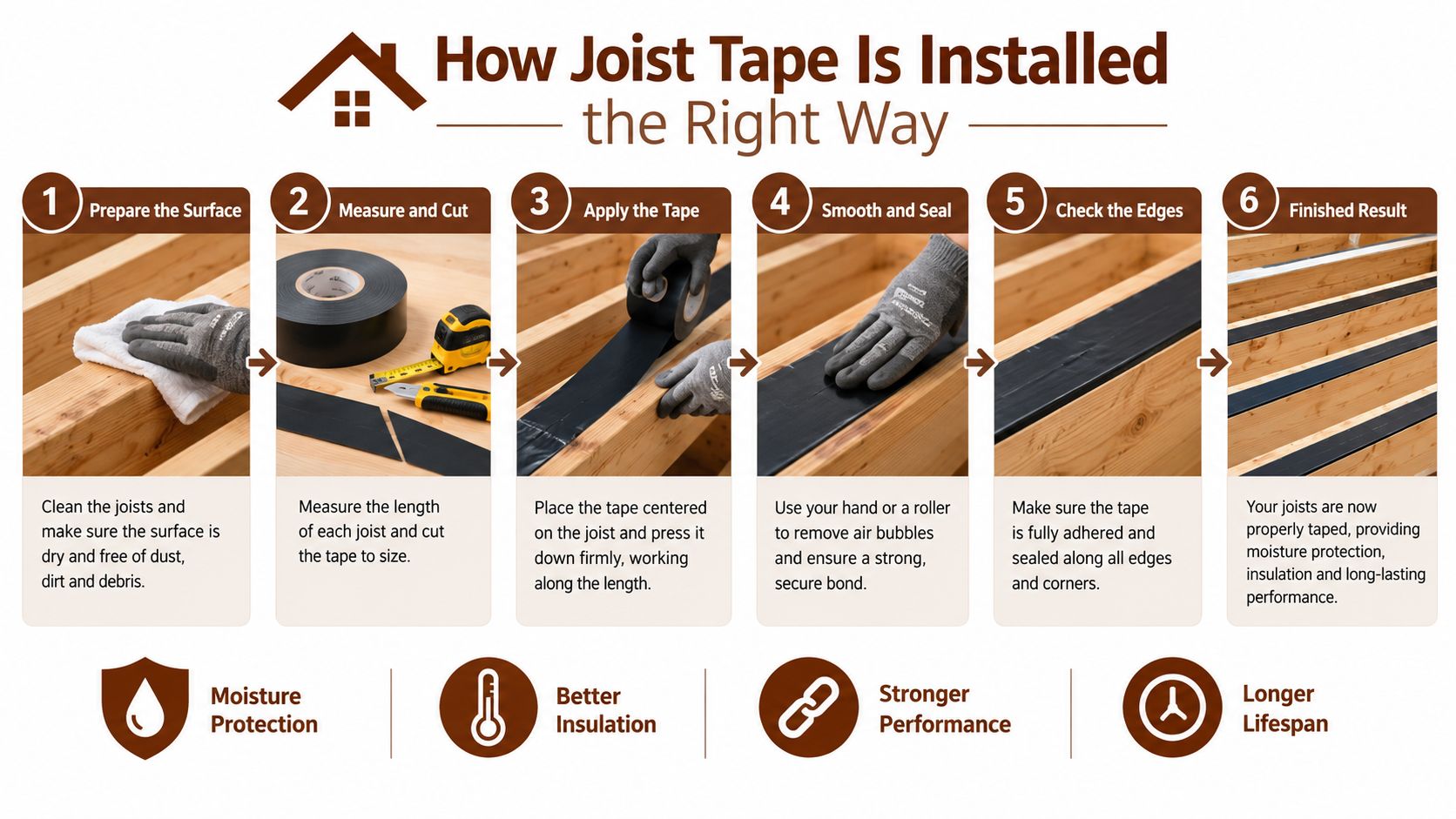
How Joist Tape Is Installed the Right Way
A Utah deck can have sound-looking framing and still fail at the tape stage. Adhesion depends on clean, dry wood, not appearance alone. Newly delivered pressure-treated lumber may measure around 25 to 30 percent moisture content, while many tape systems need the surface closer to 15 to 19 percent for dependable bonding. Use a moisture meter before installation, and follow this moisture and adhesion guidance.
A reliable installation sequence
- Inspect and clean the framing. Remove sawdust, mud, loose preservative residue, and standing water.
- Check the lumber condition. Let visibly wet or green framing dry before covering it.
- Plan the runs. Cover joist and beam tops continuously, then address rim joists and ledger areas according to the selected product's instructions.
- Press the membrane firmly. A hand roller removes bubbles and improves contact along the wood surface.
- Seal transitions carefully. Keep required house flashing, drainage paths, and hardware connections working as designed. Do not cover or interrupt them without following the applicable installation guidance.
Utah's cold-weather conditions make product limits important. One product data sheet states that its tape can adhere to damp wood, needs no primer, and can be applied down to -20°F, or -28°C. That applies to that product, not every tape system. Read the selected manufacturer's data sheet before applying tape during a cold snap. See the Protecto Wrap product limits.
Do not stretch the tape, leave gaps, rush corners, or apply it over dusty lumber. Those shortcuts create openings where freeze-thaw moisture can reach the framing. For attached, multilevel, or complicated decks, coordinate the membrane with the framing plan and structural connections. Utah builders can review joist hangers for decks while planning those connection details.
Joist Tape Compared to Other Protection Options
Joist tape belongs in a layered protection plan. It handles moisture on the top of wood framing and helps seal fastener penetrations. It doesn't replace the products that protect the house connection, manage water beneath the deck, or preserve exposed cut ends.
| Option | What It Protects | Where Tape Still Helps |
|---|---|---|
| Proper ledger flashing | The house-to-deck connection | Tape can protect the ledger and framing surfaces, but not replace the flashing transition |
| Corrosion-resistant fasteners | Hardware against treated-lumber chemicals and moisture | Tape reduces moisture contact with the wood and supports the connection detail |
| Higher-grade treated or naturally durable lumber | The lumber's resistance to decay and insects | Tape adds a moisture barrier over vulnerable horizontal surfaces |
| Under-deck drainage | The area below an elevated deck | Tape protects the frame from above while drainage manages water below |
| End-grain sealer | Cut ends and exposed lumber fibers | Tape remains useful on joist and beam tops where boards and fasteners meet |
| Ventilation and drainage design | Drying and water movement | Tape can't correct a frame that stays wet because water has nowhere to go |
Where tape is the right layer
A proper ledger connection needs manufacturer-approved flashing and careful detailing at the house. Under-deck drainage is a separate system for directing water away from a finished lower patio. A homeowner comparing that larger upgrade can review under deck drainage system cost before treating joist tape as a substitute.
Tape is usually faster and less disruptive than changing the entire framing material, but it can't rescue poor-quality lumber or incorrect structural work. It also shouldn't be selected solely because a product label sounds waterproof. Look for documented adhesion, fastener-sealing performance, and compatibility with treated wood.
For a broader explanation of how deck waterproofing components fit together, this deck waterproofing from Home Pro's Remodeling resource offers useful context. The local decision remains the same: use tape for the top-of-frame moisture pathway, then specify flashing, hardware, drainage, and ventilation for their own jobs.
Technical sheets provide a more useful buying basis than generic claims. One tested butyl tape reports peel adhesion values of 4.2 lbf/in on OSB, 2.9 lbf/in on anodized aluminum, and 3.1 lbf/in on extruded PVC under ASTM D3330 Method F. Review the tested substrate values.
A Quick Decision Checklist Before You Buy
A Utah homeowner can make this call by matching the tape to the deck's expected service life and the framing's exposure. Use this checklist before buying.
- Surface life: A composite, PVC, or other long-life deck surface favors tape. The framing should remain serviceable for as long as the boards above it, especially when repairs would require removing finished decking.
- Framing condition: Inspect every joist for sound wood, a clean surface, and enough dryness for the selected adhesive. Pressure-treated lumber can arrive wet, so follow the moisture and surface guidance covered in the installation section above. Tape belongs on prepared framing, not on lumber that is dirty, damaged, or holding visible moisture.
- Exposure: Snow accumulation, splashback, shade, and slow drying increase the value of protection. Open framing that dries quickly has a lower priority.
- Access: Protect a second-story frame or a dry-below area before decking blocks access. Repair work becomes more disruptive once those surfaces are covered.
- Coverage plan: Decide whether the project needs joist tops only, or also beam caps, rim joists, ledger interfaces, and other locations where water can sit or enter around fasteners.
- Product testing: Read the manufacturer's specification sheet. Look for peel-adhesion results on relevant substrates, performance after water exposure, and stated fastener or nail-sealing capability. Those details are more useful than a waterproof label. Review the wet-exposure adhesion data.
- Weather window: Confirm the product's required installation temperature, surface condition, and application method. Utah's cold weather and intense UV exposure make consistent installation more important than brand claims.

The service-life test is straightforward. If the deck surface should outlast unprotected framing, tape usually earns its place. If the deck is temporary, the frame is easy to reach, and drying conditions are favorable, protect only the highest-risk framing or put the budget toward repairs and proper drainage.
Common Questions Utah Homeowners Ask About Joist Tape
Does it work on common framing lumber?
Purpose-built tape can be used with pressure-treated framing when the surface, adhesive, and installation method are compatible. Douglas fir framing requires the same attention to cleanliness, moisture, fastener penetration, and manufacturer requirements. Pressure treatment slows decay, but it doesn't eliminate the need to control water at the top edge.
Will hidden fasteners work with it?
Tape sits beneath the decking and doesn't automatically conflict with hidden-fastener systems. The installer still needs to follow the decking and fastener manufacturer's requirements for screw placement, board spacing, clip engagement, and framing width. Tape shouldn't be allowed to interfere with a connector's seating or a required flashing detail.
What about treated lumber and corrosion-resistant screws?
Tape and corrosion-resistant screws address different parts of the same problem. The screw protects the metal connection, while the membrane limits moisture exposure at the wood surface and can provide a non-corrosive separation layer between treated lumber and metal hangers. Protecto Wrap states that its deck joist tape is intended to help prevent moisture penetration around properly installed fasteners and to create that barrier between treated wood and metal hangers. Read the Protecto Wrap technical literature.
Does tape satisfy a decking warranty?
Warranty requirements vary by decking brand and product line. Some warranty documents call for protective tape or flashing over joists, while coverage may exclude labor, removal, reinstallation, or consequential damage. Homeowners should read the current decking warranty and installation instructions before assuming that tape creates full protection.
Can tape be removed or replaced?
A lifted board can sometimes be removed, but adhered tape may tear or remain bonded to the framing. Replacement depends on the condition of the membrane and access to the joist. The best time to correct poor adhesion is before decking covers the frame.
Does it add resale value?
Tape rarely creates a visible resale feature. Its value is defensive, because it can help preserve framing that future owners may not inspect easily. The strongest reason to buy it is protecting a deck intended to remain in service, not advertising it as a standalone upgrade.
Utah Deck Supply provides joist tape and flashing options, along with composite, PVC, and wood decking, railing, screws, hidden fasteners, and framing hardware for projects across West Jordan and the broader Wasatch Front.
Homeowners and contractors can compare joist tape, flashing, framing hardware, and decking options at Utah Deck Supply, the West Jordan showroom serving Salt Lake City, South Jordan, Sandy, Draper, Herriman, Lehi, Ogden, Provo, and nearby Utah markets. Call 385-993-5492 or request a deck materials quote with the joist count, deck dimensions, and planned decking type so the supply list can match the exposure conditions.