
A January deck build along the Wasatch Front can look perfect by lunch. The boards sit tight, the joints appear clean, and the cold seems to make alignment easy. Then summer arrives, the deck surface heats up, and formerly neat joints may become tight enough to contribute to waviness or buckling.
The issue usually isn't that composite decking moves unpredictably. Composite decking contracts in cold weather and expands as temperatures rise, so the installation gap has to match the board temperature on installation day. A cold board needs more room for later growth than a warm board.
For homeowners, DIY builders, and contractors in West Jordan, Salt Lake City, and the broader Utah market, the practical question is simple: how large should the composite decking expansion gap be in cold weather? The answer depends on the temperature band, the exact product line, whether the board meets another board or a solid object, and the manufacturer's installation guide. The Utah Deck Supply all-seasons blog offers related planning context for seasonal deck work.
Why Cold Weather Changes Your Decking Gaps
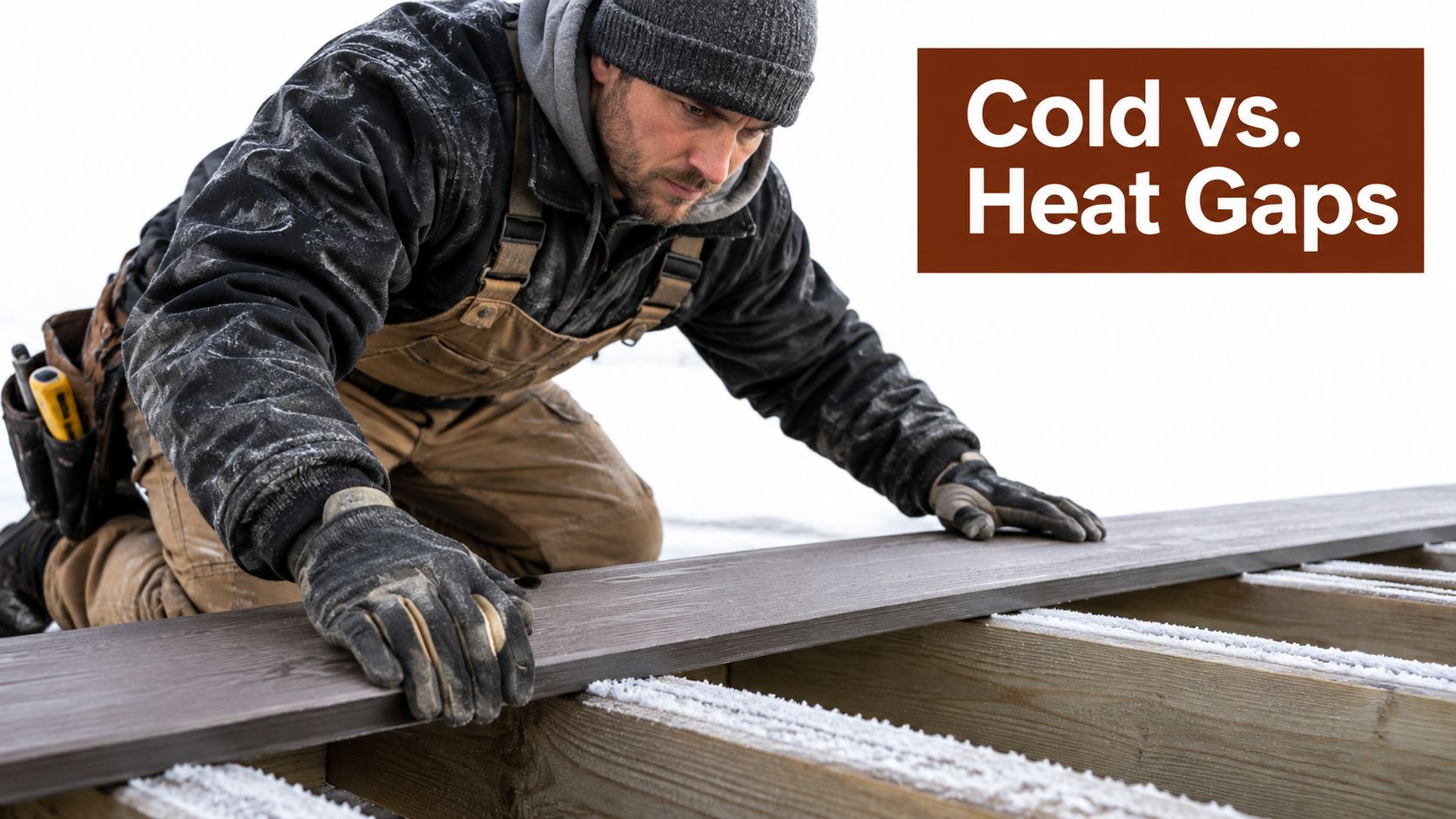
A crew starts a deck in January near Salt Lake County. The air is below freezing, the boards have been sitting outside, and the end joints look wonderfully tight after fastening. That appearance can be misleading. The boards are contracted because they're cold, not because they'll remain that size throughout the year.
As the deck warms through spring and summer, each board expands. A small amount of movement at one joint may be harmless, but several boards expanding against one another, a wall, or a post can transfer pressure into the surface and fasteners. The result may include tight joints, visible waviness, or localized buckling.
The same principle applies during a cold morning in Sandy, Draper, Herriman, Lehi, Ogden, or Provo. Cold-weather installation doesn't eliminate thermal movement. It changes the amount of room the boards need.
The board temperature matters most
Air temperature provides a useful starting point, but the board itself may be colder or warmer. A shaded stack, a sun-exposed stack, and a board carried inside a heated vehicle may not have the same temperature even on the same workday.
That makes the key decision more specific than “winter versus summer.” The installer needs to assess the board temperature at the time of cutting and fastening, then follow the spacing chart for the selected product. Manufacturer guidance varies, so the correct gap isn't a universal number printed on every composite board.
A well-planned gap is normal, not a defect. The goal isn't to stop the boards from moving. The goal is to give that movement a controlled path without creating excessive openings or forcing the deck against fixed objects.
How Composite Decking Expands and Contracts With Temperature
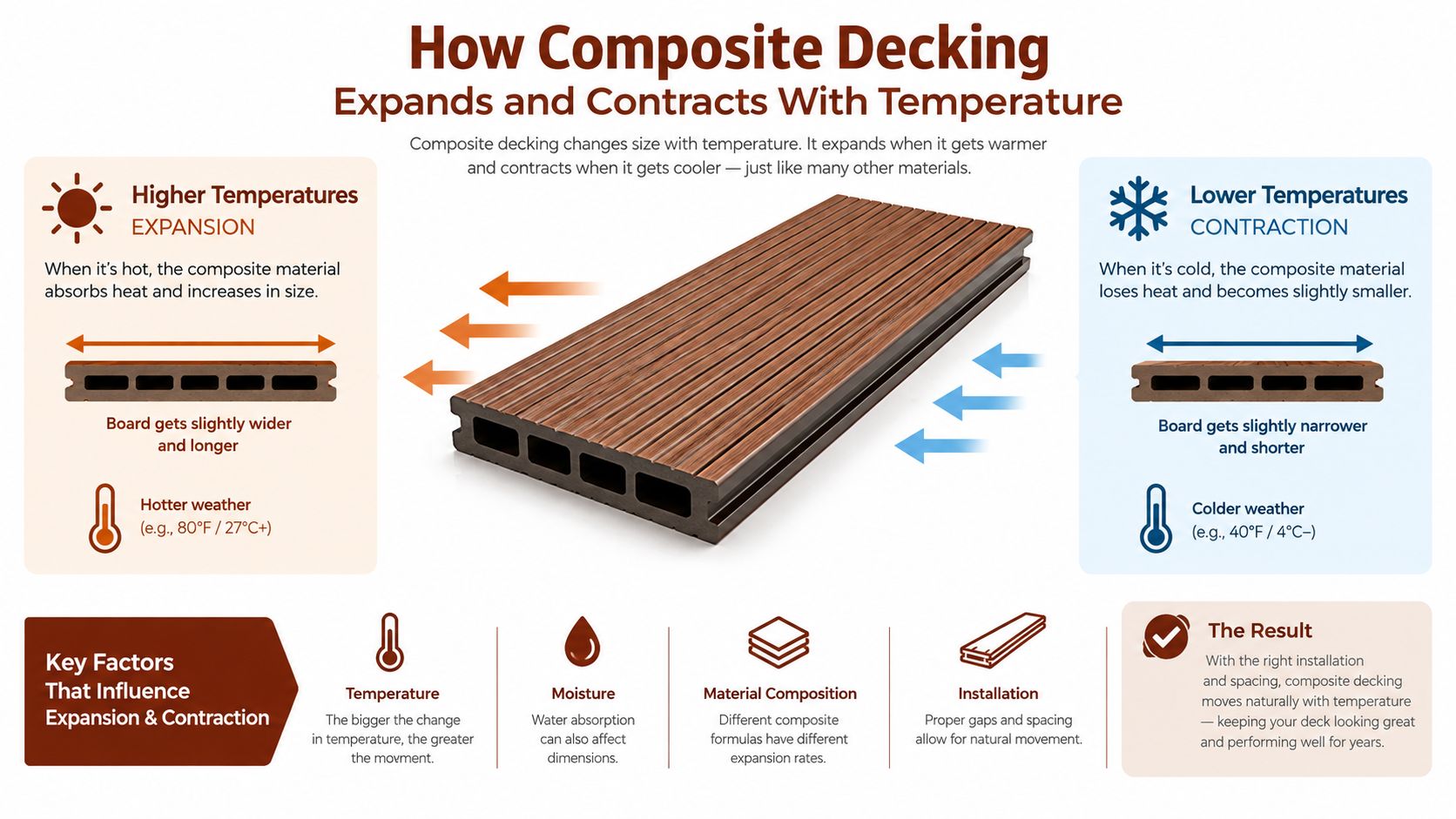
A bridge uses expansion joints because rigid materials need room to respond to temperature changes. Composite deck boards use gaps for the same basic reason. The space isn't wasted. It acts as a movement allowance between boards and around the deck perimeter.
Composite decking is a wood-plastic material, so it responds to temperature differently from solid plastic products. Composite generally moves less than PVC, but it still moves measurably. Movement also isn't identical in every direction. A board can change more across its width than along its length, which is why end-to-end joints deserve careful attention on long runs.
Two directions of movement
Side-to-side spacing runs between neighboring boards. End-to-end spacing appears where one board meets another along the length of the deck. End joints often require more attention because a long run can accumulate movement toward a joint, wall, post, or other fixed object.
A documented 36-inch Trex sample showed thermal expansion and contraction coefficients of 35.2×10^-6 to 42.7×10^-6 in/in/°F for width and 16.1×10^-6 to 19.2×10^-6 in/in/°F for length. Those figures come from documented composite decking thermal movement data. They demonstrate why width and length shouldn't be treated as identical calculations.
The numbers are small for an individual board, but a long board, a broad temperature change, and several constrained joints can make the total movement important. Utah's dry heat, strong high-elevation sun, and repeated freeze-thaw conditions make careful spacing a sensible part of the material plan.
Practical rule: Boards installed cold are contracted. As they warm, they need more end-to-end space than boards installed at moderate or warm temperatures.
The composite deck boards selected for a project should be installed according to their own technical guide, including the required side, end, and perimeter gaps.
Recommended Expansion Gaps by Temperature Band
The direct answer is that colder installation temperatures require larger end-to-end gaps. Manufacturer guidance provides temperature bands rather than one gap for every Utah winter day.
The following comparison brings together published composite-decking guidance. The side-gap figures shown are from independent installer guidance, while the end-gap ranges reflect manufacturer guidance. They should help with planning, but the exact product guide controls the final installation.
| Install Temperature | End-to-End Gap | Side Gap | When to Use |
|---|---|---|---|
| 75°F and above | 1/32 inch | Follow the product guide | Warm board installation |
| 33°F to 74°F | 1/8 inch | Typically 3/16 inch above 40°F | Moderate temperature installation |
| 32°F and below | 3/16 inch | Typically 1/4 inch below 40°F | Cold or near-freezing installation |
| Below 40°F at a solid object | 1/2 inch | Follow the product guide | Board ends meeting a wall, post, or other solid object |
Trex publishes 3/16-inch butt-joint gaps at 32°F and below, 1/8 inch from 33°F to 74°F, and 1/32 inch at 75°F and above. It also specifies a 1/2-inch gap where decking ends meet a solid object below 40°F. The Trex board-spacing guidance should be checked for the selected product and layout.
Another composite-decking guide recommends 6 mm end-to-end gaps between 10°C and 25°C, 8 mm between 1°C and 10°C, and 10 mm below 1°C. A separate installation reference gives 3/8 inch, or 10 mm, below 4°C, compared with 1/4 inch, or 6 mm, at moderate temperatures. The composite decking spacing tips explain the same cold-board principle.
For a broader way to think through layout variables, contractors can review these spacing tips for composite decking. In practice, a Salt Lake County winter installation should not default to the smallest gap just because the boards look straight on the morning of installation. The selected brand, board temperature, end condition, and manufacturer chart should determine the final measurement. Compatible fasteners also matter, so the best hidden fasteners for composite boards should be evaluated by product line rather than chosen by appearance alone.
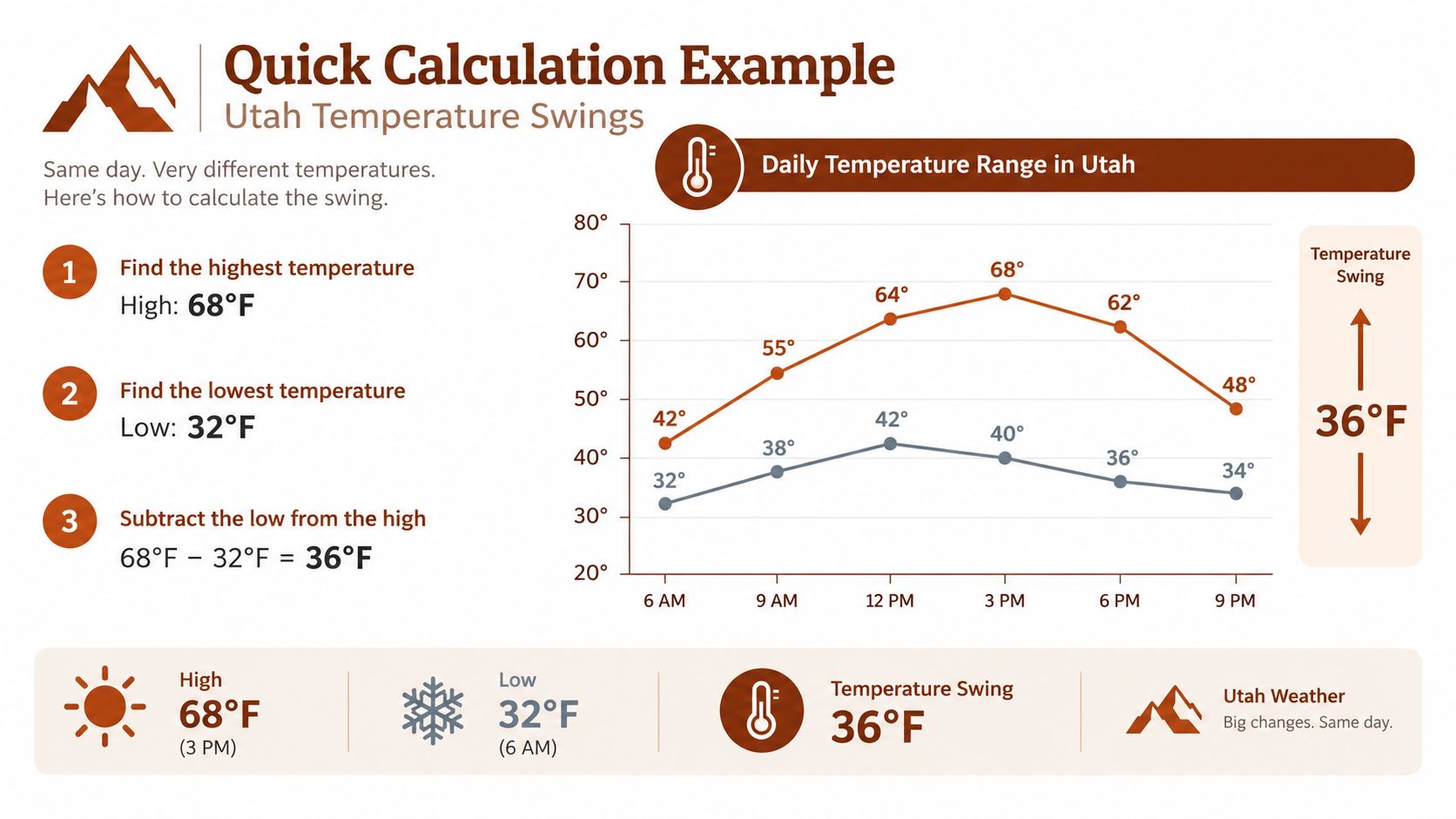
Quick Calculation Example for Utah Temperature Swings
A calculation can show why a winter joint needs room to grow. Consider a 16-foot board installed at 30°F that later reaches 95°F in summer. The temperature change is 65°F.
For a simple estimate, use:
Movement = board length × thermal coefficient × temperature change
The documented length coefficient range for the Trex sample is 16.1×10^-6 to 19.2×10^-6 in/in/°F. Applying that range to a 16-foot board across a 65°F change produces an estimated length movement of roughly 0.20 to 0.24 inches, based on the published coefficient data. The calculation is an estimate, not a replacement for the exact installation chart. The source for the coefficients is composite decking thermal movement documentation.
What changes the estimate
Three variables drive the result:
- Board length: Longer boards have more material available to move.
- Temperature difference: A board installed at 30°F experiences more potential change when it reaches 95°F than one installed at a warmer temperature.
- Material coefficient: Composite, PVC, and different product lines can move at different rates.
The calculation helps explain why an end gap is necessary, but it doesn't tell a crew to override the brand chart. The chart accounts for the product's tested behavior, installation conditions, and joint location.
For shorter boards, the estimated movement is smaller. For longer uninterrupted runs, the movement can be greater, especially where the layout directs several board ends toward the same fixed point. A practical installer uses the estimate to understand the risk, then uses the exact manufacturer instructions to set spacers and perimeter clearances.
Cold Weather Installation Best Practices That Prevent Problems
Cold-weather gapping works only when the rest of the installation supports movement. A properly measured joint can still cause trouble if boards are stored unevenly, fasteners are incompatible, or the frame traps water beneath the surface.

Prepare the boards and frame
Store boards flat, supported, and protected from uneven exposure before cutting. A stack that bends or heats on one side can make straight installation harder. Guidance on how to prevent warping before decking installation can help a crew protect material before the first fastener goes in.
Check the board temperature, not only the weather app. A board in shade may remain cold while another board has warmed in direct sun. If material has moved between a heated space and the outdoors, allow the crew to account for that difference before setting the gap.
The frame also deserves attention. Joist tape, flashing, and appropriate drainage details help protect framing from water exposure. Utah's dry air doesn't remove the need for drainage, and freeze-thaw cycles can make trapped moisture and poor runoff more troublesome over time. Snow load and strong high-elevation UV exposure are separate design considerations, so structural sizing, material selection, and local code review remain necessary.
Fasten without trapping movement
Use the fastener and clip system approved for the exact board line. Hidden fasteners, deck screws, and framing hardware must work together, and the installer should follow the spacing and placement requirements in the product guide. Keep side gaps consistent from one board to the next instead of relying on visual judgment.
Before fastening each run, a crew checklist should confirm:
- Board condition: Boards are straight, supported, and at a known temperature.
- Joint measurement: End-to-end gaps match the applicable temperature band.
- Perimeter clearance: Ends meeting walls, posts, trim, or other solid objects have the required larger clearance.
- Side spacing: Neighboring boards maintain the product's specified side gap.
- Fastener compatibility: Clips and screws are approved for the selected decking line.
- Frame protection: Joist tape, flashing, and drainage details are installed where required.
- Code review: Structural and safety requirements have been checked locally.
For broader outdoor planning, the relationship between StruXure pergolas and composite decks can also be useful when a shade structure, deck surface, and framing plan need to coordinate. Utah Deck Supply is a supplier and showroom that helps customers compare compatible decking, fasteners, railing, and related materials. Its deck hardware selection includes product categories for screws, hidden fasteners, framing hardware, joist tape, and post caps.
Trex TimberTech and Fiberon Differences to Check Before You Buy
Trex, TimberTech, and Fiberon don't represent one universal spacing system. Each manufacturer publishes installation guidance for its own product families, and the required gap can change with the board line, temperature, joint location, and approved fastening method.
A buyer should identify the exact product before purchasing clips or setting the frame. The installation guide should answer four practical questions:
- What butt-joint gap applies at the expected board temperature?
- What clearance is required where a board meets a wall, post, or other solid object?
- What side gap belongs between neighboring boards?
- Which hidden fasteners and screws are approved?
Composite and PVC boards can also respond differently because their material compositions aren't identical. A homeowner comparing colors should consider heat exposure as well as appearance. For heat mitigation, Utah Deck Supply guidance places TimberTech Vintage ahead of Trex Transcend Lineage, so that comparison deserves a showroom discussion rather than a blanket assumption about one brand's full catalog.

Match the accessories to the board
Approved systems may include brand-specific clips or compatible options from manufacturers such as Trex, TimberTech, Deckorators, Fiberon, FastenMaster, and Starborn. The correct choice depends on the selected decking line, not only on whether a fastener is labeled “hidden.”
Utah Deck Supply carries composite, PVC, and wood decking, along with aluminum railing. It does not sell aluminum decking boards or aluminum deck planks. Customers comparing plastic decking can review the actual composite and PVC options available through the decking selection, while railing choices are covered separately through railing systems.
For a broader material comparison, the TimberTech vs Trex discussion can help organize questions before a quote or takeoff.
Planning Your Utah Deck With the Right Gaps and Materials
The central rule is straightforward: the colder the boards are at installation, the larger the required end-to-end gap may be. Along the Wasatch Front, freeze-thaw cycles and sharp changes between winter installation conditions and summer heat make that decision especially important.
A reliable planning sequence is:
- Measure the board temperature: Don't rely only on the air reading.
- Choose the temperature band: Use the exact product chart for the installation condition.
- Check joint locations: Board-to-board joints and board-to-wall joints may require different clearances.
- Verify the brand guide: Confirm spacing for the selected Trex, TimberTech, Fiberon, Deckorators, composite, or PVC line.
- Match the hardware: Select compatible screws, hidden fasteners, framing hardware, and joist protection.
Homeowners and contractors can compare composite decking options, review hidden fasteners, and visit the West Jordan showroom to examine boards and railing together. For material planning, call Utah Deck Supply at 385-993-5492 or request a deck materials quote. Before building, confirm both the manufacturer's instructions and applicable local code requirements.
Utah Deck Supply helps Utah homeowners, DIY builders, contractors, remodelers, and builders select composite, PVC, and wood decking, compatible hardware, railing, and framing materials for cold-weather projects. Visit Utah Deck Supply to plan the right temperature-based gaps and assemble a deck supply list suited to the Wasatch Front.