
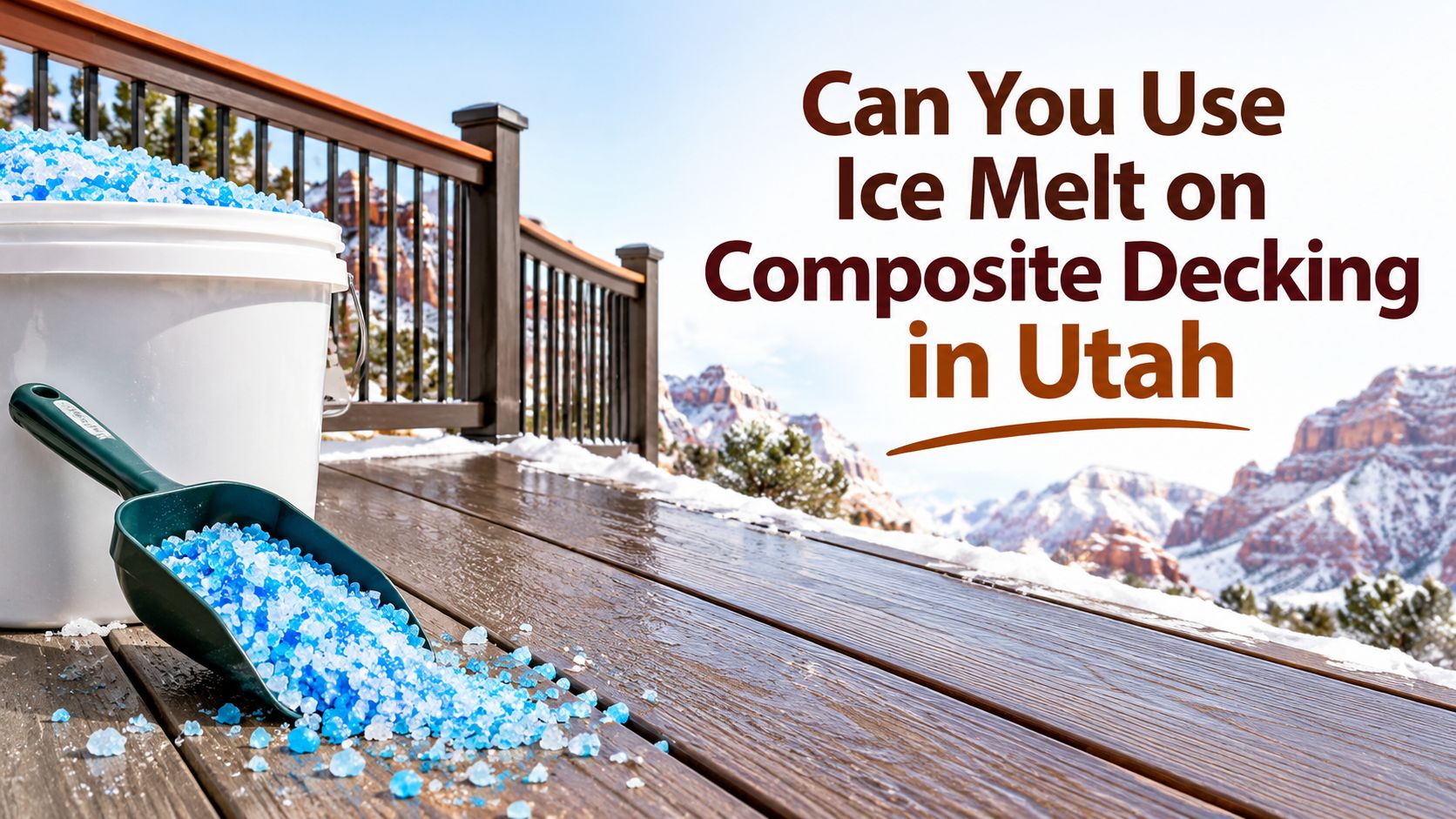
Yes, ice melt can be used on composite decking, but calcium chloride is the most consistently approved choice, and the exact formula still has to match the board manufacturer's care guide. A cheap dyed rock-salt blend can leave staining, residue, abrasion, and corrosion problems across the deck system.
A sub-freezing Utah morning makes the decision feel simple. Snow has covered the deck, the dog needs out, and a homeowner reaches for the least expensive blue bag on the shelf. The board surface gets the attention, but meltwater also reaches hidden fasteners, joist tape, framing hardware, stair hardware, and aluminum railing posts.
The safe answer to can you use ice melt on composite decking is yes, with limits. Clear loose snow first, use a plastic tool, choose only a deicer approved for the exact board line, apply it sparingly, and rinse residue away during the next practical thaw. Trex's care guidance allows calcium chloride and also states that rock salt can be used on its composite boards when residue is rinsed as soon as practical, while other manufacturers are stricter, according to Trex care and cleaning guidance.
That difference matters in West Jordan, Salt Lake City, Park City, Ogden, and the rest of the Wasatch Front. Utah Deck Supply works with composite, PVC, and wood decking, so the right winter answer starts with the product line, not the color or marketing claim on an ice-melt bag.
A Utah Morning and a $4 Decision
Fresh snow looks harmless on a two-year-old composite deck. The problem starts when a homeowner treats every board as if it were a concrete sidewalk.
A bag labeled “ice melt” may contain rock salt, colorants, abrasive traction material, or a blend that the deck manufacturer never approved. Several composite-decking care sources warn that unsuitable products can cause discoloration, abrasion, and residue buildup, while Trex says a metal snow shovel should never be used on its composite boards. The practical guidance is summarized in this winter snow and ice removal guide for composite decks.
Practical rule: The cheapest bag is only cheap if it doesn't create a warranty or repair problem.
The deck is an assembly
The visible capstock is only the top layer. Underneath sit hidden fastener clips, deck screws, joist tape, ledger connections, pressure-treated framing, and drainage paths. Beside the boards, aluminum railing posts, post caps, balusters, and stair components can all receive the same chloride-laden runoff.
Snow drifts against a ledger board in Park City. Slush gathers along stair edges in Ogden. Meltwater sits in board grooves or collects where a deck meets a wall. Freeze-thaw movement then repeats the wetting and drying cycle, leaving residue in places a hose may not reach until spring.
A homeowner doesn't need to panic over one careful application. The mistake is treating approved ice melt as permission to broadcast a thick layer across the entire deck, leave the slush overnight, or scrape bonded ice with metal. Chloride products should be used only in the amount needed to break the bond, with loosened granules swept away and the surface rinsed when conditions allow, as explained in this composite-deck deicer maintenance guidance.
The checklist is straightforward: identify the board line, read its care guide, remove snow without metal, select an approved formula, protect pets and landscaping, and inspect the surrounding hardware after winter.
Which Ice Melt Ingredients Each Brand Approves
There isn't one universal rule for every composite or PVC board. Calcium chloride is the most consistently recommended deicer, but manufacturers differ on rock salt, magnesium chloride, dyes, and traction additives. TimberTech's published guidance recommends calcium chloride and advises against rock salt and sand, while Fiberon recommends calcium-chloride-based ice melt and warns that colorants can stain composite or PVC surfaces, as outlined in this Fiberon winter-care guidance.
The table below is a screening tool, not a substitute for the exact care document. “Check line” means the homeowner should confirm the specific board and finish before applying anything.
| Deicer ingredient | Trex | TimberTech (AZEK) | Fiberon | Deckorators |
|---|---|---|---|---|
| Calcium chloride | Specifically recommended; rinse residue when practical | Acceptable in published guidance | Recommended for ice melt | Commonly identified as the safer starting point, verify the line |
| Magnesium chloride | Check the current care guide | Check the current care guide | Verify the exact product and rinse residue | Verify the exact product and board line |
| Rock salt, sodium chloride | Trex states it can be used, with prompt rinsing | Not recommended | Not the preferred choice | Verify before use |
| Sand or abrasive traction material | Avoid abrasive products | Not recommended | Discouraged because it can scratch | Verify before use |
| Dyed or colored blends | Avoid staining additives | Avoid unless expressly approved | Colorants can stain composite or PVC | Avoid unless the care guide expressly permits them |
Read the ingredient panel
The front of a bag is marketing. The ingredient panel and use directions tell the homeowner what touches the deck. A chloride-based product without dyes is generally the more defensible starting point, but the board manufacturer's document controls.
TimberTech guidance is especially important for anyone comparing that line with other composite products. Utah homeowners evaluating TimberTech decking should match the deicer decision to the exact product family rather than assume that every capped board has identical care requirements.
PVC and mineral-based boards can have different surface and care instructions from wood-plastic composite boards. A product labeled safe for concrete, grass, or masonry isn't automatically approved for a deck cap or PVC wear layer. The same caution applies to familiar store brands that sell multiple formulas under similar packaging.
When the bag lists dyes, abrasive traction additives, or an ingredient the care guide doesn't mention, the correct decision is to leave it off the deck and verify first.
A Utah-Friendly Winter Event Routine for Your Deck
A winter storm routine should protect the walking surface without pushing snow, chemicals, and slush into the rest of the assembly. The order matters more than speed.
Clear snow before treating ice
Begin with loose snow, not chemical. Use a plastic-edged shovel or a soft household broom, moving in the direction of the boards. A roof rake with a soft roller can help where the tool is designed for low-pressure contact, but metal blades and ice chippers shouldn't touch composite or PVC surfaces.
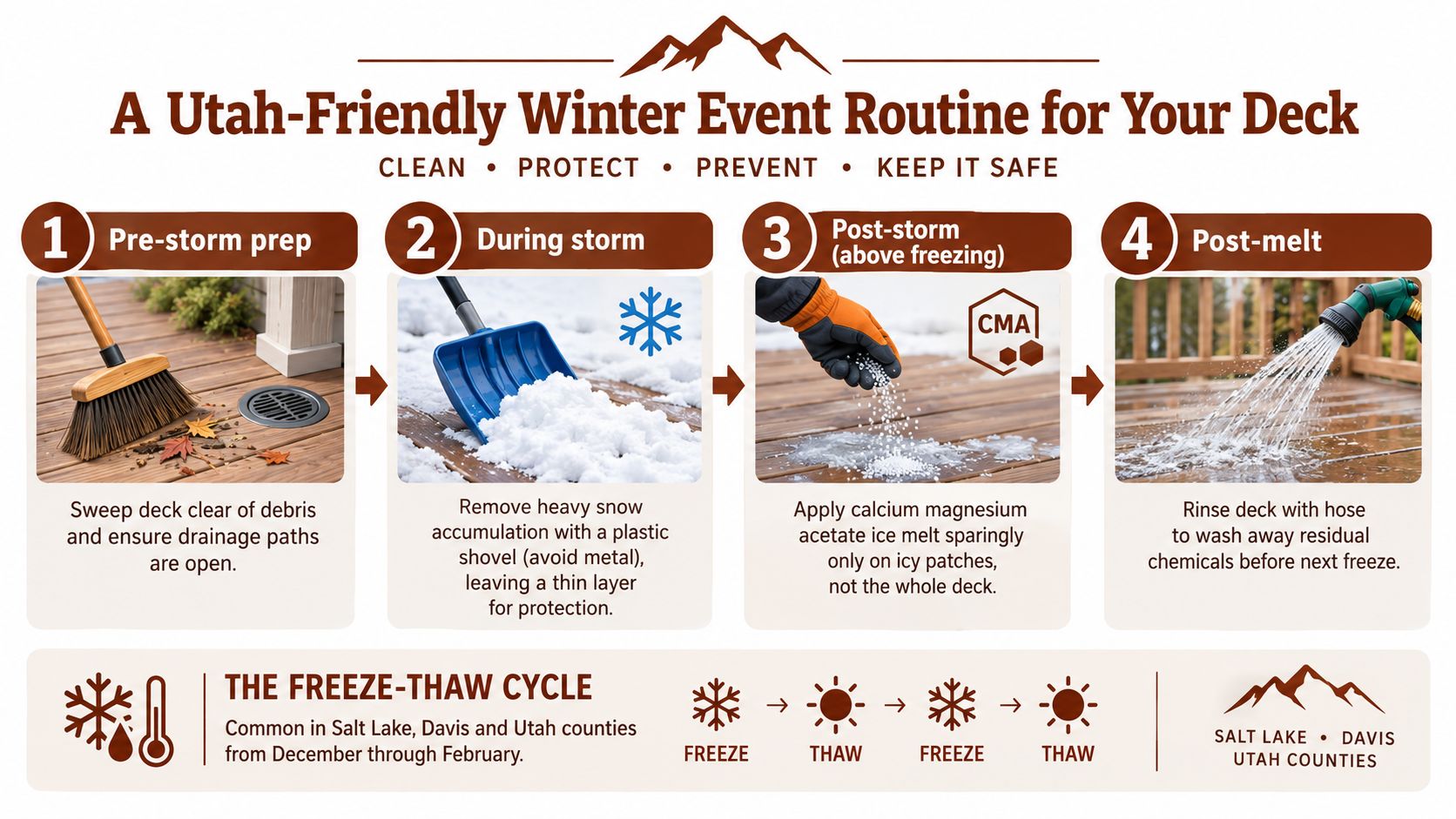
Removing loose snow reduces the amount of deicer needed and exposes the bonded ice that creates a slip hazard. It also prevents a heavy wet layer from sitting in grooves, stair corners, and gaps near the ledger.
Use a small, controlled application
A new product deserves a spot test in a low-visibility corner after the care guide confirms that its chemistry is permitted. Apply only enough approved material to break the bond, concentrating on the traffic path, stairs, and stubborn icy patches rather than covering the entire deck.
Avoid dyed products unless the exact manufacturer instructions allow them. Keep pets away from the treated area while granules and slush remain, and keep nearby lawn, boxwood, juniper, and other plantings clear of runoff. Pet-safe labeling describes the product's intended use, but it doesn't remove the need to prevent animals from licking residue or walking through wet meltwater.
Remove slush and rinse during thaw
Once the ice loosens, sweep or shovel away slush and leftover granules before they refreeze. Loose residue can scratch the surface under foot traffic, and trapped chloride water can sit against hardware.
When daytime temperatures rise above freezing and rinsing won't immediately create a new hazard, use a garden hose to wash residue from the boards and accessible gaps. Check that drainage paths remain open, especially where snow has piled against a wall or ledger. The broader seasonal principles also apply to decking for all seasons, because winter cleanup affects spring inspection.
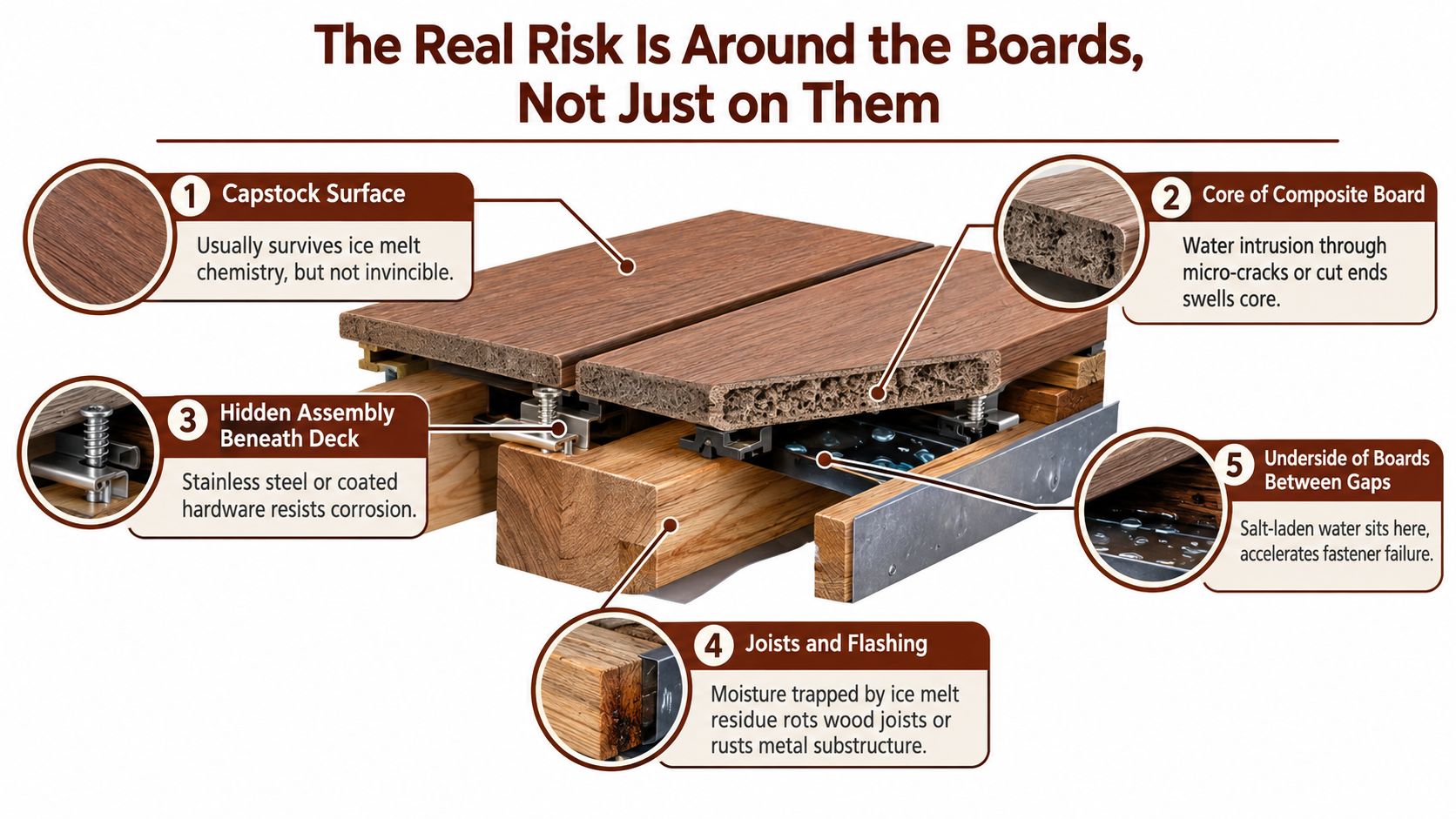
The Real Risk Is Around the Boards, Not Just on Them
The capstock often handles a careful, approved application better than the surrounding hardware handles repeated exposure. That doesn't make the board invulnerable, but it changes where a homeowner should look after a storm.
Chloride residues can remain until they're washed away. Meltwater can carry those residues through board gaps and into joist pockets, where screws, hidden clips, ledger hardware, and metal railing components stay wet longer than the exposed surface. Guidance on salt damage around decks and adjacent exterior components highlights corrosion, white residue, and discoloration as maintenance concerns.
Follow the runoff path
The places most likely to deserve attention include:
- Board grooves and ends: Residue can collect where water drains slowly or exits at cut ends.
- Hidden fastener clips and screws: Chloride exposure can contribute to corrosion, especially when meltwater remains trapped.
- Joist tape seams: Pooled slush can work into poorly sealed or lifted seams. A properly selected joist tape system should still be checked after harsh weather.
- Framing and ledger hardware: Brackets, bolts, and connectors can receive concentrated runoff from stair landings and wall edges.
- Aluminum railing posts and caps: Chloride residue can stain or attack adjacent finishes, particularly where meltwater dries repeatedly.
A metal shovel can also create mechanical damage before chemistry becomes relevant. Vibration from aggressive scraping may loosen older hidden clips, while an ice chipper can nick a board edge, fastener, or railing base.
Inspect in spring
During the first workable thaw, rinse accessible gaps and check for white deposits, unusual staining, loose clips, damaged post caps, and changes at board ends. A visual review of screws, framing connections, and railing bases is more useful than judging the top surface alone.
The system-level approach is simple. The deicer must be compatible with the board, the cleanup must protect the surface, and the runoff must not be allowed to linger against the hardware.
Warranty, Care Guide, and Why Your Exact Board Line Matters
Generic advice is not enough for a Trex capstock, a TimberTech PVC line, a Deckorators mineral-based board, or a Fiberon composite product. Manufacturer instructions vary, and warranty-safe maintenance depends on following the published care guidance for the exact product.
Use a four-step lookup
- Find the board line. Check the original invoice, order record, board-end stamp, or project materials list.
- Open the current care document. Use the manufacturer's published maintenance guide for that line, not a general search result.
- Locate the winter-care language. Check the deicer, snow tool, residue, cleaning, and prohibited-product sections.
- Save the passage. A dated screenshot or PDF copy gives the homeowner a clear reference when comparing a product label.
Formulations change, so an older bag in a garage may not match a newer version with a similar front label. If the document doesn't clearly approve the ingredient, the prudent choice is to avoid applying it until the manufacturer or qualified supplier confirms compatibility.
For surface cleaning and broader maintenance technique, Cultivate House Detailing composite deck care offers another useful reference. Utah homeowners can also use this deck maintenance guide when organizing spring checks.
Utah Deck Supply can help a homeowner or contractor cross-reference an invoice or board offcut against current product documentation at the West Jordan showroom. That support is useful when the deck line is unclear, but the manufacturer's care and warranty language remains the deciding authority.
Your Next Step for Utah Composite Decking Questions
The decision can be reduced to three practical actions:
- Choose a manufacturer-approved calcium-chloride-based or magnesium-chloride product only after checking the exact board line, and prefer a dye-free formula.
- Clear snow with plastic tools, apply sparingly, remove slush and granules, and rinse during the next practical thaw.
- Inspect the runoff path, including fasteners, joist pockets, railing posts, post caps, and nearby landscaping.
Homeowners planning a replacement or remodel should also consider how winter runoff interacts with the whole material package. Composite or PVC boards, hidden fasteners, joist protection, railing, framing hardware, and drainage need to work together. Utah Deck Supply's composite decking category is a useful starting point for comparing the board options carried for Utah projects.
Landscaping can add another runoff concern. Homeowners planning artificial grass beside a deck can review this guide to installing turf next to decking and coordinate the slope, drainage, and edge details before winter.
For a material takeoff, board-line cross-check, or product conversation, homeowners and contractors can get a decking quote or visit the West Jordan showroom with a board offcut. The showroom serves West Jordan, Salt Lake City, Salt Lake County, South Jordan, Sandy, Draper, Herriman, Lehi, Ogden, Provo, and the broader Utah and Wasatch Front market.
Utah Deck Supply supplies composite, PVC, and wood decking, along with railing, joist tape, fasteners, framing hardware, and replacement components for winter-exposed deck systems. Visit Utah Deck Supply, call 385-993-5492, or bring a board offcut to the West Jordan showroom before the first major storm.